In the course of its 21st plenary session in October 2010 the State Assembly (Il Tumen) of the Republic of Sakha (Yakutia) reached a key decision to give consent to turning ZAO AK ALROSA into a public corporation. Science is also interested in this move since the company as a closed entity does not permit its economic performance to be analyzed and predicted and generally leaving it precluded for scientific research. For instance, over the past 5 years the Institute for Regional Economy of the North in Yakutia was unable to get an order from the industry to carry out any research. However, we deem it necessary first of all to stress groundlessness and possible negative consequences of some of the arguments set forth by proponents of the new incorporation status for the company and, secondly, the narrow meaning of the name given to the law in its first reading and consequently its incomplete contents.
In our view, the fundamental issue is the participation of Yakutia in state administration and control over the economic activity of ALROSA, which is subject to the jurisdiction, government, economic and social policy of the Republic of Sakha (Yakutia). The latter must manage not only ALROSA’s shares, but its ownership ratio and production as well as the company’s socio-economic activities in general. The law must define the functions and tasks of state management and control by the government and other bodies of executive power of the Republic of Sakha (Yakutia) and not just those pertaining to the "representatives of the republic in the company’s administration and control bodies.” Therefore, we believe that the name of the law “On management and disposal of shares issued by the ALROSA Joint-Stock Company which are a state property of the Republic of Sakha (Yakutia)” adopted in first reading in October 2010 does not reflect the essence of the issue.
Further, at the general meeting of ALROSA’s stockholders they will discuss the issue of transforming it into an open joint-stock company. Its positive solution is guaranteed, since the major shareholders - the Russian Federation government and the government of the Republic of Sakha (Yakutia) - possess nearly 83% of the company’s equities. However, any further transformations of ALROSA may turn out to be very problematic and difficult. Without knowing thoroughly the relationship existing between the shareholders and having no leverage in this specific situation, we may be wrong about certain things, but as scientists and economists we have no right to remain on the sidelines when Yakutia is going through momentous transformation of its economy.
The first thing to be done is to re-estimate the authorized capital of ALROSA. Currently, it is extremely undervalued, and in 2008 was worth only 3,682 million rubles, while the company’s total assets reached 285,615 million rubles, its capital goods were 127,067 million and sales amounted to 73,986 million rubles. For comparison, the authorized capital of relatively smaller joint-stock companies as of October 1, 2010 reached: 9,296 million rubles in OAO AK Yakutskenergo; 11,064 million rubles in OAO Sakhatransneftegaz; 1,016 million rubles in OAO Nizhne-Lenskoye; and 2,106 million rubles in OAO Sahaneftegazsbyt.
ALROSA’s real capitalization and market value of its shares may be determined when the company will turn public and its shares will be traded at the stock exchange.
Floating additional shares by the company will be a very complicated issue because before that the existing shareholders should re-distribute equities between themselves. And this directly affects the interests of each side and will be disputable. Currently, the shareholders and their stakes are as follows: the government of the Russian Federation owns 51%, the government of the Republic of Sakha (Yakutia) owns 32%, eight uluses (districts) of the diamond province own 8% and other legal entities and individuals own 9%. It may be assumed that after the company turns public the latter will try to sell their shares in the free market at a maximum price. The uluses (districts) should retain their stakes which are municipal property and manage their equities themselves.
Thus, the re-distribution of shares and additional equity issue mostly depend on the two major shareholders - the Russian government and the government of the Republic of Sakha (Yakutia). They certainly have the ability to solve these problems step by step and in many ways. Which is most important, the interests of the federal center and those of the Republic of Sakha (Yakutia) should be observed while transforming ALROSA, and this is possible if both parties will pursue a differentiated approach to assessing the role and mission of the diamond complex.
The diamond complex is insignificant by its input in the overall production and export of the Russian Federation economy. Rough and polished diamonds are luxury items, while natural diamonds earlier widely used in the engineering and military equipment have been replaced by synthetics. Consequently, the rough and polished diamond complex as a whole has no strategic value for the Russian Federation.
At the same time, ALROSA’s business appears to be a core and budget-making industry for the Republic of Sakha (Yakutia) (Table 1).
Table 1
The role played by ALROSA in the economy of the Republic of Sakha (Yakutia) in 2001-2009
RUR millions
Currently, ALROSA’s share in the gross regional product amounts to 25%. The company turns out 40% of Yakutia’s industrial production and provides about one third of its fiscal revenue in the consolidated budget. ALROSA employs about 33,000 people, and taking into account the entire service infrastructure and social amenities - more than 60,000 people, or nearly 12% of the total labor force employed in the republic. Hence, it is clear that there is a vital need to maintain state administration and control over the activities of ALROSA by the Republic of Sakha (Yakutia). Thus, in our opinion, at the first stage after the company will be made public the Russian Federation government could reduce its stake from 51% to 32% and sell 19% of shares, which will help to determine the real value of the company’s stock and raise additional funds to the budget of Russia. In any event, the Russian Federation government intends to sell its blocks of shares in state-owned companies in 2011-2013 eventually gaining about 1 trillion rubles in revenues1. At the following stage in 2012, when, according to most analysts, the consequences of the global economic crisis will be fully overcome, ALROSA may venture an IPO additionally floating 28% of shares to their number existing by that time. In this case, the stakes owned by the Russian Federation government and the government of the Republic of Sakha (Yakutia) will be brought to 25% plus one share from 32%, while their total stake will be brought to 50% plus 2 shares from 64%, i.e. the controlling stake in the company will remain to be owned by the state. In this connection, we made a sample calculation of the shares value for a possible IPO. According to various estimates made in recent years, the company's value varies from $2.4 billion to $9.0 billion (Table 2). Table 2 Various estimates of ALROSA’s value and performance
Our calculations show that by way of issuing additional equities ALROSA may attract $1.12 billion, which should be used not only to repay debts and finance the construction of underground mines, but also to invest in future projects, such as Timir, to develop iron ore deposits in South Yakutia. There is no doubt that the imminent conversion of ALROSA into a public corporation is the natural result of organizational and legal transformation of this company, which will lead it to higher publicity and additional opportunities to attract investments. In the first place, after the proposed changes OAO ALROSA will be able to launch an additional issue of shares equal to 28% of its authorized capital selling them in the free market and attracting more than $1 billion in investments. Secondly, the governments of the Russian Federation and the Republic of Sakha (Yakutia) as major shareholders will retain their blocking stakes of 25% plus one share jointly equal to 50% plus two shares. Besides, it is very important that in this case there will be parity in relations between the state shareholders bearing joint responsibility to ensure state administration and control over ALROSA, as well as its economic security. Yegor Yegorov, Director of the Institute for Regional Economics of the North (Federal State Scientific Entity), Doctor of Economics, Professor, Academician of the Academy of Sciences of the Republic of Sakha (Yakutia) Yuri Danilov, Senior Research Fellow, Institute for Regional Economics of the North (Federal State Scientific Entity)
1 Olga Shkurenko. Big Sale of Russia / Money Magazine № 33 (790) dated 23.08.2010, posted at http://www.kommersant.ru/doc.aspx?DocsID=1491418.
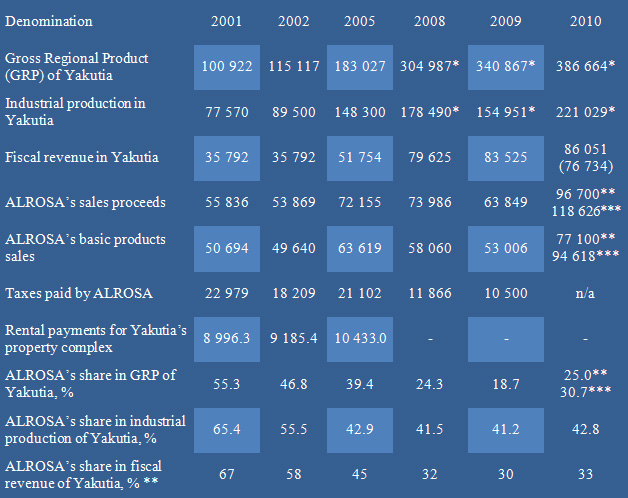
The table is compiled by the authors based on the data provided by the Federal State Statistic Service of the Russian Federation and the Territorial Agency of the Federal State Statistic Service of the Russian Federation for the Republic of Sakha (Yakutia), as well as on the reports and materials provided by ALROSA for 2001-2010.
* According to the Ministry for Economic Development of the Republic of Sakha (Yakutia); ** the authors’ estimation; *** ALROSA Group.
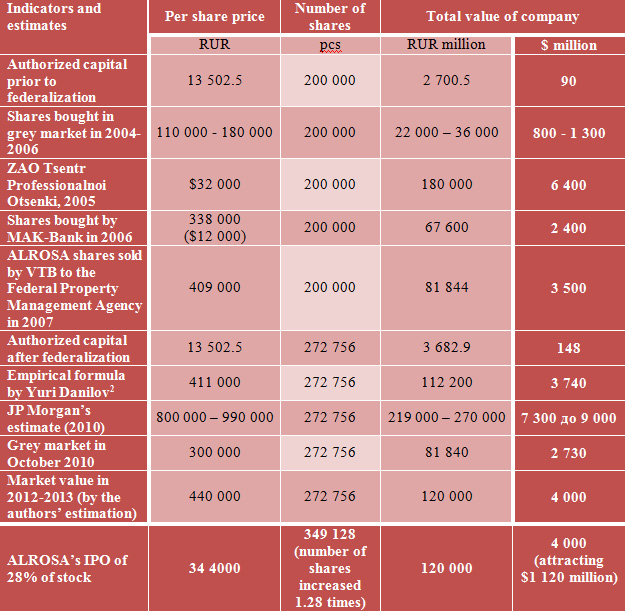
2 Yuri Danilov, Turning ALROSA Public and Prospects of IPO, published on 05.04.2010 at http://www.rough-polished.com/ru/analytics/38608.html.
