As is known there are four companies in the Republic of Sakha (Yakutia) currently engaged in diamond mining and Yakutia has a 100-percent stake only in OAO Nizhne-Lenskoye. Economic analysis of the company’s activities has scientific and practical significance, because this experience can be applied to develop new diamond deposits in Yakutia in the future. Establishment of such enterprises will give a possibility to preserve Russia’s leading position in diamond mining, which is an important task for the national diamond industry at the current stage of its development. In addition, this will facilitate the formation of an industrial diamond cluster and will help to improve efficiency and competitiveness in diamond mining. Table 1 provides the data related to changes in production and economic performance of OAO Nizhne-Lenskoye in 2006-2009.
Table 1
Key performance indicators of Nizhne-Lenskoye in 2006-2009
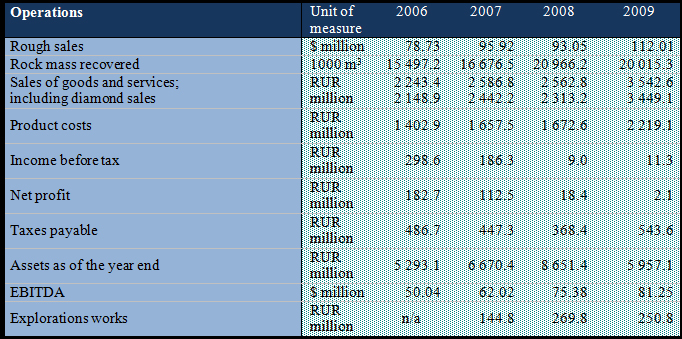 The table is compiled by the authors and based on the annual reports of Nizhne-Lenskoye for 2006-2009.
In 2009, the company’s revenue from sold products and services amounted to 3,542.6 million rubles or 138.2% compared with 2008. During 2009 product costs grew by 32.7%.
In comparison with 2008, the company processed less rock in 2009 reducing its amount by 7.6% but increasing it by 49.1% in value terms (Fig. 1).
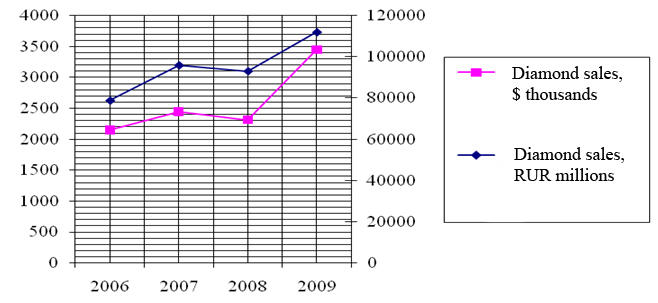
Fig. 1. Rough sale proceeds in 2006-09.
This is probably due to increased diamond output, which according to the authors’ estimates increased by 8.3% in 2009 versus 2008 (Fig. 2).
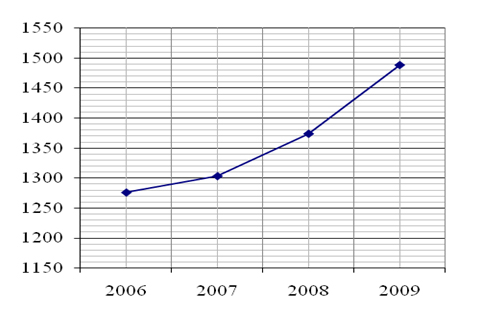
Fig. 2. Diamond output in 2006-09, thousands of carats
The company’s mineral resources base is continuously expanding due to ongoing exploration under available licenses. The reserves of the deposit located in the Molodo River valley increased 3.2 times by sand and 2.5 times by diamonds which made it possible in 2009 to construct the first stage of a new processing plant with a capacity of 400,000 m3 to be engaged for at least 15 years. To supply power to the new factory the company purchased four Komatsu diesel engine power plants. In 2009, the company evaluated the predicted resources of the Bolshaya Kuonamka diamond field, which if transferred into the proven reserves category, will provide the company with rough diamonds for 15 years.
In 2009, the company gained only 2.1 million rubles of net profit. However, it should be noted that its EBITDA is continuously growing. This indicator reflects the company's earnings before interest, taxes, depreciation and amortization. In 2009, EBITDA was 73% of its annual revenue, which proves that Nizhne-Lenskoye is an enterprise having a high return on investment and self-financing reserve.
In 2010, Nizhne-Lenskoye performance is expected to be better than in the previous years of crisis due to the recovery in demand for rough diamonds. Thus, last August it produced the ten millionth carat of rough diamonds since the company was established.
The analysis of financial sustainability of this enterprise proves this assumption taking into account the company’s report for the third quarter of 2010 (Fig. 3).
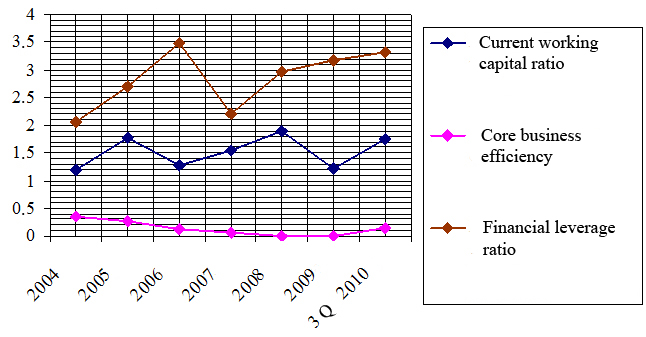
Fig. 3. Indicators of financial sustainability in 2004-2010.
Nizhne-Lenskoye’s current working capital ratio, dropping slightly in 2009, rose to 1.75, which is high for seasonal diamond business. The company’s core business efficiency in 2010 also increased while its financial leverage ratio is not critical.
Summing up it may be said that recent critical publications describing this company as being in crisis are, to put it mildly, not relevant to the actual economic situation in Nizhne-Lenskoye. It should be added that financial sustainability of Almazy Anabara based on the 3Q 2010 results is identical to the above data.
Yuri Danilov, Ph. D., Leading Research Fellow, Department of Rough and Polished Diamonds Complex Economy, Institute for Regional Economics of the North (Federal State Scientific Entity)
Maya Kurneva, Junior Research Fellow, Department of Rough and Polished Diamonds Complex Economy, Institute for Regional Economics of the North (Federal State Scientific Entity)
