Results in 2010
ALROSA’s subsidiaries - OAO ALROSA-Nyurba (where the parent company has a stake of 87.57%) and OAO Almazy Anabara (100%) – are also recovering their pre-crisis performance on the backdrop of increasing demand and rising prices (Table 1).
Table 1
Diamond output in 2006-2010 by mining companies belonging to ALROSA Group and the Sakha Republic (Yakutia)
($ million)
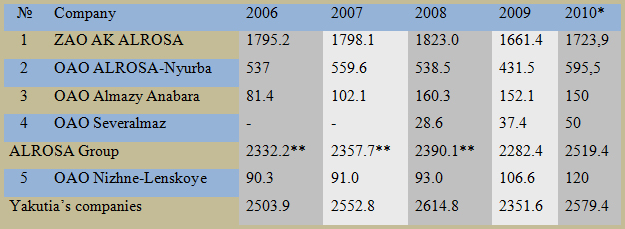 The table is based on the companies’ reports for 2006-2010
* Author’s estimate
** Excluding Almazy Anabara
And if ALROSA’s subsidiaries and Nizhne-Lenskoye have actually regained and significantly exceeded their pre-crisis diamond production in 2007, ALROSA itself has somewhat lower figures due to its large-scale transition to underground operations on the primary diamond fields. As a whole, Yakutia’s diamond mining operations posted higher-than-2007 output in 2010. Growing prices for rough diamonds facilitated their successful sales which totaled $3.4 billion in ALROSA Group and $3.5 billion in Yakutia’s companies.
Jumbo plans
On February 21, 2011 ALROSA’ Board of Directors approved the company’s development strategy towards 2018 and set the task to expand the miner’s mineral resources outpacing their depletion and to ensure higher capitalization of ALROSA with a view to reach its major goal - strengthening its leading positions in the global market. To achieve this, the company intends to complete the construction and commissioning of underground mines Mir, Aikhal and Udachny. It will also significantly increase the scale and pace of exploration and prospecting operations and implement the program aimed at upgrading core operations. ALROSA is also to complete its customer network based on geographical diversification of sales and long-term contracts with major consumers of rough diamonds. The company will implement programs of social partnership and environmental protection in the territory where it runs its major business.
Below are the key indicators set by ALROSA’s program of strategic development towards 2018:
- By 2018, ALROSA Group will build up its diamond output to 39.6 million carats per year, compared with 32.8 million carats in 2009.
- The company’s forecast for rough sales is around $35,132 million.
- Its investment budget in 2009-2018 will amount to RUB 215,302.5 million, including RUB 32,140.8 million for long-term purposes.
- Investments in non-financial assets will reach RUB 148,201.5 million, including RUB 147,151.4 million for construction.
- Retooling and replacement of worn equipment will absorb RUB 34,960.2 million.
- Exploration expenses from 2011 to 2018 will consume RUB 25,594 million.
- The company expects to drive its net profit in this period to RUB 93.87 billion.
- By the end of 2018, ALROSA forecasts its long-term loans at $1.9 billion.
This program is basic and will be adjusted in accordance with the previously established technical solutions to improve the efficiency of operations at the Yubileinaya and Komsomolskaya Diamond Mines, as well as to boost the construction of the Udachnaya Underground Mine.
Besides, ALROSA’s development model towards 2018 is to be adjusted depending on the choice of a basic scheme aimed at developing Timir, the iron ore project in South Yakutia, after the company will examine its feasibility study and complete negotiations with potential investors.
Transition to underground mining on kimberlite pipes Mir, Aikhal and Udachnaya requires significant capital investments. In addition, the forthcoming development of iron ore deposits in South Yakutia by OAO GMK Timir, a subsidiary of ALROSA, suggests bringing in sizable investments. So, it is reasonable to ask where the money will come from?
On February 23, 2011, the Supervisory Board of ALROSA reviewed the issue related to a revised draft of ALROSA’s charter which says that the company is an open joint stock entity and has the right to issue 76,362 shares (making 28% of the stock before the company’s conversion) in addition to its 272,726 outstanding shares.
Furthermore, to capitalize the debt of OAO Severalmaz to ALROSA, the Supervisory Board defined the total price of shares additionally issued by Severalmaz and purchased by ALROSA as being equal up to 17.1 billion rubles (about $590 million). The general meeting of shareholders to be held on April 5 this year will decide on changes to the company’s charter and its transformation into an open joint-stock corporation and whether to approve or not the deal involving the shares of its subsidiary.
Subsidiaries to be “married off”
According to Finmarket, in 2010 the sale of shares of all its subsidiaries could bring ALROSA up to 20 billion rubles to finance investment programs. Of them, ALROSA’s share in OAO Severalmaz (45% minus 1 share), which is the most problematic subsidiary, is estimated at 10-12 billion rubles. From the very beginning of diamond mining this company proved to be a money-loser, currently inflicting about 1 billion rubles in net losses every year, as its production cost ($70 per carat) is above the sales price (about $50 per carat). Some time ago, ALROSA’s President Fyodor Andreev said that Severalmaz was the most likely candidate for selling some part of its shares (from 25% to 49%). According to the feasibility study developed by the parent company, Severalmaz is to switch over from pilot mining to industrial production of diamonds and to achieve the scheduled performance of up to 4 million tons of ore per year (in this case its diamond output will reach $200-250 million). An estimated investment of $400-500 million will be needed to build a factory to be run by Severalmaz. Thus, even if Severalmaz’s shares will be sold this will hardly bring the necessary investment resources to ALROSA.
Probably, it would be worth considering a possibility of IPOs by other diamond mining subsidiaries, ALROSA-Nyurba and Almazy Anabara, as well as selling the company’s Angolan assets. Given the increasing value of securities on the global stock market in recent times, as well as improving performance of the above companies these assets may be roughly estimated at $3 billion, while ALROSA's value may reach $6 billion. As a result, if these companies will float their stocks ALROSA Group may well raise up to $3 billion needed for its further development.
Yuri Danilov, Ph. D., Institute for Regional Economics of the North
