The past economic crisis of 2008-2009 has drastically changed the relationships established between diamond mining, diamond cutting and sales companies existed before the recession. The sharp decline in demand for rough and polished diamonds occurred in 2009 led to a significant decline in production, and the proportions between diamond businesses dramatically changed. Further on, in 2010, the diamond market started to recover which was accompanied by a much higher competition between major producers of rough diamonds as well between rough diamond consumers and manufacturers of polished goods and jewelry. To give a more accurate assessment of and forecast for the diamond market in the current environment, the author used a ternary diagram, which displays all the three segments of the diamond market.
Since there are four major companies playing the key role in the diamond industry, which regularly publish their financial reports on their websites, we have a possibility to make a preliminary estimate of global diamond output prior to the official statistics annually released by the Kimberley Process in late July (Table 1).
Table 1
Diamond output in 2006-2010 by the world's major diamond miners
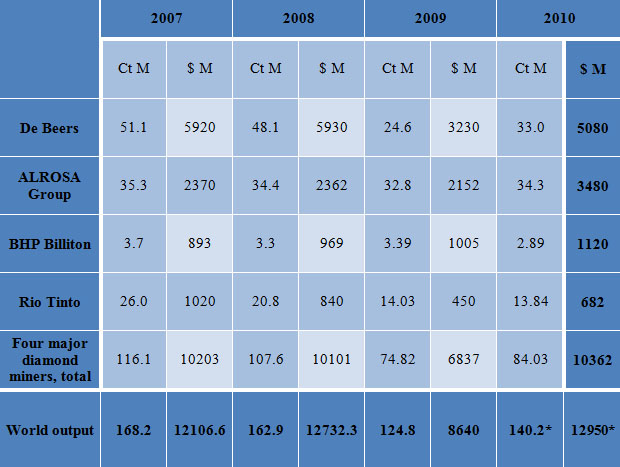 The table is compiled by the author on the basis of annual and quarterly reports issued by De Beers, BHP Billiton, Rio Tinto and ALROSA
in 2006-2010.
* Author’s estimate.
The share of the world's largest diamond mining companies in global output makes up 70% by volume and about 80% by value. Assuming that the proportions in the diamond sector remained at their previous levels, we can figure out global diamond output for the year. Further, taking into account the trends in other market segments, we can determine their values using a ternary diagram (Figure 1).
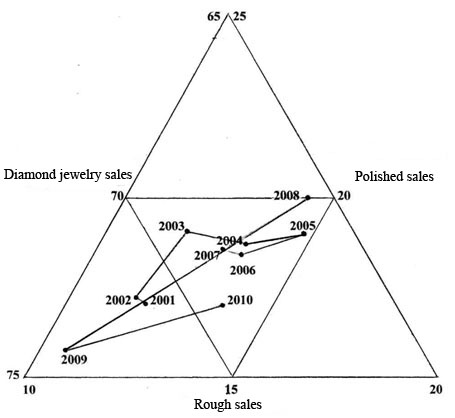
Fig. 1. Segments of the global diamond pipeline in 2001-2010 on the ternary diagram.
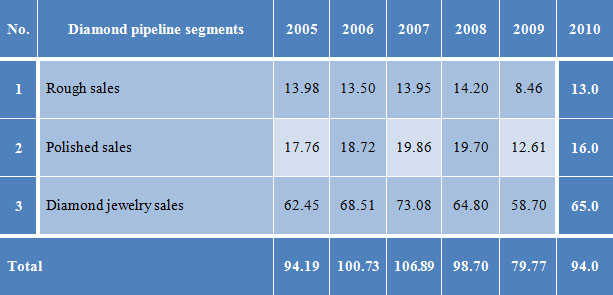
The forecast values for 2010 estimated in this way are combined with the diamond pipeline indicators by Chaim Even-Zohar for 2005-2010 and given in Table 2.
Table 2
Global diamond pipeline in 2005-2010
$ billion
To study the regional diamond industry, the author has developed a model (Fig. 2) dealing with three levels of competition: regional, national and global.
This angle of approach taking into account the share and role of each of the segments of Yakutia’s diamond industry gives a possibility to determine their competitiveness at these competition levels (Table 3). The diamond mining industry led by ALROSA, which commands over 20% of the market (29% in 2009), appears to be competitive at the global level. The diamond cutting companies of Yakutia have a small market share on a global scale and can only compete at the national level accounting for 20 to 25% of the market in different periods. Table 3 The role of Yakutia’s diamond industry in the global diamond business in 2005-2010 $ million
The regional sector trading in diamond jewelry, being the most profit-making and competitive in the local diamond industry, takes up just a tiny fraction of the world diamond market and a small part of the Russian diamond market, and so far it possible to speak only about regional competition in this respect. Thus, the diamond industry in the Republic of Sakha (Yakutia) appears to be competitive at the international level, while its diamond cutting industry can compete at the national level and its diamond jewelry trade can be considered competitive only at the regional level. In accordance with the projected growth in global demand for diamond goods in the future, the regional diamond industry may move along the following ways in its development: - Maintaining the achieved level of diamond output. - Pursuing cluster-type development. - Introducing innovations into diamond enterprises and modernizing them. - Diversifying production by way of developing other mineral resources in Yakutia. Implementation of the proposed mechanisms for the development of the diamond industry in the region will ensure its rapid development and significantly increase the share of the Russian Federation and that of Yakutia not only in diamond mining, which will account for 25% of the world diamond output, but also in the diamond cutting sector and diamond jewelry trade. By 2020, it will be possible to achieve a 5-percent share in the global diamond cutting industry and by 2030 a 1-2% share in the world diamond jewelry trade. In 2020, total production of diamond goods will reach $5 billion and in 2030 - $6 billion. Hence, the diamond industry of Yakutia, despite the development of mega-projects, will continue to play a leading role in the economy of this region. Yuri Danilov, Ph. D., Institute for Regional Economics of the North
With the world economy undergoing market globalization and liberalization on the backdrop of increased competition in all areas, it appears to be a high-priority challenge to identify prospects and trends for developing the diamond industry of the Republic of Sakha (Yakutia).
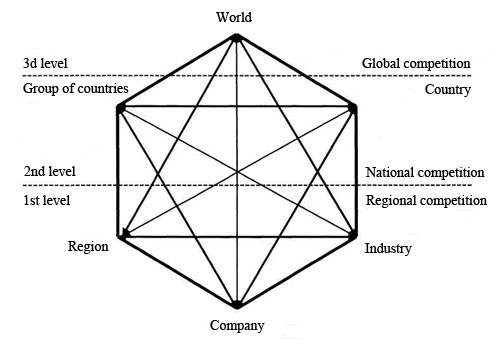
Fig. 2. Model of competition levels.
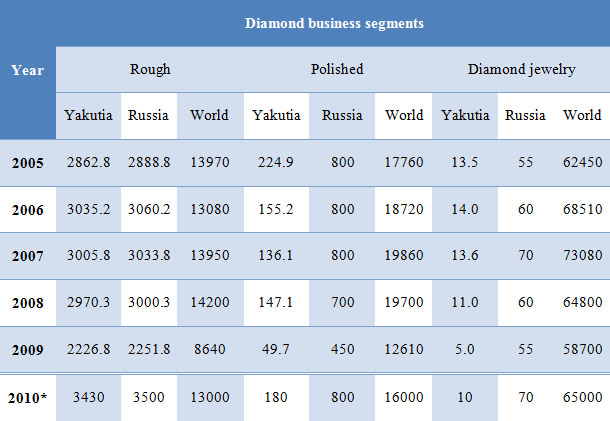
The table is compiled by the author and based on the Kimberley Process data, as well as on reports issued by major diamond companies
and on the existing proportions in the global diamond business.
* Author’s estimates.
