In 2001, when Jim O'Neill, a Goldman Sachs analyst, coined the acronym of BRIC (Brazil, Russia, India, China) to identify the most rapidly growing economies of the world, many experts suggested that in the future these dynamic economies would become the mainstay of the global diamond jewelry market. They argued about timing, but the overall trend was beyond doubt: a sustainably high GDP growth brought about increased incomes, which in turn implied an increase in consumption of luxury items. Today, ten years later, it can be said that this prediction has been excellently proved to be true for India and especially China - they are in the top three in terms of diamond consumption, trailing only the United States. But the hope that by the end of the Zero Decade consumption of diamond jewelry in Russia and Brazil would pass the mark of $2 billion and they would join the world’s ten largest customers have not materialized. The increasing share of these countries in world diamond consumption was expressed in mere tenths of a percent and did not stand any comparison with the rapid development of the diamond markets enjoyed by their companions within the BRIC group of countries.
Meanwhile, it seemed that macroeconomic indicators were to testify to the contrary. Judging by the GDP per capita, we should recognize that Russia and Brazil are much richer nations than India and China (according to Standard&Poors’ data).
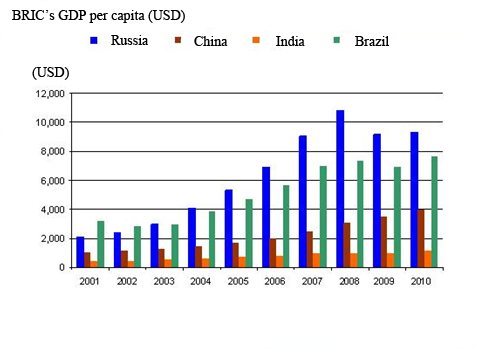
It is true - the consumption of a single Brazilian or Russian household is on average higher than that of Indian or Chinese households in almost all commodity groups, including real estate, automobiles, consumer electronics, clothing, perfumes, etc. But not in diamond jewelry. This paradox is also extended into long-term forecasts for the diamond market: they say that China and India will strengthen their pace-setting positions and their share in global diamond consumption in 2016 will reach 16% and 11% respectively, while Brazil and Russia will remain in the category of "other countries" whose combined share would diminish (according to De Beers’ outlook). Although the number of dollar millionaires and the middle class with regard to the total population in Russia and Brazil is very high, the world's fashion brands leave unattended the development of specific marketing strategies for these countries, unlike India and China.
What is the reason? Why Russia and Brazil continue to languish on the sidelines of the diamond market, while their counterparts in the BRIC group are making a triumphant push forward?
Perhaps the answer lies in the totality of those less formalized factors, which may be conventionally identified as an ethical model of behavior, in which the family and traditional family relationships are primary and unconditional values. If we look at the history of the diamond market, we may see that success in promoting diamonds and in creating mainstream diamond markets came to those countries where rapid economic development was combined with stable traditionalist patterns of behavior immanent to mass consumers of diamond jewelry. Initially, it was Europe flaunting Catholicism which at that time preserved its luster, later followed by the Protestant United States, then by the Shinto Japan, Confucian China and Hinduism adherents - with all the differences between these philosophical and religious systems the primacy of traditional family relationships is obvious and the positioning of the diamond as a gift of love and a symbol of tradition that accompanies and captures the most important stages in creating and developing a family appears impeccable and universal.
In Russia, the traditionalist ethical patterns of behavior were destroyed long ago and probably irreversibly. Degradation of the family institution is evident and the country is one of the world's leaders by divorce rates - about 60% of marriages are dissolved (compared to 1.1% in India) and the country’s mortality rate exceeds its birth rate. Promoting a product symbolizing the eternal value of family traditions in such an environment is obviously meaningless.
Brazil is a Roman Catholic country (90% of the population) and at first glance this suggests presence of a stable traditionalist ethical model. Anyway, Brazil’s demography is not comparable with that of Russia and in many respects is similar to the Chinese pattern. But the problem is that it is in the last decade, during the period of rapid economic growth in this country, that the traditionalist Catholic model has been exposed to significant erosion: the nations’ birth rate went down, while its divorce rate increased undermining the prestige of being married and giving way to drug addiction and prostitution. Although Brazil is fortunately still far behind Russia’s demographics, nevertheless it has turned into an unrivalled global leader in terms of crime: by the number of murders per 1,000 inhabitants it is second only to Sierra Leone. In the streets of Rio de Janeiro one may get shot just for a pair of shoes not to mention a diamond ring.
It is revealing that for out-of-home entertainments the Brazilians and Russians spend respectively 52% and 46% of their discretionary incomes, while the Chinese and Indians only 28%. As for savings, the picture is just the opposite. One’s perception of the world defines the structure of consumption: you do not need eternal values if you live for a day, as in a war time. The lack of traditionalist ethical behavior or its rapid degradation are counter indicated for the diamond market even in the face of strong economic growth. And vice versa - a flourishing diamond market is the evidence of stable traditions, healthy ethics and morality.
Sergey Goryainov, Rough&Polished
