The first quarter of 2011 in the U.S. jewelry market can be compared to a thaw in a spring forest: sales started to grow, fresh profits came into view and prices continued to swell. It is noteworthy that the jewelry trade shows held in this period in the U.S. were particularly emphasizing new collections of eye-catching jewelry with precious and semiprecious stones of most unexpected colors and shapes heralding spring and loudly announcing the arrival of a new season.
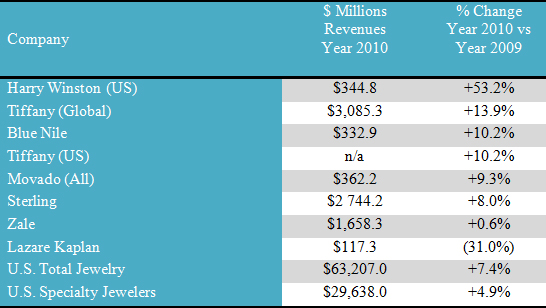
The industry completed the fourth quarter of 2010 and the last year as a whole pretty well, and this has laid a good foundation for positive results in early 2011. Every public company with a fiscal year ending in December 2010 or January 2011 reported solid sales gains that were above the industry average. Lazare Kaplan was an exception since its 31-percent decline in revenues related to some problems with its mining partners. Clearly, the large retail jewelry chains are picking up market share at the expense of the smaller independent specialty retailers.
Table 1. Sales dynamics of U.S. major public jewelry companies
Source: IDEX Online
Virtually every public company reported improved profits or a smaller loss in 2010, when compared to 2009. Further, almost every company generated margin improvement.
Table 2. Comparison of 2010 and 2009 results
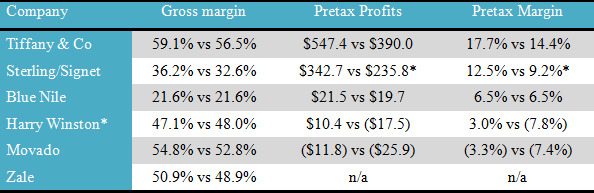
* Harry Winston: Retail operations only.
Source: IDEX Online
This was the life-affirming note, which sounded in the end of the 2010 fiscal year. Let's see how things changed in the first quarter of 2011.
Table 3. Sales in the 1st quarter of 2011
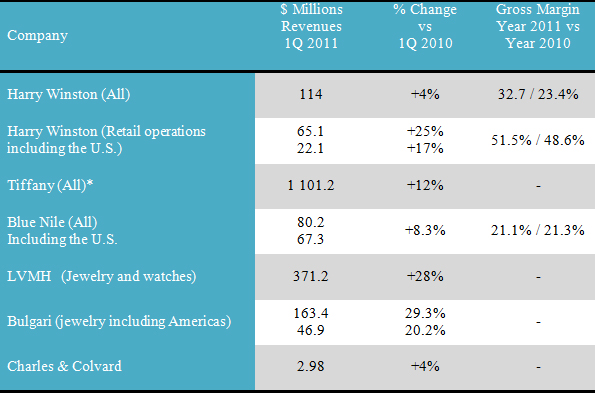
* Tiffany will officially announce the results of the 1st quarter on May 26, 2011.
The data is provided by Zacks Investment Research.
Many large companies will post their 1Q 2011 results in the end of May, but based on preliminary data we can conclude that the start of the year was passed by the jewelry industry if not with a triumph then at least with a solid B grade.
Here is something for investors to note: according to Zacks Investment Research, the first quarter of 2011 revealed five companies in the Precious Metals & Minerals Industry with the lowest Price To Last Quarter Annualized (LQA) Sales ratios. This ratio may be used as an instrument to identify undervalued companies. Generally, the lower the ratio, the higher the probability that the market value of a company is underestimated which makes purchasing its shares a possibly good deal based on its future growth in the stock market.
Among the "dark horses" were:
Harry Winston Diamond (NYSE: HWD) with EV/EBITDA ratio of 2.92x,
Stillwater Mining (NYSE: SWC) - 3.91x,
Pan American Silver (NASDAQ: PAAS) - 7.03x,
Hecla Mining (NYSE: HL) - 7.26x,
Coeur d'Alene Mines (NYSE: CDE) - 7.29x.
According to the April report of the American Institute of Supply Management, the U.S. jewelry manufacturing was among the industries which last month saw growth in sales and new orders (including exports), increased production, new jobs, bigger inventory, higher cost of raw materials, as well as reduced imports of raw materials.
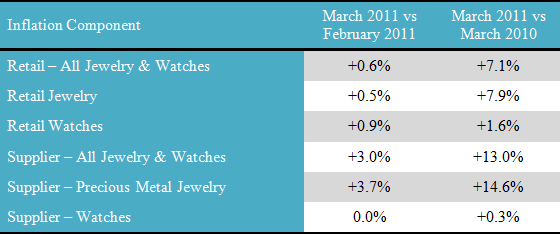
The main theme of this spring is inflation in the jewelry industry, both at the level of manufacturers and suppliers, as well as in retail. The government’s jewelry industry inflation report for March was a repeat of the trends which characterized February: supplier price inflation remained at double-digit levels, and retail jewelry price inflation held at high single-digit levels.
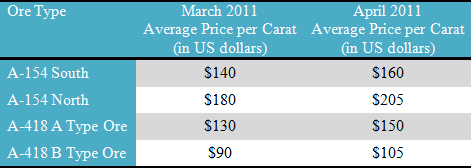
Harry Winston may be indicative of double-digit price movements in rough supplies. The company carried out two rounds of sales in the 1st quarter of 2011 demonstrating a rise in prices for these goods. Having assessed the production and market situation, Harry Winston reached the following conclusions regarding the cost of 1 carat of diamonds mined at Diavik:
Table 4. Diamond prices
Source: IDEX Online
The hit parade of main causes generating inflation remains almost the same:
1) Rising prices for precious metals and diamonds. Last year, gold prices went up more than 25%, while polished diamonds gained about 12%. Currently, these metals and stones hold record positions in terms of value, and it seems this is not the limit.
2) Polished prices are moving up due to limited production on the backdrop of a rapidly growing demand from India and China and also from U.S. buyers who appear to come round after the downturn.
Table 5. Inflation in the U.S. jewelry industry in March 2011
Source: IDEX Online
There is good news in this regard: jewelry retail prices are moving upwards much faster than before. This is reducing the price gap between retailers and suppliers. Now it is evident that fashion retailers are no longer willing to dampen price hikes generated by suppliers at the expense of their own retailers’ margins.
Olga Patseva, Editor of the Rough&Polished American Bureau in San Diego
