The JCK exhibition held on June 3-6 in Las Vegas was obviously one of the largest trade shows, which gave birth to new jewelry brands and introduced new collections of famous jewelers (Lili Diamonds, Royal Asscher, Rahaminov Diamonds, Danhov and others). In fact, most of the exhibitors here tried to present new product lines, since in their view this exhibition was a "springboard into the new season" and it was a propitious moment because retailers were ripe for expansion and experimentation with new images.
While the "frontier" of JCK, that is the exhibition halls, was busy with "tactical actions" going on between sellers and buyers, the conference halls of the Mandalay Bay Hotel & Resort (the new home of JCK Las Vegas) hosted strategic meetings and press conferences in which prominent industry players were analyzing current events "forecasting the future" and making recommendations on how to develop the assortment of goods in jewelry stores and adapt marketing strategies in accordance with the influence of time. They even painted a portrait of modern consumer to be oriented by in the current economic situation.
It would be appropriate to mention two press conferences among the most interesting strategically within JCK Las Vegas - Trends in Jewelry Forecasting with Paola de Luca, co-founder and creative director of TJF, and The State of the Diamond Industry organized by the Rapaport Company and led by Martin Rapaport, as well as the workshop on Conflict Minerals - Gold, Tungsten and the SEC run by the Jewelers Vigilance Committee.
“Fashion is a prevailing tendency on the market that makes money and becomes a profit. Trends come from the streets, from socio-cultural changes. People often ask me 'How do you predict trends'. I don't predict trends, I'm an analyst. So basically what we do is we monitor socio-cultural influences, how technology evolves nowadays, how they affect our everyday life and therefore create consumer attitude. So we are able to forecast trends ahead of time in most cases,” Paola De Luca said in her presentation.
Is it possible that jewelry fashion may be predicted for a few steps in the future, almost like a rise or fall of stocks in Wall Street? According to Paola, it's quite real. And indeed, at JCK Las Vegas one could see almost all the tendencies presented in the book of TJF trends for 2011-2012. "It looks even boring", De Luca noted in this connection. However, forecasting trends, she said, calls for global monitoring "from the U.S. to Europe, from Europe to China and beyond." Among today's epicenters producing the greatest impact on socio-cultural trends she mentioned New York, Hong Kong, Shanghai, Beijing, Mumbai, Dubai, Sao Paulo, Rio de Janeiro, Milan and others.
The issue of global influence (or should I say world domination) in the diamond market was more acute at the press conference of Martin Rapaport held one day later. "Now the contest is China vs. India. There's no America in this picture, we are not even in the game! It’s one billionaire against another billionaire. India is going to be faster than China for a lot of interesting reasons. One of them is the Chinese policy enforcing people to have one child. Aging population problem is going to become incredible in China. So India is winning the game.” This was the verdict delivered by Martin Rapaport on global competition in his speech. "Therefore, now I'm talking about how the situation will develop in the post-American world," he added.
It seems that China will not be very eager to accept such a conclusion. India has enough domestic problems, including shortages of skilled labor to expand jewelry industries, increasing labor costs, etc., while China weathered the global economic crisis in a very organized and harmonious way, one can say bearing minimal losses, whereas Chinese consumers who are gaining interest and appetite for luxury goods coupled with their increasing purchasing power give their country a strong trump card in this game.
"We are taking part in JCK Las Vegas to promote jewelry trade in Hong Kong and our spring exhibition, the Hong Kong International Jewellery Show. In 2012, it will take place in February. More than two hundred companies from China and Hong Kong are represented at JCK Las Vegas 2011. Moreover, there is a separate pavilion specially given for Hong Kong at this show," Teresa Hung, Business Development Officer of the Hong Kong Trade Development Council in Los Angeles, told Rough & Polished at the show in Las Vegas.
I immediately opened the JCK Show Daily and saw a flyer of the Hong Kong International Jewellery Show scheduled for February 16-20, 2012. It read - attention! - that the Hong Kong exhibition would attract 2,750 exhibitors from 44 countries and over 32 thousand customers! That was already exceeding the declared results of the jewelry show in Las Vegas with its 2,500 exhibitors and 20 thousand visitors respectively.
"The Hong Kong International Jewellery Show, held in March 2011, was an excellent illustration of the contradictions in the diamond business. It's the only major international show with a heavy representation of diamond dealers from all over the world. For the first time in memory, suppliers we spoke to in Hong Kong said the power was now in their hands, whereas for many years the buyers held the power in negotiations. Suppliers said they quoted prices and refused counteroffers," wrote Ben Janowski in the June issue of the JCK Magazine. This is once again to mention the trumps on China’s hands.
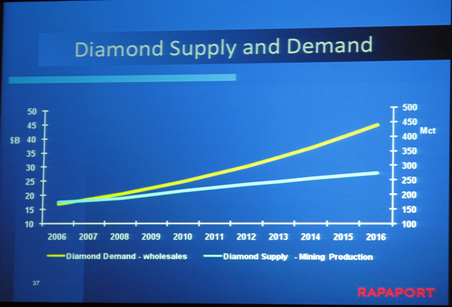
Despite the gloomy prospects of the U.S. economy, predicted by Martin Rapaport, diamonds, in his own words, will feel fine. "Diamond demand is going to double in the next couple of years. But mining production will not increase that much. 7-8 years to make a new mine. So you can predict what's going to happen. The best source of diamonds is resell. Diamonds will be reselling as baby boomers in the next three years," the Rapaport Company’s head said. He also noted that prices for rough diamonds were growing faster than polished prices.
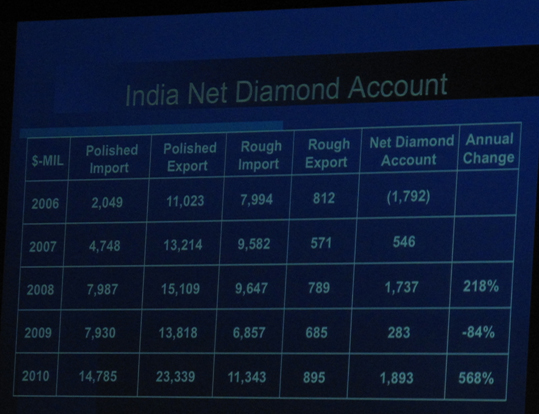
He believes that India will be the largest "absorber" of diamonds. According to Rapaport, in 2006 India’s net diamond account was negative (- $1.792 bn), which means that India was primarily importing rough diamonds, cutting them and selling more polished diamonds making money. In 2010, India turned into a consumer of polished diamonds and its net diamond account amounted to $1.893 bn (increasing by 568% compared with 2009). According to what Martin Rapaport said in his speech, in the first quarter of 2011, India almost reached the level attained for the whole of last year. "I expect India in 2011 to absorb 3 billion dollars of diamonds. In 2-3 years India will be absorbing more diamonds than the United States of America," the chairman of the Rapaport Group said.
He wasn’t oblivious of Russia, saying that "Russians are holding good stones, 1.5-2 bn worth of diamonds." "Holding" - in a speculative sense.
So, what do experts advise to jewelry retailers in the new market situation? "New communications and distribution create new markets for new products. Now when the world is changing and when we are facing reallocation of global wealth, the game will go to whom who changes best. Most importantly, you need to decide who you want to sell to," Rapaport said. According to him, many retailers make a mistake relying on a TV-guy, who spends his free time mainly on the couch watching TV and is indifferent to active lifestyle. He makes purchases also mainly guided by the TV.
Today we can speak of a new breed of consumer, “Multi-Platform Male," who is a simultaneous user of multiple screens - his PC, laptop, iPhone, smart phone and TV; he is a high money earner continuously communicating with a wide circle of friends in social networks. If he likes your product - he will tell you about it on Twitter, Facebook, Odnoklassniki, VKontakte, etc., spreading information in social networks at the speed of a tsunami. According to the head of the Rapaport Company, this kind of buyer is the most promising and the retail sector should focus on such customers in the first place.
"A primary characteristic of the new world order is prioritization of social connectivity. We must define ourselves and our jewelry as part of this mega trend," he stressed.
Paola De Luca also drew attention to the changes in the customer medium: “In the past consumers were divided into demographic segments, now it's into psychographic segments. It's no longer important how old you are, but what lifestyle you have, your education, cultural background, where you live etc. People in their fifties, who have a very active lifestyle, might wear what youngsters wear in their twenties and vice versa. The world is not linear."
Paola de Luca also said, “Here's my advice to retailers that have a very conservative customer base, but want to start implementing newness without losing the customers. Keep your collection 85%-90% the way it is, but try to be courageous and innovative, buy something new, start creating these clusters, new merchandising mix and offer it to an icon of style in your city. Sell it with a glass of wine or during a cocktail!"
"Be proud of your product, be proud of your identity, know who you are, add value in a clear way and you are going to do fine," - these were the words which Martin Rapaport used to conclude his speech at the press conference on the state of the diamond industry and its medium-and long-term prospects.
Olga Patseva, Editor in Chief of the Rough&Polished American Bureau
