Blue Nile, the largest online retailer of diamond and other jewelry, announced the results of the second quarter ended July 3, 2011.
Net sales went up 5.1% to $80.5 million, a record figure for the second quarter in the company’s history. Operating income reached $4.3 million, operating margin was 5.3% of net sales and net profit chalked up to $ 2.8 million, producing $0.19 of per share earnings. However, this figure was below the expectations cherished by the Wall Street stock market, which had predicted that Blue Nile would generate $0.20 to $.29 cents of earnings per share. And the overall stock market reaction to the company’s statement was lukewarm - its stock price plummeted by more than one dollar. Was it a paradox or a regular phenomenon?
Blue Nile’s international sales grew by 40.7% to $12.8 million, also a record figure for the 2nd quarter. However, the company capitalized on currency fluctuations, without which its overseas sales would amount to 29.7%.
Regional sales in the U.S. remained flat at $67.72 million, according to Rapaport calculations. The company’s costs involving raw materials, supplies, sales, administrative and other expenses increased by $0.9 million over the same period last year.
Blue Nile pointed out that EBITDA (Earnings Before Interest, Taxes, Depreciation and Amortization, which under the Russian Accounting Standards are equal to sales profit + accrued depreciation) was $6.9 million in the second quarter (according to the American accounting standards).
"While we delivered record second quarter sales and non-GAAP adjusted EBITDA, our results were impacted by rapidly rising diamond and metal prices amid a weakening consumer environment in the U.S. Despite these external headwinds, we achieved sales growth across all product categories, including double-digit sales growth in the non-engagement category. We also experienced strong growth in our international business," said Diane Irvine, Chief Executive Officer.
"We finished the quarter with a record second quarter cash balance of $74.2 million while repurchasing $8.4 million of stock. We are keenly focused on driving growth through an enhanced customer experience, expanded product assortment, investments in our international business, and in executing our differentiated model to grow long-term value for our shareholders," she said.
Despite the positive results of the second quarter, Blue Nile’ shares traded on NASDAQ closed 8.23% lower within two hours after the company announced its results, turning cheaper by more than a dollar in value terms. As a result of the trading session closed on August 4, 2011 Blue Nile was priced at $ 36.59 per share, its lowest level since July 2009.
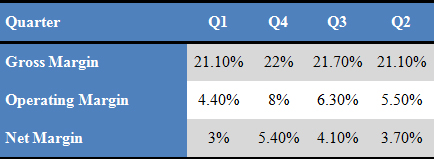
According to some analysts, the skeptical attitude of the stock market may stem from the fact that Blue Nile’s operating margin was just 5.3%, while in the fourth quarter of 2010 it was 8%, suggesting a decrease in the rate of return due to rising prices for raw materials and due to other factors. Perhaps the company's decision to buy back $8.4 million of its own shares was dictated by the desire to improve its earnings per share.
Indeed, redeeming its stock the company reduces the number of shares in circulation, which in effect means that if its revenue remains flat or even decreased, it will be divided between a smaller number of shares, hence the per share income will be higher, or at least it will not decrease.
Blue Nile Margins for the last 4 quarters
Source: AOL Daily Finance
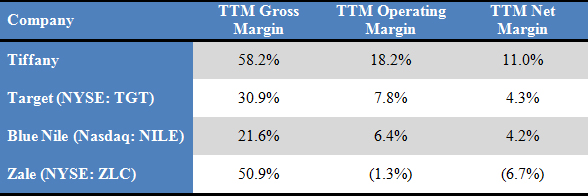
Blue Nile margins vs. competitors
Source: Capital IQ, division Standard & Poor's. Period: March 2010 to March 2011.
As can be seen from this table, Blue Nile performance figures lag behind those of some of its major competitors. One of the risk factors which may also weigh heavy on investors' mood is the company’s very large basket of currencies - Blue Nile accepts payments in 24 different currencies around the world.
“This exposes the company to foreign exchange rate fluctuations and we may record significant gains or losses as a result of such fluctuations. The functional currency of Jewellery is the Euro. The assets and liabilities of Jewellery have been translated to U.S. dollars using the exchange rates effective on the balance sheet dates, while income and expense accounts are translated at the average rates in effect during the periods presented,” says Blue Nile in its quarterly statement.
In the light of large foreign currency fluctuations and general economic instability, investors are less inclined to trust companies, balancing on the edge of a currency sword – one cent up or one cent down may easily generate an increment in overseas sales of more than $1 million (as it is proved by Blue Nile’s performance in 2Q 2011) on the profit-and-loss account of such a company as Blue Nile, whose market capitalization is over $500 million.
"Investors are skeptical of companies which are badly affected by currency fluctuations as it is more like a roulette game than a real business," a private investor from the United States told Rough&Polished.
For large jewelry companies operating in international markets, it is becoming increasingly important to demonstrate not only financial growth, since higher quarterly sales do not mean that the company was actually effective as we can see from its margin and exchange rates. It is also important to demonstrate sound policies in managing foreign exchange and commodities risks to maintain a stable position in the stock market and investor confidence, which are instrumental to generating an inflow of cash proceeds to the company.
Olga Patseva, Editor in Chief of the American Bureau, Rough&Polished
