The first month of spring is traditionally associated with an ardent desire to put oneself in good shape and take off excess weight. Obviously, the diamond industry is also not alien to anything human. So, with the advent of March, two mining giants, Rio Tinto and BHP Billiton, said they planned to leave the diamond industry to "take off" their diamond business as being the least money making and also a whimsical asset. In addition, the U.S. diamond market in March was hit by news heralding the emergence of new competitors to the orthodox diamond.
Used diamonds, or diamonds which have already been owned by someone else, are rising as a new competitor No.1 to brand new diamond goods. As is well known, the United States has one of the highest divorce rates in the world. During his or hers lifetime, the statistically average American can have two or more weddings buying a diamond ring for every occasion. Besides, diamond jewelry ranks among the most popular gifts for such landmark dates and holidays as Christmas and Valentine's Day.
As a result, Americans can accumulate a significant amount of jewelry, many of which are associated with memories or past relationships. Despite the sentimental associations, hard times are pushing people to take such a step as "turning memories into cash" by selling their jewelry. High medical bills and unpaid loans leave you little choice with a continuously high level of unemployment.
Chaim Even-Zohar, CEO of Tacy Ltd, a diamond industry consultancy based in Israel, believes this new trend will produce profound effects on the jewelry industry at a time when high-quality rough diamonds have become more difficult to find, and more expensive to mine. Used diamonds may generate strong competition and hurt miners for years. According to Even-Zohar’ estimate, the market may expect a comeback of used diamonds worth $1 billion this year alone.
The press in California is really flooded with ads offering to buy gold and diamond jewelry. However, Michael Pinn of Abacus Jewelers, a local jewelry wholesaler, told Rough&Polished that as a rule dealers and buyers do not pay much for used jewelry, unless it is of investment quality which is not what most people have.
Indeed, for a piece purchased for $6,000 in good times, you will now get only $2,000 or even less. Michael Pinn says this may make consumers think jewelry is not such a good purchase from the investment point of view. How can a jewelry piece be a store-of-value if they get back hardly one third or fourth of its original price?
Also in March, the natural diamond faced a second potentially dangerous rival - its twin brother born "in vitro." Gemesis, a diamond company, announced it had launched online sales of colorless or "white" diamonds of high quality created in laboratory. According to Forbes, it is the innovative production of these diamonds that can be a factor able to change the game on the jewelry scene, because, in the first place, white diamonds are the most popular choice for customers, and secondly, buyers, as well as retailers and jewelry designers will now have an alternative to choose between two types of real diamonds, because lab-made diamonds are essentially different only in that they are made by man in laboratory. And this difference cannot be spotted by the naked eye.
In fact, in March, a question mark was put over the most highly valued feature of diamonds - their eternity. After all, if diamonds are forever, so their numbers can only grow until diamond mining is finally exhausted. They do not wear out or deteriorate, and so getting into the market once, they can return to it from private jewel boxes over and over again.
A word of rescue came from Rapaport throwing the weight of a Goldman Sachs forecast behind diamonds, according to which polished prices were to stay firm due to strong demand from India and China coupled with an improving macro-economic outlook for the U.S.
Also in March, the Organization for Economic Co-operation and Development said that the United States economy will be recovering at a higher pace in 2012 than predicted earlier. The U.S. economy will reach a 1.9% growth rate in H1, according to the OECD's chief economist, Carlo Padoan.
Tiffany improved its profit forecast for 2012 by 10% due to increased sales, including in the U.S. - a pep talk for investors. Movado Group announced it had been able to restore the earning power of their business and achieve growth in sales and net profit in Q4. The company’s net income swung to $10.7 million compared to net loss of $31.0 million in the year ago earlier.
Late last month, Zale Corporation made a presentation to investors at the annual spring conference of Telsey Advisory Group in New York, while Forevermark held its first forum for the American partners in Florida, where the company described business opportunities and new initiatives for the participants, who included leading jewelers and diamantaires operating in the United States. One of the most fascinating opportunities offered by Forevermark was the Forevermark Online Trading Network (FMX), which is expected to give jewelry companies an efficient access to Forevermark diamonds.
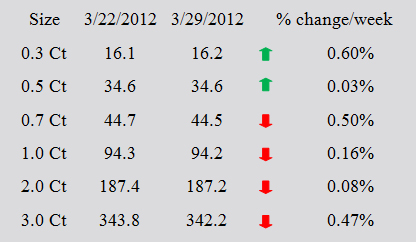
According to Rapaport, polished prices in March, as well as in February, continued to behave differently for different carat weights. Small stones from 0.3 to 0.5 carat went up in price, while larger gems, on the contrary, went down.
RAPAPORT DIAMOD PRICES
RAPI Index Graph 1 CT.
Gold prices were also restless. Market participants find it difficult to predict in which direction gold will move, and this constrains demand. Ben Bernanke, Chairman of the U.S. Federal Reserve, gave gold a boost, saying the U.S. labor market was still unstable. According to the Wall Street Journal, after this gold rallied back toward $1,700 per ounce.
All eyes were once more turned back to silver as the most inexpensive of the commercially available precious metals. In March, the Silver Institute published its annual Silver Jewelry Sales Survey, conducted by Nielsen and National Jeweler. The survey found that 77% of U.S. jewelers reported a year-over-year increase in silver jewelry sales in 2011, while 27% of survey respondents saw silver jewelry sales rise by more than 25% in 2011 from the previous year.
In March, experts reported a steady sales growth in retail chain stores, which averaged 3%-3.5%, according to the International Council of Shopping Centers (ICSC).
Olga Patseva, Editor in Chief of the American Bureau, Rough&Polished
