The end of the diamond century
Since the start of 2000, the global diamond business has been going through epochal changes defining the prospects for its development in the foreseeable future. First of all, these changes are associated with the globalization of the world economy, which triggered fundamental transformations in the structure and organization of diamond trade involving major diamond mining companies, De Beers and ALROSA. However, it should be recognized that many analysts overlook the fact that it was De Beers, a former monopoly in the rough diamond market, which identified a long-term vector of the diamond business, consciously choosing a strategy focused on modern market competition.
After the reorganization of the company in 2001, when it was divided between the Oppenheimers (via Central Holdings Group), Anglo-American and the Government of Botswana, De Beers, once being a public company, turned into a private corporation owned by three shareholders which held the following stakes:
- Anglo American plc - 45%;
- Central Holdings Group - 40%;
- The Government of Botswana - 15%.
At that time the company was valued at $17.6 billion. For comparison, in 2011, when the Oppenheimers decided to sell a 40-pecent stake for $5.1 billion to Anglo American, the company's value was estimated at $12.75 billion. If we take into account that De Beers was formerly producing 38.7 million carats sold through a single-channel marketing system and that later its output dwindled by 15% (to 33 million carats in 2011), the price of its stake put on the block now appears quite justified.
Slump or slowdown?
If we look at the quarterly movements in diamond production of De Beers, we can see that they are seasonal decreasing in winter and reaching a maximum in the third quarter. However, it can be noted that the company’s diamond output in recent years was constantly decreasing (Fig. 1, Table. 1).
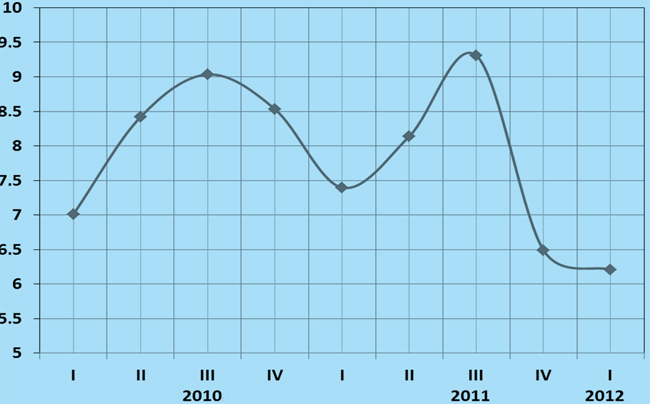
Fig. 1. Quarterly diamond output of De Beers in 2010-2012.
Table 1
Diamond output by De Beers’ diamond fields and operations in 2010-2011
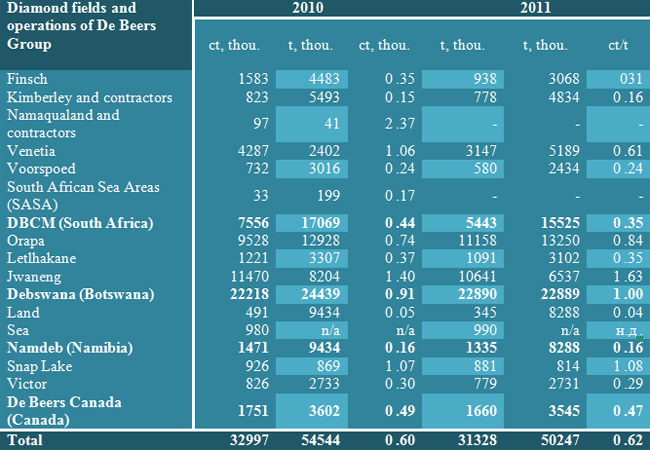
Diamond production by De Beers operations in 2008-2011
Debswana
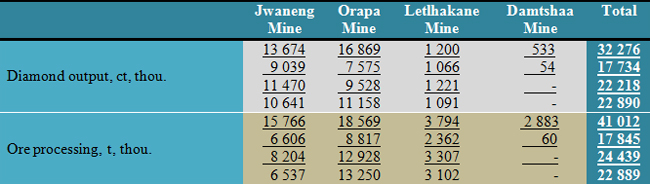
The pace-setting division of the Group, Debswana (50% owned by the Government of Botswana and 50% by De Beers) operates four mines (Fig. 2, Table 2). To date, it accounts for a two-thirds share of the Group’s output.
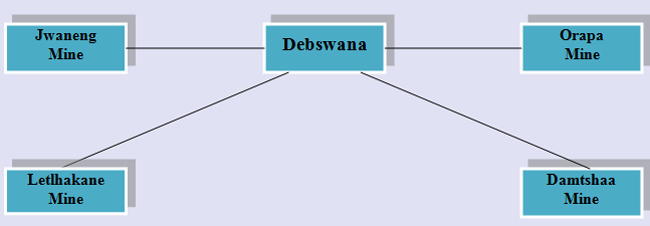 Fig. 2. Debswana’s diamond mining operations.
Table 2
Performance of Debswana mines in 2008-2011
 * 2008
** 2009
*** 2010
**** 2011
De Beers Consolidated Mines (DBCM)
This oldest company of De Beers Group is mining diamonds in South Africa in two old mines, which are Finsch and Kimberly, and four new sites, which are Oaks, Venetia, Voorspoed and the coastal area of South Africa (Fig. 3, Table. 3).
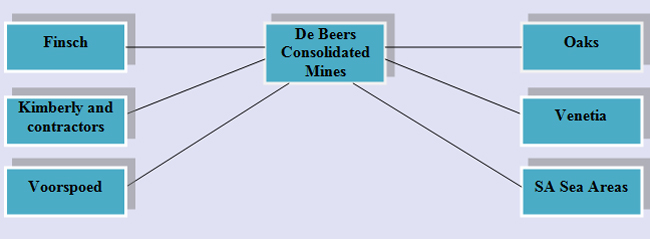
Fig. 3. Diamond mining operations of De Beers Consolidated Mines.
Table 3
Performance of De Beers Consolidated Mines by diamond mines in 2008-2011
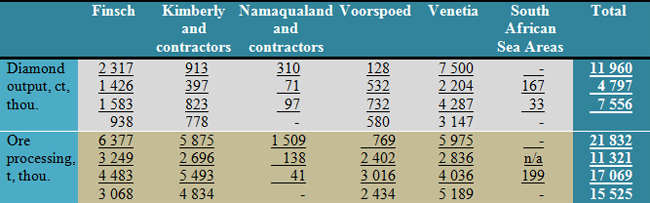 * 2008
** 2009
*** 2010
**** 2011
De Beers Canada
De Beers Canada operations are mining diamonds in Canada (Fig. 4, Table 4). In the future, diamond mining in Canada is expected to offset gradually depleting production in old fields to some extent.

Fig. 4. De Beers Canada’s diamond mining structure.
Table 4
Performance of De Beers Canada in 2008-2011
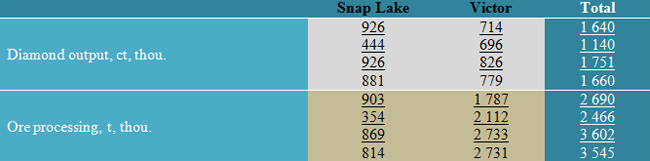 * 2008
** 2009
*** 2010
**** 2011
Namdeb
Namdeb, a joint venture between De Beers (50%) and the Government of Namibia (50%), is mining diamonds offshore and on land alluvial deposits located in the country (Figure 5, Table. 6).

Fig. 5. Namdeb’s diamond mining structure.
Table 5
Performance of Namdeb by diamond mines in 2008-2011
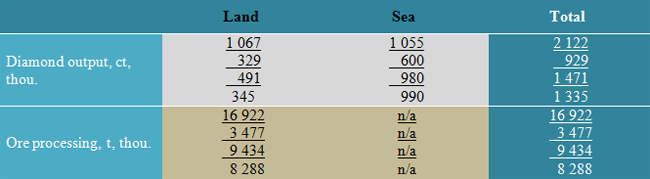 * 2008
** 2009
*** 2010
**** 2011
Options for further development of the diamond business: IPO, sale of core assets, stabilization
After completing all the procedures to get necessary permits at the end of the second quarter of this year, Anglo American will own an 85-percent stake in De Beers, which can later result in making the company public and selling some part of its shares in the open market (IPO).
In contrast to ALROSA, which began to dispose of noncore assets, De Beers is engaged in selling phased-out deposits. Thus, in 2006 the company stopped mining operations at Koffiefontein, where the first diamonds were recovered as early as 1870, and in 2009 it shut down Cullinan later selling both to Petra Diamonds. In 2011, De Beers Consolidated Mines sold the Namaqualand diamond mines located in South Africa to Trans Hex Group Ltd.
Despite the fact that De Beers is able to produce 36 million carats a year, it is most likely that it will stabilize its production in the range between 30 to 32 million carats, depending on market conditions and trying to prevent a decline in diamond prices from the reached record levels. It should be said that expected scarcity of rough diamonds until 2020 will drive the growth of rough prices on the backdrop of almost flat world diamond production.
In the future, the risks facing global diamond mining may be substantially increased due to developing technologies permitting to synthesize artificial diamonds of high quality.
Yuri Danilov, Ph. D., Director of the Department of Regional Subsoil Management Economics, Institute for Regional Economics of the North at Ammosov North-Eastern Federal University
