The Hong Kong Jewelry Fair held in late September could not completely reverse the mood reigning in the diamond market. Various experts describe it in similar words: "dull market," "meager interest" and "bleak optimism." In September, trading continued to be low and diamonds were bought only for current needs, evading stocks.
But October has brought unexpected news. According to market sources, De Beers drove its sales to more than $700 million at the recent sight, exceeding any of the most successful months this year. In the absence of outward signs pointing to rising demand, this can only mean one thing - the company has significantly reduced prices for rough diamonds and, most probably, also compelled the sightholders to buy previously deferred goods now, not in the spring next year as it had been promised earlier.
State of the market
The scenario based on a sudden increase in demand may be brushed away immediately. Just re-read the September news carried by any of the industry mass media - it would be great if you can find at least five items written in an upbeat tone. The most that market participants were admitting to notice were “signs of recovery” reflected, for instance, in the demand for Indian goods. In late September, Diamond Corp even announced that it would not hold a regular auction for selling rough due to weakened prices.
Foreign trade statistics from Belgium and India for September are not yet ready, but the data for August also pointed to a significant slump in trade, which could hardly be made up for just within one month.
Trade data for Belgium and India (monthly, million carats):
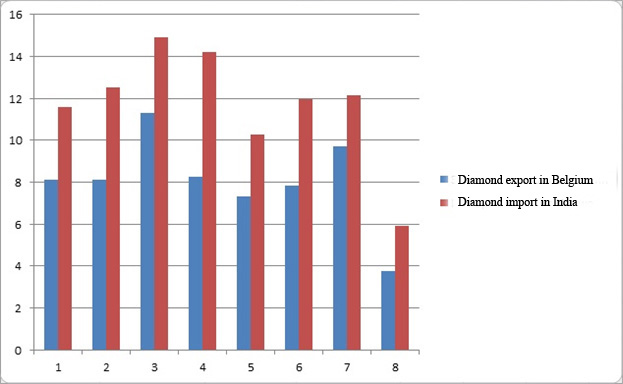
Moreover, in August, there was registered a noticeable drop in average export prices for polished diamonds from these countries (also based on foreign trade statistics).
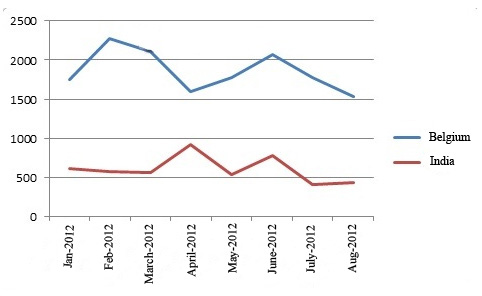
Given that, according to media reports, diamond and jewelry trade in September was also weak, diamantaires had no chance to accumulate a large amount of available funds to dramatically increase purchases.
There is another hypothetical reason due to which the value of DTC’s sight could suddenly grow within one month. Theoretically (and in no other way) DTC could somehow oblige the sightholders to increase purchases by adding some attractive amendments into their contracts. But, as I said, just a couple of months before that DTC had already allowed the sightholders to abandon some of the purchases and defer up to one half of the offered goods until next spring. A second candy in the course of two months in a ‘thin’ but not critical market? It seems unlikely.
Therefore, the only logical option is reduced prices. And prices seem to have been reduced significantly, making it possible to "convince" the sightholders to buy the deferred part of goods right now. In general, these assumptions are confirmed by what market participants say.
A least-evil solution?
Reducing prices looks like an extremely illogical step for De Beers, if only because it denies its own declaration made two weeks ago. De Beers CEO Philippe Mellier said at the Hong Kong exhibition that the next sight "will again be small" and the company does not intend to further reduce prices (in August, DTC reduced them by 8-10%) - “the industry needs to be optimistic to ensure that prices will increase.”
One can only guess what caused De Beers to make a U-turn in their trade policies in a matter of 10 days. But it seems that what happened is exactly what the market had feared since last year: Anglo American, having consolidated control of De Beers in mid-August, began to exert direct influence over the diamond miner and bring it to its own understanding of “market standards.” By the way, it's not fortuitous that the news of the impending restructuring in De Beers accompanied by DTC and Diamdel consolidation also appeared only in the fall.
Let’s turn to figures
The financial statement of De Beers for the first half of 2012 looks quite confident. The company’s sales are not much lower than in the first half of 2011, while its debt is gradually being reduced.
$ m
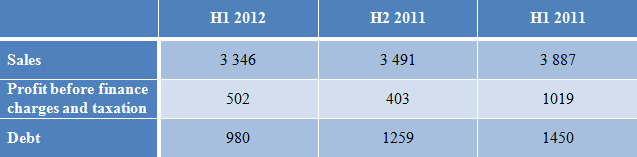
However, the picture is far less serene, if you look at Anglo American’s report for 1H 2012.
Anglo American is a transnational mining corporation that is far from making money on diamonds only. The structure of its operating profit is shown in the table below (based on the company’s reports).
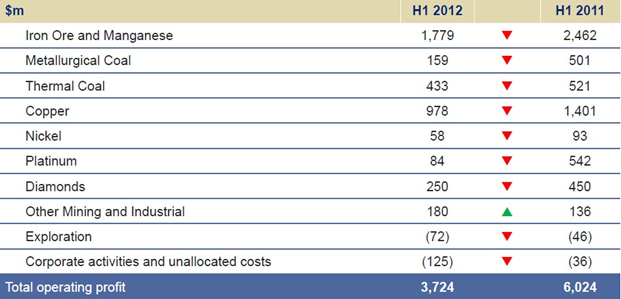
As can be seen from the table, in the first six months of the year Anglo American saw its profits slump across the board. This was due to the general crisis in the global economy, as well as due to falling prices for metals and thermal coal. Because of sinking prices, Anglo’s operating profit fell by almost 40% in 1H 2012.
The corporation has not yet published its statement for nine months (although it should be expected in the near future). However, judging by the current prices for commodities, Anglo American’s performance during the nine months of 2012 will be low. Below are price graphs for basic commodities produced by Anglo American during the past year, inclusive of October 8.
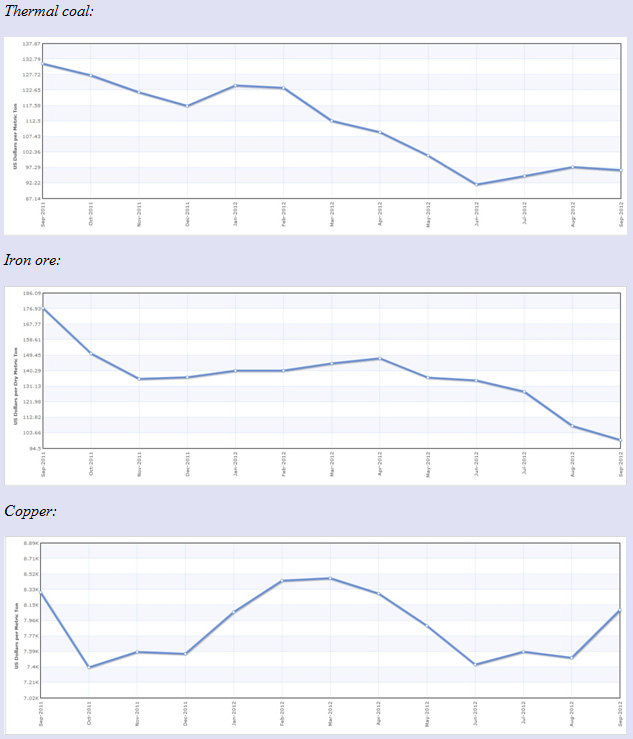
It should also be noted here that the purchase of De Beers and transition of its liabilities to Anglo American brought about an additional $6.3 billion of debt to the corporation, and this debt is to be paid for a long time. And the state of the global economy is still fragile and prices for commodities are still falling.
In our previous market report we cited DTC sales for this year. As of August, DTC lagged behind the level of sights held in 2011 by more than $800 million. Nevertheless, the company allowed its customers to give up half of the offered rough goods in July and August and skipped September to run a sight.
The end of September - beginning of October is the usual time for third quarter reporting. I shall not at all wonder if De Beers will post a sharp decline (if not a loss) in operating profits in 3Q 2012 - and now it will be a loss on Anglo American’s balance sheet. And similarly I shall not wonder if Anglo American being the owner of an 85-percent stake in De Beers sent, to put it mildly, a clear message to the diamond miner’s management: the parent corporation cannot afford losing money on a secondary business when its major businesses are phasing down operations, which means that De Beers will have to enable market price regulation and show good sales figures.
Short-term gain, long-term failure
Cutting prices for raw materials is an efficient and logical measure for the commodities market, which permits to increase sales and profits in the short term. However, diamonds have never been a commodity and their consumption market is largely artificial. To decrease prices right now means in fact that De Beers abandons its policy of shaping a long-term market, which was actually historically authored by the company and which it continues to preach via its marketing initiatives.
It is difficult to predict what kind of consequences will be brought by this step, but it is unlikely to be positive. Just remember that the large-scale market collapse in 2008 started with an uncontrollable spin demonstrated by BHP at auctions.
Decreasing prices by De Beers may trigger similar steps from other mining companies and make Cecil Rhodes’ nightmare - price competition between diamond miners - a reality. So, is the sharp decline in prices coupled with increased auction sales a feature of the ‘Brave New World’? I’m afraid no one in the diamond pipeline will benefit from this.
In the medium term, diamond miners themselves will start losing money and get less profit. In addition, they will always have significant operating costs on their hands due to maintenance and supply needs, and no one can say if the existing operations will be profit-making. And in case some part of the existing capacities will have to be mothballed this will result in a shortage in the market, which will automatically boost prices initially intended to be cut by miners. In its turn, this will put the social factor on the front burner - in 2009, it instantly turned into one of the defining features of the situation in Botswana, Russia and India.
A sharp decline in rough prices cannot play into the hands of diamantaires as well - it will depreciate their inventories and bank collaterals, and even without this Indian diamond manufacturers are now in a difficult position, because of the rupee depreciation and increased payments for U.S. dollar loans. The best option for them is to stabilize prices at a restrained level of supplies.
It is hard to imagine that De Beers does not evaluate possible repercussions. If not, it would be utterly deplorable, because the market sincerely hoped that the Oppenheimers’ withdrawal will not bring disturbing changes to the industry.
In the early 20th century, there was a fairly large and dynamic market of gem-quality amber. It was built on the same principle as the diamond market: moderate satisfaction of demand on the background of strong marketing. Later on, these principles were buried in oblivion and amber went streaming like a river. So where is this market now?
Elena Levina for Rough&Polished
