We have again delayed this market overview for November waiting for export and import metrics from Belgium to avoid unsupported guesswork. And it was not in vain. The market stabilization that was evidenced in October is continuing and this is proved by the statistics, as well as by marketers at work.
Rough prices
According to the data released by the AWDC, Belgium imported 7.9 million carats of rough worth $ 1.1 billion in November. These numbers give us an average price of imports to Belgium equal to $ 139.4 per carat.
Compared with October, prices for imported rough increased by 16.8%. However, this hardly proves that diamonds turned more expensive. In terms of volume, total supplies went down by nearly two million carats versus last month, whereas prices remained virtually flat. In all likelihood, higher prices were a consequence of the re-shaped product range coming in to Belgium. This theory is generally confirmed by market players, who say that November saw a period of roaring trade in large-size diamonds going on in Antwerp.
Belgium’s rough export replicated the same picture. In value terms, it was $ 1 billion, down 16%, while in volume terms it declined by almost 30% - to 7.2 million carats. The average export price has also increased by 17% (about the same $ 20 per carat) compared with October - up to $ 145 per carat.
Prices of rough imports to Belgium, as we have already noted, reflect the primary selling prices offered by diamond mining companies. Belgium’s export prices for rough diamonds mirror the prices eventually paid by diamond manufacturers. Comparing the movement of these prices in November gives reasons for optimism.
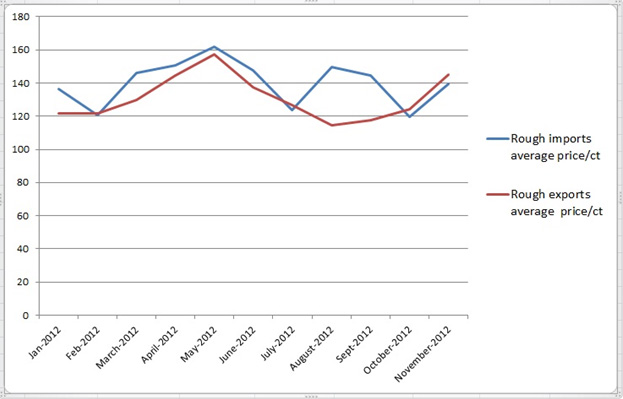
Throughout the year, average prices from rough producers remained higher than purchase prices paid for rough by diamond manufacturers (of course, we mean here only average prices, because the situation in different categories of rough was disparate). Sometimes this gap was minimal, sometimes conspicuous. Market participants repeatedly pointed to this situation, saying that rough coming from De Beers and ALROSA was resold at a discount, causing complaints from manufacturers, which ran into a liquidity crisis.
The statistics published by the AWDC in November show that prices for rough offered by producers are in line with prices at which diamantaires are ready to buy goods for the second consecutive month. Of course, in order to call it a recovery, you need to wait at least another couple of months. But the situation is already looking promising.
It’s worth to pay attention at least to the fact that export prices for rough from Belgium exceed import prices (about 4%) for the second consecutive month. This indicates that diamond trade again begins to generate profit.
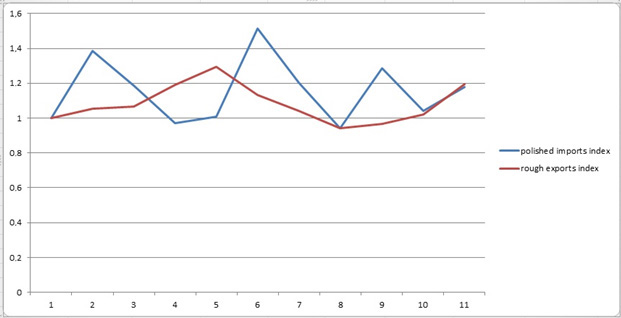
No less optimistic picture is arising from the movement of polished prices. If you compare the price indices for rough and polished diamonds (taking the beginning of the year as a reference point), you can see that the movement of prices for rough and finished goods is unidirectional.
What has December in store for us?
Over the last month, I have seen repeated comments in the media written by different experts, but having approximately similar contents.
These were the calls addressed to diamond miners to support the cutting industry and saying that time will come when there will simply be no one to cut diamonds. The authors of these appeals argue that the diamond cutting business equally suffers from the high level of prices, when a rough diamond is valued more than a polished diamond made of it, as well as from the consistent decline in prices from month to month along with a market glut.
Despite the excessive emotionalism permeating these appeals, they do have a grain of truth.
If the market will manage to stay in this state as it is now just a few months more, we shall have a good chance to see its gradual growth. According to market players, right now rough prices turned already comfortable enough for diamond cutters and generally are in tune with polished prices. However, most diamantaires still have problems with loans, so their activity is now more focused on demonstrating their monthly business turnover (to report to their banks). Working in a stable environment, manufacturers find it a lot easier to adjust to price fluctuations and gradually start to make profit once again. Little by little, profits will escalate business turnover – thus increasing rough purchases and diamond manufacturing.
But, again, this is only possible if the market will keep staying in a stable condition for some time.
From conversations with diamantaires it follows that many of them have serious concerns about the last sight of De Beers this year. The unexpectedly large sight in September they explained by the need of the company to show good numbers for the third fiscal quarter. December completes the fourth quarter, which was not fortunate for Anglo American as well. Therefore, many feel understandable qualms about possible recurrence.
Both ALROSA and De Beers have fairly large amounts of unsold rough and lag behind the last year's sales schedule. During a recent conference call, ALROSA’s management said that currently the company accumulated stocks amounting to 20% of its annual output – some 6-7 million carats. Of course, the company’s representatives assured that ALROSA would be putting these stocks on sale on a piecemeal basis, carefully watching the market. But at a time when all market players feel extremely tense, words alone are not enough to calm them.
ALROSA significantly reduced rough sales by carat in the third quarter. However, after the third quarter, the company has adjusted prices in line with demand, which (the management says) made it possible to regain sales at previous rates in terms of volume.
In the last review, we have already stressed the need for producers to stop for a while at the level they achieved. The price correction has already triggered increased activities in the market. If now prices will continue to go down accompanied by higher sales of goods by volume, manufacturers may turn really apt to face new financial challenges.
Of course, the amount of polished diamonds produced does not depend only on the desire of manufacturers, but also on demand. However, so far demand forecasts look optimistic for the short and long terms. De Beers expects that diamond sales in China are to grow by 11% and in the U.S. by 4% in 2012. These figures are far from the high results last year, but nevertheless it is growth, not decline. In the long-term, demand for diamonds will increase, primarily due to the growth of the middle class in emerging economies.
Elena Levina for Rough&Polished
