The diamond cutting industry of the Republic of Sakha (Yakutia) includes a network of cutting businesses, which currently has only 11 operating factories (Fig. 1).
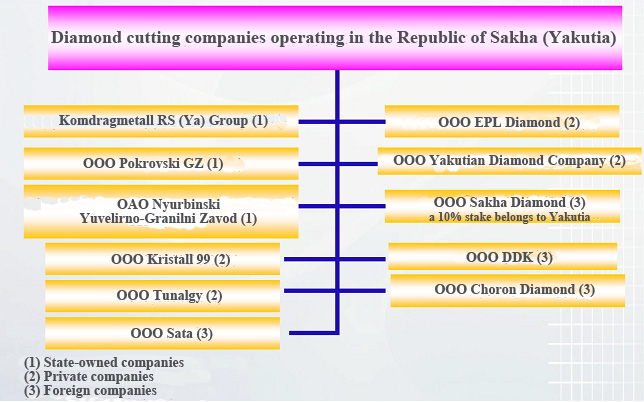
Fig. 1. Diamond manufacturers in the Republic of Sakha (Yakutia) in 2011
Since the manufacturing and sale of polished diamonds appears to be only an intermediate segment in the diamond pipeline, where final goods are represented by diamond jewelry put on sale, this survey is also focused on the jewelry industry of Yakutia (Fig. 2), providing data on the diamond manufacturing and jewelry industry in this republic (Tab. 1).
Besides, ALROSA also has its own diamond-cutting facilities, and since this company is based in Yakutia and despite the fact that its diamond manufacturing businesses are located in other parts of Russia, their results, in our opinion, should be viewed along with performance indicators posted by Yakutia’s diamond cutting industry (Tab. 2).
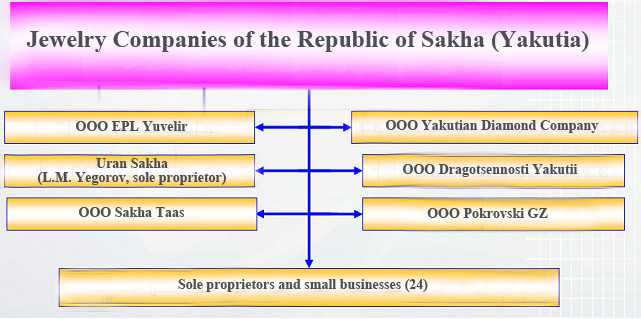
Fig. 2. Jewelry manufacturers in the Republic of Sakha (Yakutia).
Table 1
Performance results posted by diamond-cutting and jewelry industries in the Republic of Sakha (Yakutia) in 2005-2012
$ M
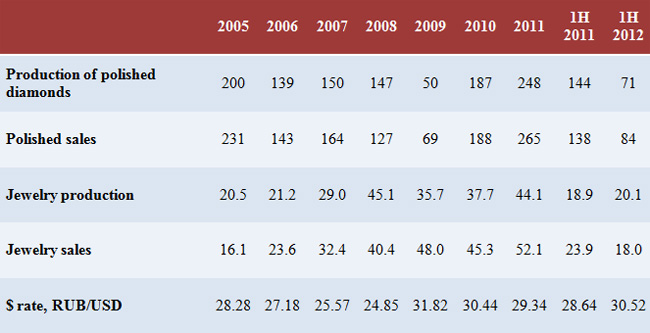
The table is based on the report titled "On the development of the diamond-cutting and jewelry industries in the Republic of Sakha (Yakutia)" released by the Ministry of Economy and Industrial Policy of the Republic of Sakha (Yakutia) in 2012.
In 2011, Yakutia’s diamond cutting industry accounted for 24% of polished sales in the total sales performed by the Russian Federation, and if ALROSA is to be added to that proportion Yakutia’s polished share will make over 40%, which proves its diamond cutting industry is competitive at the national level.
Table 2
Sales of polished goods by major diamond manufacturers in the Russian Federation in 2008-2011
$ M
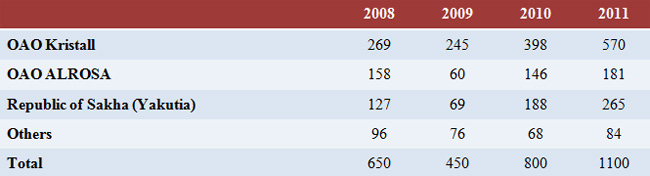
The table is based on the report titled "On the development of the diamond-cutting and jewelry industries in the Republic of Sakha (Yakutia)" released by the Ministry of Economy and Industrial Policy of the Republic of Sakha (Yakutia) in 2012, as well as on the reports issued by OAO ALROSA and OAO Kristall in 2008-2011.
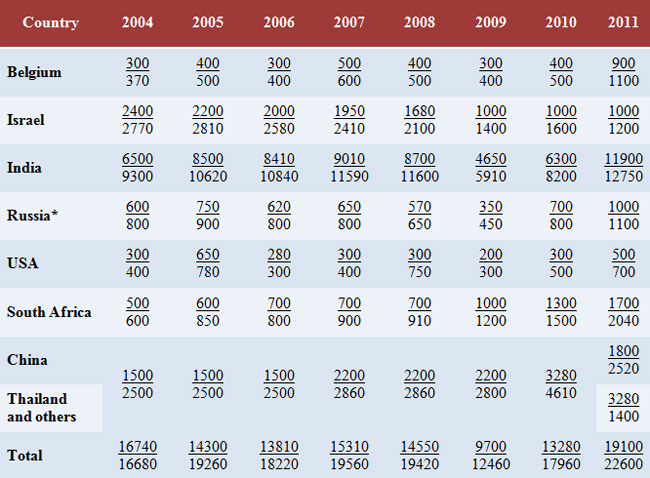
However, if we consider the diamond cutting industry of Yakutia and Russia as a whole on a global scale, we can see significant potential for its development, as the share of diamonds cut in Russia is less than 5% of world’s production (Table 3).
Table 3
Diamond manufacturing and sales in the world's major diamond centers in 2004-2011, $ M
manufacturing
sales
According to Chaim Even-Zohar, Diamond Pipelline 2004-2011.
* Estimated by the Institute for Regional Economics of the North.
Despite the availability of unique mineral reserves, the diamond cutting industry of Yakutia cannot realize this potential to the full extent due to a number of objective and subjective reasons.
First, the diamond cutting and jewelry manufacturing, being a business producing non-essential goods and luxury items, is dependent on the purchasing power of consumers, and therefore on the standard of living of the population in the province and country at large, which has decreased considerably due to the global economic crisis, especially in 2008-2009.
Second, the legal framework governing the activities of enterprises and organizations associated with diamond cutting, jewelry manufacturing and sales, is not conducive to effective development.
Third, the Republic of Sakha (Yakutia) has no coherent strategy aimed at developing the diamond cutting and jewelry industries for some perspective, despite the adoption of a number of relevant target programs.
Fourth, the diamond cutting and jewelry industry in the province, in spite of their obvious relationship, are developing in isolation from each other and do not use the benefits of cooperation in the diamond jewelry market.
Fifth, sales and management remain to be a weak point of Yakutia’s diamond cutting factories. In our view, the goods produced by the local diamond cutting factories cannot compete in the international market due to their quality, whereas in the domestic market they lack proper marketing. It is the absence of a development strategy based on modern market mechanisms that has brought about a systemic crisis in the industry, which can be overcome only if the latter pursues a cluster approach.
Yuri Danilov, Ph. D., Director of the Department of Regional Subsoil Management Economics, Institute for Regional Economics of the North at Ammosov North-Eastern Federal University
