One may talk ad libitum repeating that diamonds are not commodities, which means that the diamond market is not like other markets. However, the globalization of the economy makes this thesis doubtful. Over the past few years, we have repeatedly experienced ups and downs of commodity prices, witnessing financial "bubbles" and crises in demand. The diamond market is unstable, and this is one of the properties, which is usually inherent to the “market" in the conventional sense of the word.
In 2012, the diamond market took another step towards this "conventional sense." Because of the liquidity crisis experienced by manufacturers diamond miners were forced to reduce prices to a level comfortable for buyers. As a result, despite the rapid rise in prices in the first half of the year, the industry kicked off 2013 at the same price level for rough which was registered in January 2012. And it is a good reason to think about how the pricing practiced in the industry should develop in the future.
Rough prices
According to the statistics released by the AWDC, Belgium imported 6.65 million carats of rough diamonds worth $ 929.8 million last December. This was somewhat lower than the previous month both in terms of volume and value, but the decrease in trade in December is a phenomenon considered altogether regular and repeated from year to year.
One carat of rough imported to Belgium in December was on average worth $ 139.7, virtually unchanged compared with November. For the diamond market, which was volatile in recent years, this kind of "stability" for even two months appears to be a remarkable development.
The decline in prices undertaken by rough producers, which occurred in the autumn, offset all the previous attempts to increase prices made in the first half of the year. Diamond miners ended the year having the same prices as in the beginning of the year (according to the above mentioned AWDC statistics, these were $ 136.6 per carat in January).
Below is the chart of price movements for rough diamond imports to Belgium by month:
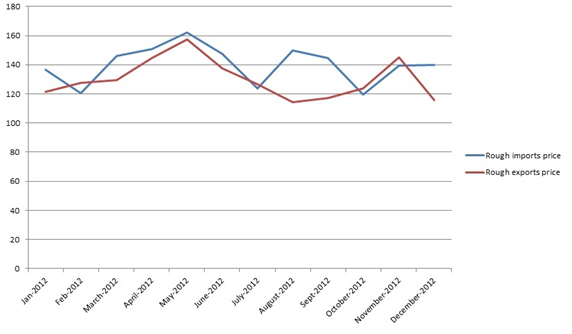
Speaking about diamond export from Belgium, it should be mentioned that in December the average price of rough exported from Belgium fell to $ 115.6 per carat. This occurred on the background of significantly increased volume of transactions: 12 million carats worth $ 1.39 billion. On the whole, prices for rough exported from Belgium in the end of 2012 stayed at about the same level as they were in January or $ 121.4 per carat.
It is worth to dwell on the December export metrics separately. Prices for rough exported from Belgium were lower than import prices for rough. However, this is hardly the evidence that producer boxes were once again sold at a large discount on the secondary market. In value terms, diamond exports from Belgium rose by 30% in December (compared to November), and in volume terms by more than 60%. Since export volume rose faster than prices, it can be assumed that the reason was in changed assortment of sales. In all likelihood, December saw a brisk market for small-size "Indian goods."
Obviously, large amounts of "Indian goods" came from the stocks kept by Belgian diamantaires. In any case, Belgium’s rough exports in December exceeded rough imports by 6 million carats. Totally, during 2012 Belgium’s stocks ‘released’ an additional amount of rough (to imports) equal to 16 million carats.
On the whole, Belgium’s diamond stocks continue to be released to the market for at least five years. In 2011, Belgian exports exceeded imports by 8.2 million carats; in 2010 - by 17 million carats; in 2009 – by 10.5 million carats; and in 2008 – by more than 6 million carats. One can only guess how big the stocks now accumulated by Belgian diamantaires are, taking into account that they were reduced by almost 60 million carats in the course of only 5 years. These stocks of rough were accumulated since the pre-crisis period, although it is most likely that their assortment was repeatedly changed depending on the market conjuncture.
All in all, Belgium imported 88.3 million carats of rough in 2012 or by 10 million carats less than in 2011. The main reasons for this decline lie with the liquidity crisis which hit diamond manufacturers, as well as with the supply of rough reduced by producers, which tried to maintain rough prices in this way.
New monopoly
Until the 2000s, there was a sole seller of rough in the diamond market, which was De Beers. Today we can say there is another monopoly and this is the buyer’s monopoly. Almost all rough diamonds en masse come to India to be cut - even if it goes to a large number of different buyers. And this kind of monopoly, as it turned out, can have a significant impact on the market in the periods when the Indian economy is weak.
Many of the problems experienced by the diamond market, which we faced in 2012, were caused by the sharp depreciation of the Indian rupee. Annually, India imports huge amounts of resources, particularly oil and petroleum products, and has a huge negative balance of foreign trade, which eventually led to the fall of the national currency. The trade in rough and polished diamonds has a very small share in the Indian foreign trade, but the impact the rupee is producing on the diamond industry is significant.
Here is how the rupee fluctuations looked like in 2012:
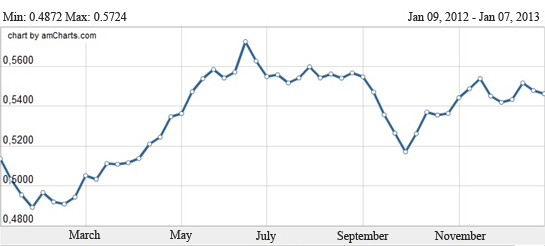
The sharp depreciation of the national currency significantly reduced the ability of Indian manufacturers to buy rough: using the same amount of rupees they were able to buy much less goods. Besides, diamantaires lost heavily at frequent conversion of rupees to dollars and backwards (which was mandatory under local law). It should be said that polished diamonds do not go up in price as fast as rough diamonds. The result was that diamond manufacturers were left without margins or even driven into the red. Representatives of the diamond cutting industry once again started saying that rough prices were too high and that rough diamonds are often more expensive than polished goods, which are made of them.
The Indian regulator said there were a series of measures aimed at strengthening the national currency. However, as it can be seen from the rupee graph, they failed to produce visible results. The rupee rate has stayed at around 54 rupees to the U.S. dollar for several months, and probably will remain at the same level in the future. Judging from the current state of the market, manufacturers adapted to work at the current rupee rate, and the decline in producer prices has contributed to this a lot.
The issue of trust
However, to "adapt" and "have a profitable business" is not the same thing. The year end was marked by a large number of appeals on behalf of the diamond cutting business and experts calling for diamond miners to pay more attention to the needs of diamond manufacturers and ensure that the relationship between prices for rough and polished diamonds was acceptable.
The market is subject to the laws of supply and demand. This means that consumers and producers are trapped “in the clutch of circumstance.” If a manufacturer will work without getting some margin, his work will have no meaning. On the other hand, diamond miners are using high prices trying to make more profit, most of which in the current environment is spent on maintaining production. The time of easy open-pit mining passed and the existent mines are being depleted – this problem is facing both ALROSA and De Beers. Getting profit is a way to develop underground mines. The less is the profit, the less is underground mining, as well as diamond output. Given that demand is already higher than supply, this is also not the best scenario.
But there is one more factor that has received little attention for some reason.
Pricing in the diamond market is a process historically closed and opaque. And in many ways it is based not on economic feasibility, but on ... trust.
Today, miners do not always know what happens to their diamonds after they are shipped to the buyer. This process was much simpler when De Beers was a trading monopoly. According to the accounts of market experts, at that time there were agreements with buyers to monitor the situation in the market and provide information on what kind of polished diamonds were made from rough goods supplied and how exactly these polished diamonds were sold.
After the collapse of the monopoly it has turned many times more difficult to pursue such market monitoring. Of course, both major diamond miners have their own "offshoots" cutting and selling diamonds, which permits them to obtain at least an approximate idea of the situation in the market. De Beers has the added benefit of Diamdel, which is active in the "secondary" market. The company has analytical services, sales offices in different parts of the world, but ...
Anyway, running a trading session, the producer can only rely on the words of his counterpart. Pricing depends on what this counterpart will tell about demand for rough goods, what kind of information he or she will provide. And in our time, it is no secret that any information can be fed the way it is convenient to its holder. Sources that sell diamonds to manufacturers say that this kind of information often makes them wonder. "I always guess what kind of business it is,” one of the sources said ironically. “According to the documents provided by diamantaires, their business has been sustaining losses for a long time and my prices are too high for them. However, they continue to buy, and moreover, they solicit larger consignments."
Prices have always been the subject of agreement between the buyer and the seller. However, in order to keep prices for rough and polished diamonds in compliance with each other (as required by the market), it would be useful to develop a tool, which would determine the rate of such compliance with a certain degree of accuracy to make it clear at least for the seller and his or hers customers, if not for the general public.
To develop such tools would be no less useful than the joint marketing efforts to promote diamonds as a generic product, on which the expert community is now so insistent. At any rate, it would remove at least some part of mutual claims made by diamond miners and diamond manufacturers. And it would not at all mean any final transformation of diamonds into commodities since there is no one to cancel the concepts of "premium/discount to the market price."
Elena Levina for Rough&Polished
Exclusive
Diamond market crash is Africa’s opportunity, not its crisis – M'zée Fula Ngenge
Global natural diamond supply is forecast to fall below 95 million carats this year, the lowest since 1987. For Dr. M'zée Fula Ngenge, chairperson of the African Diamond Council (ADC), this is not a death knell but a clarion call. In an exclusive...
12 october 2026
Tracr passes 5 million rough diamonds milestone as De Beers expands provenance push
De Beers Group's blockchain-enabled traceability platform Tracr reached a significant milestone in 2025, with more than 5 million rough diamonds individually scanned and registered, up from 2.8 million cumulative registrations reported in 2024. The...
28 september 2026
South African diamonds head to Hong Kong: SDT partners with BRINKS for JGW 2026
South Africa’s State Diamond Trader (SDT) has confirmed the country's participation in Jewellery & Gem World Hong Kong (JGW) 2026 through a partnership with BRINKS. SDT marketing and communication manager Tsholofelo Gopolang Tselapedi...
14 september 2026
David Benderly: PermaScribe seeks to put trust mark on diamond table, not just girdle
In this interview with Rough & Polished’s Mathew Nyaungwa, PhotoScribe Technologies president and chief executive David Benderly explains how PermaScribe differs technically from conventional laser inscription, its potential to strengthen security, and...
31 august 2026
The great reset: Paul Zimnisky on supply catharsis, De Beers' bargain and the case for natural diamonds
The natural diamond industry is in the throes of its most profound reset in a generation. Supply is plunging to its lowest level since 1987 and De Beers—once valued at over $9 billion—is reportedly being sold for as little as $1 billion.
Lab-grown...
10 august 2026
