Maybe it is not entirely correct to look back at January in the end of February. But the analysis of January results produced by trade in rough diamonds gives rise to contradictory feelings. In first approximation, the picture is quite simple: the small sight run by De Beers led to shortages of goods, due to which boxes in the secondary market finally started to be traded at a premium promising a rise in prices for rough diamonds. But a closer look brings about a host of questions. The sales data from producers appear greatly divergent, the series of metrics describing scarcity do not match, and it is not quite clear who was the end winner last month.
According to the statistics provided by the AWDC, the average price of Belgian diamond imports in January went up 2.6% compared to December last year and reached $ 143.4 per carat. The average export price remains below the price at which rough diamonds were brought into the country, but now it is much closer to it compared with last December, staying at $ 133.15 per carat.
Average diamond export and import prices in Belgium in January 2013 ($):
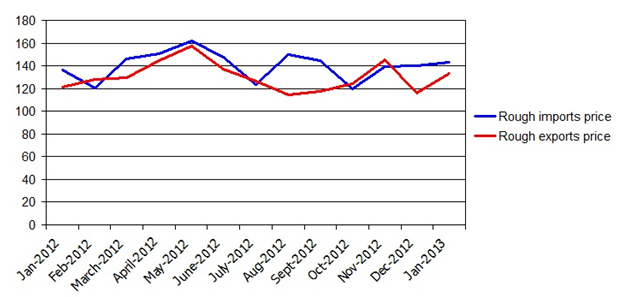
The growth of import prices by 2.6% is on the whole concordant with reports from various sources saying that De Beers increased its prices by 2-3%, while adjusting the product range.
However, this is the only thing which entirely agrees with the statistics.
It has been repeatedly reported that due to the last year's cutback in rough sales by diamond producers, as well as due to the small size of the January sight the market started to experience a shortage of rough by the end of the month, which pushed premiums in the secondary market up to 5-9%.
Market operators estimate January sales of ALROSA at $ 300-350 million - about the same level as in January in previous years or in December 2012. In their estimation, ALROSA’s product range remained comparable with the one offered last December and prices were "on par with the market."
According to market operators, Rio Tinto carried out a sufficiently large trading session by volume. BHP reduced their sales, but only slightly - by about 3-4%.
Actually, the most controversial estimates are associated with the De Beers sight: the numbers mentioned by various sources range from $ 450 to $ 550 million - that is, the sight was smaller than usually in January by $ 100 million or $ 200 million.
However, the AWDC statistics are to a certain extent contradictory towards the theory of reduced supplies by rough producers. In January, Belgium imported 7.77 million carats of rough diamonds - almost 17% more than in December. In dollar terms, this growth is even more substantial - 20% to $ 1.114 billion, which is one of the highest import indicators for Belgium in the past year.
That said, it should be mentioned that though Belgium’s rough exports correspond to the volume of imported goods, but appear surprisingly small, if we look at the country’s historical trading volumes. To verify this, it would be enough to look at the ratio between Belgian diamond exports and imports in 2011 ($ million):
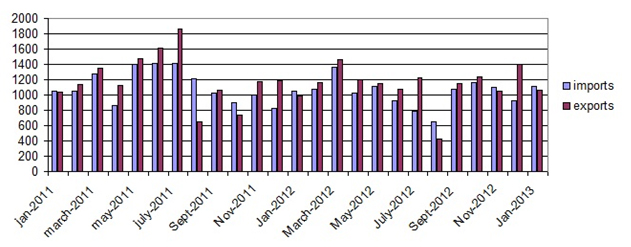
Belgium’s export of rough diamonds reflects, above all, the trade going on in the secondary market and final distribution of goods among diamond manufacturers. And if the secondary market experienced shortages of goods urging customers to buy boxes at a premium, it was unlikely that the small volume of exports was an evidence of lack in demand for rough diamonds.
Shortages of rough in the market cannot be generated by diamond miners only. After so many months of decline, the market lives in hope for a price recovery in the first quarter. The above diagram of exports and imports makes us think that in anticipation of this growth Belgian traders are holding back their rough and accumulating stocks, thus making it even more real.
Elena Levina for Rough&Polished
