What is the best marketing strategy for diamond jewellery in the 21st century? Exactly the one that De Beers has been following for almost a hundred years, if we look at the new Forevermark Diamonds campaign in the United States.
Powerful messages and celebrities wearing diamonds are at the centre of the marketing campaign that De Beers’ premium diamond brand is using to conquer the American market.
It all started in November with the launch of the “Center of My Universe” collection, accompanied by an emotional TV advertisement in the style that made De Beers famous all over the world. The campaign was very positively received by the public, and has been watched again on Youtube over 800.000 times, considering both its long and short versions.
But apparently the best had yet to come and in January Forevermark made sure to appear in some of the most glamorous events in the United States.
The open fire was one of the premier events in the cinema business, the Golden Globe Awards, where several movie celebrities, including rising star Hayden Panettiere wore the Center of My Universe collection on the red carpet.
This was just an anticipation of the centrepiece that Forevermark was preparing for January. Indeed, the circumstance was so extraordinary that many jaws must have dropped after seeing it: at the 57th Presidential inauguration, Michelle Obama was photographed wearing a set of Forevermark diamond bangles designed by Kimberly McDonald during a dance with President Barack Obama. The news was immediately reported by Forevermark and rebounded on the hundreds of fashion magazines and blogs that usually comment on the First Lady’s style and fashion choices.
So is Forevermark’s campaign being successful? From a commercial point of view, answering is not easy, as the jewellery market tends to react slowly to advertisements. People do not go to buy a $4.000 diamond ring just because they saw a TV ad the night before and marketing strategies are therefore oriented on winning hearts and minds in the long term rather than on stimulating a temporary caprice.
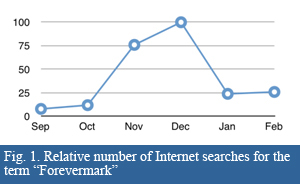 Still, thanks to the Internet, we can at least monitor the impact that the new Forevermark campaign is having on the people’s interest toward the brand. This can be done by analysing data coming from search engines such as Google and Bing, or social networks (Twitter).
As we see in Figure 1 the trend of Internet researches that included the term “Forevermark” has sharply increased after the launch of the new TV advertisement in November. While it is true that part of this growth is due to the opening of the Christmas season, rarely a jewellery brand (including Forevermark in the past years) experiences an increase bigger than two times the normal volume. Last autumn, with the launch of the new commercial, Forevermark’s search rate grew a full order of magnitude (ten times) above its previous average. This already tells us a lot on the tremendous impact that “Center of my Universe” has had on the public before the winter holidays.
But there is a second interesting long-term trend: while usually in January search rates go back to pre-Christmas value, this year they stabilised in a volume two times bigger, meaning a relevant expansion of the brand visibility in the US market. More people are looking for information on Forevermark every day.
Finally, there is a geographic indicator confirming the trend: while until a few months ago the countries that most looked for Forevermark in search engines were located in Asia (mostly China, Hong Kong and India) since last Autumn it is the United States that has produced the largest results in terms of search volume.
Search Engine statistics can tell us a lot on who is looking for a certain brand, but this is not all. We also need to know who is talking about that brand, and for that social network analysis is the best option.
This is really important in contemporary marketing strategy: in the past the launch of a marketing event represented the peak of interest for the public, while now the interest can reverberate over time as people use social networks to talk about it. That is why most brands, including Forevermark, now have a Twitter and Facebook account. Even if the brand has a limited audience on social networks, its news and photos can be shared by private users to a larger number of people, thus keeping its popularity high for long time.
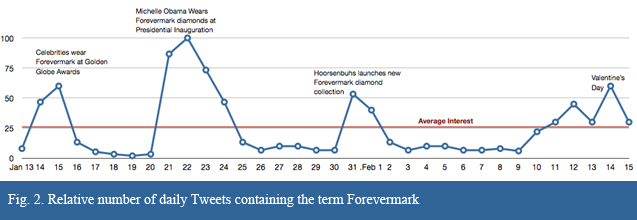
In Figure 2 it is possible to see how people reacted to every single event that Forevermark or its partner companies launched during the last month. This has been done by monitoring the relative number of tweets containing the term “Forevermark” extracted from a representative sample of 1% of the total Twitter volume.
The most evident feature of the figure is that so far Michelle Obama has been the most successful testimonial for Forevermark campaign, shadowing all other events in terms of impact on the public. It could sound trivial to say, but this proves once again that the most successful diamond testimonials are these women who represent an icon for the American society.
A second interesting feature is that after every event there is a “tail” of discussions (usually lasting a few days), which represents the reverberation of the news on twitter. This helps prolonging the visibility effect of every event.
The final result is the evident regularity in the rise and fall of interest toward the brand. Indeed, such regularity is not just a casual occurrence, but rather the example of how finely the Forevermark’s campaign is being handled: events are scheduled in such a way that, just as the interest towards the brand starts to fade, something new comes out bringing the name back at the centre of the discussions.
In conclusion, while it is still too early to determine the full potential of the Forevermark brand in the United States, these months have proven that thanks to a perseverant and well organised marketing campaign, the brand’s visibility is rapidly climbing.
Now only the sales figures will tell us if such an effort has been successful but, looking at the premises, we would be really surprised if it wasn’t.
Matteo Butera, Rough&Polished
