Industry players are so reserved and careful in their assessments of the market that it seems they are afraid to "put a hex" on what is going on. In any case, most of the experts commenting the results of diamond trade last February are trying to avoid positive adjectives. Though I think, there is really no point in this at all. January and February give real grounds for optimism, albeit cautious.
The AWDC statistics show a gradual recovery in diamond trading. Belgium’s diamond export in February increased by 6% compared to January in terms of value (reaching $ 1.121 billion), despite the fact that it went down in carat terms. Average export prices increased by 12.5% to $ 149.7 per carat.
Movement of average prices in diamond export from Belgium ($/ct):
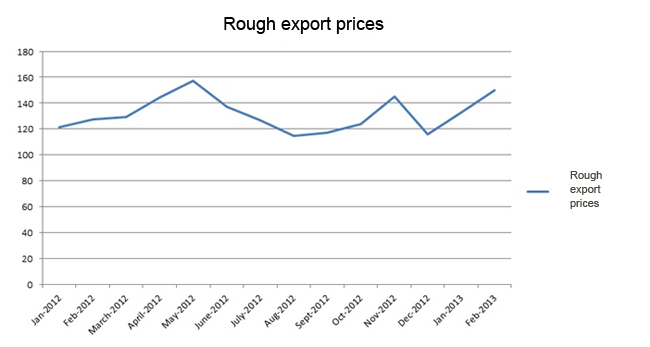
It is clear that the average export price actually means only an "average temperature of patients in a hospital," since it is too dependent on the predominance of some diamond goods in the sales mix. But looking at the graph above, you cannot deny that rough prices are now clearly exceeding the last year’s level and already crawling up to maximum values in 2012.
The growth in average prices is not triggered only by the activities of rough producers, but also by enhanced trade in the secondary market - between diamond dealers and diamond cutters.
In February, De Beers sold $ 500-550 million worth of rough. According to various estimates, boxes went up in price by 7.2%, but this was primarily due to the adjustment in the range and quality of stones. Such a change was received positively, and as a result De Beers boxes are once again trading at a premium of about 5% in the secondary market (and up to 8% for small goods).
ALROSA’s February sales are estimated at up to $ 400 million by market insiders, who also point to a slight increase in prices.
Contradictory information is coming about BHP Billiton’s sales. According to some sources, average prices decreased by 3.5%, while others say they were up by 5%. Gem Diamonds auctioned its rough in February at prices higher by 2% on the average.
Market participants agree in one thing - that rough transactions in the secondary market started to generate profit once again. It is this tendency outlined in January that can be considered a positive signal of a gradual recovery in the market. For a long time, rough prices were much higher than financial capacities of diamantaires. As a result, manufacturers had to resell the waste part of their boxes at a loss in the second half of 2012. If manufacturers are currently getting premiums, there is a good chance to see the market recovered in the near future.
However, there is some uneasiness about it all arising from the feeling it could be due to another round of speculation. Market players are wary of the fact that trading in rough diamonds accompanied by price hikes comes at a time when polished prices remain flat. According to their estimates, diamond manufacturing continues to yield some margin improvements so far, but if prices for polished diamonds will not start to rise, things could slide to the same blind alley in which they already were in 2012.
However, the AWDC metrics point to a general positive trend in polished prices. In February, Belgium exported polished diamonds at a price coming to $ 2.127 per carat, up by an average of 13.3%.
Belgium’s average diamond export prices ($ per carat):
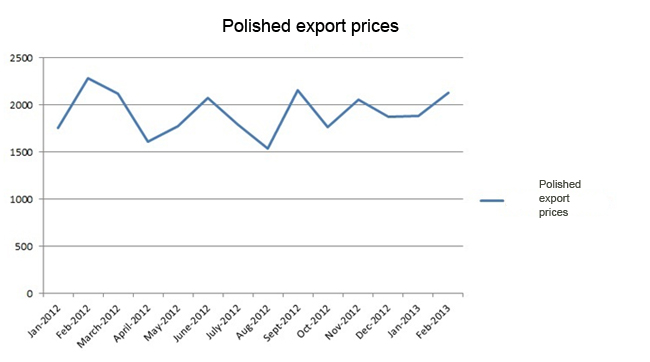
According to market experts, diamond traders have significantly reduced their inventories selling off at low prices and now they will tend to sell polished diamonds at higher prices, on the one hand, trying to compensate for the rise in rough prices, and on the other hand, to preserve the correlation between prices for rough and polished stones.
There is a hope that the recently held Hong Kong Jewellery Show will give a positive impetus to trading in polished diamonds. Market participants are also cautious to comment its results, but they state there was a marked increase in the activity of buyers and sellers, especially among those dealing in small size polished goods.
Over the last couple of weeks I have repeatedly encountered the view that the market is still at an impasse, because there are no events of a "breakthrough" kind, which would change the situation essentially and in a short lapse of time. But under the current circumstances it is exactly this kind of development – orderly and progressive – that may be seen as the best solution for the market. It is easier to adapt to gradual transformations for those who sell rough diamonds and those who buy them to cut and polish.
Elena Levina for Rough&Polished
