Perhaps we are now witnessing a new stage in the evolution of the diamond market. Rough diamond producers continue to set prices at trading sessions, while buyers continue to acquire rough proceeding from their fortune. However, at the same time there is a third and new force gaining influence in the market, which previously used to stand aloof, and this is the financial sector. The banks lending to diamond trade. The situation looks as if the state of the industry now depends on them.
Diamond trade is historically operating based on credit lines, as the path from the purchase of a rough diamond to the money gained for a polished diamond made from it takes a few months. Only a few large companies have sufficient turnover to use their own funds for this purpose. But this mode of operation was not imperative: the dedicated pool of "diamond" banks was always extremely willing to work with industry participants. At least until the crisis of 2008, it was probably easier to get a loan against rough than any other kind of loan.
In this sense, it is even surprising why the events of 2008-2009 are labeled as the "crisis" of the diamond industry and not the events of 2011. Because it was the year of 2011 that made a crack in the situation, which existed for decades.
The jump in prices for rough diamonds in 2011 (bringing them up by more than half) was of course perceived by banks positively: trading companies and manufacturers demonstrated an ever-increasing sales turnover, and the value of their deposits in banks grew with each passing month. The fall in prices, which began in September, depreciated these deposits by more than 20% in just a few months. The situation was further complicated by the drop of the Indian rupee against the U.S. dollar due to the nature of the Indian economy. Given that India cuts about 90% of the world's diamonds, the rupee depreciation hit the purchasing power of most of the world's diamond manufacturers. There emerged a significant risk of defaults on loans.
The situation did not reach the point of mass bankruptcies, but the depreciation of collaterals and the threat of defaults did the trick. "Diamond" banks did not just significantly raise the level of requirements for borrowers - some of them even decided to explore the feasibility of financing the diamond sector (putting it in simple terms, they decided to think whether it would be worth to drop this business entirely). An important role in this process was played by the mandatory introduction of the Basel 3 banking regulations in 2012, which set stringent requirements for the banks themselves.
According to marketers, the tightening of requirements affected all companies without exception, including the sightholders of De Beers and the customers of ALROSA. The only difference is that a large company is now required a deposit of up to 30% of the cost of purchased diamonds, while a little-known company may be asked for a collateral comparable in value with the amount of purchases. Sources say that access to credit for new companies is closed altogether.
Credit problems stem from the specifics of the diamond business. The system of long-term agreements with customers, which is currently practiced by all major diamond mining companies, provides a good profit for rough diamond traders in a good market, but also requires them to buy a specified amount of diamonds at fixed prices in case of a weak market. This was the situation in which the market was in November 2011, and from which, it seems, it has just started to come out. It is no secret that in 2012 many manufacturers operated with a minimal margin, and some of them - at a loss. According to the GJEPC data, India's polished exports fell by 35% in the 2012-2013 fiscal year (ended March 2013) compared with the previous year. Who would you rather lend to: to a steadily growing business or to a diamond cutter working to reach a ‘breakeven’?
In addition, in times of economic instability banks want to have a clear idea of the value of collaterals held - in fact, they want to know the principles of diamond pricing. Who would you rather lend to: say, to some gold mining company, whose collateral is easy to be calculated based on the average exchange price of gold fixed on the day of transaction, or to a diamond business in which the concept of an exchange price for diamonds does not exist at all? The answer is obvious.
Re-read the analyses published by any mass medium in the last year - the problem of financing the industry is mentioned almost in any of them. Perhaps, this problem becomes a cause of conflict cases between banks and their customers now flaring up almost every month.
The more questions from the banks to the diamond business, the smaller the amount of money they are willing to lend. The lower the credit received by the industry, the slower the development of the market. The situation with rough prices in early 2013 is a typical example. The smooth progressive increase in prices initiated by largest producers of rough diamonds (by a few percent at each trading session), along with controlled supply gave the market a chance to start recovering. For the first time in a long period, boxes on the secondary market were once again traded at a premium in February and March, and manufacturers were finally once again talking about getting a margin able to provide relatively comfortable operation.
The dynamics of prices for rough diamonds in the first quarter can be traced by the graph of average prices for rough diamonds exported from Belgium ($ per carat):
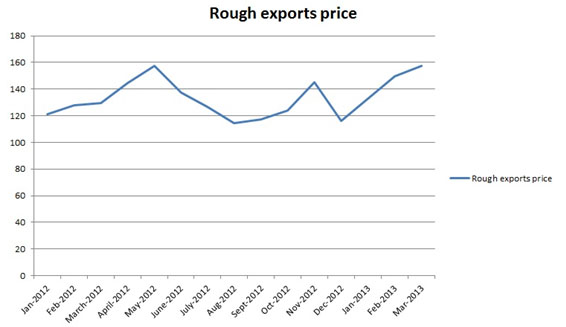
* Prepared by Rough&Polished based on the AWDC data
However, another price increase in April (estimates vary from 3% to 7%), according to market sources, resulted in "eaten up" margins for manufacturers and caused the market to pause. With a limited access to financing the market has no time to "digest" the fluctuations in rough prices. Demand for polished diamonds, however, remains quite stable, and jewelry companies report a continued increase in their performance during the last financial quarter.
Probably, we should once again expect a period of price stabilization. According to market sources, ALROSA has already decided not to raise prices at the next trading session. It can be expected that the same decision would be taken by De Beers, whose May sight kicks off this week. In any case, to increase prices right now would be an extremely illogical step for diamond miners, since it may threaten to get a drop in sales instead of growth as a result.
But steps taken by diamond miners and aspirations expressed by diamond manufacturers seem to be not enough, taken alone. In order to buy diamonds people will still need money. And it seems that it is high time for the "forces" acting in the diamond industry - now the three of them - to come to some agreement on this issue.
Elena Levina to Rough&Polished
