Have you ever experienced deja vu? A drawing sensation when it seems that you have been in this place and witnessed these events? If so, then you probably know the important feature of déjà vu: it usually does not bode well.
Looking at the diamond market, sometimes it seems that it lives in a permanent state of déjà vu. And looking at the numbers and graphs, you realize that it does not "seem" to you at all.
Again India
Articles posted by leading diamond experts this summer painfully remind of their articles published one year ago. Diamond miners should reduce prices for rough, because they are too high. Diamond manufacturers cannot buy rough and make a profit at current prices, because they are squeezed by a liquidity crisis.
The liquidity crisis was triggered by a more stringent banking policy and another weakening of the rupee in India, the country, which is cutting over 80% of global rough production, in the last analysis. To curb the rupee depreciation the Indian government once again introduced strict measures for importers, which will give effect in the foreseeable future, but it is unclear when exactly.
Consider the graph displaying the movement of the Indian rupee rate against the U.S. dollar:
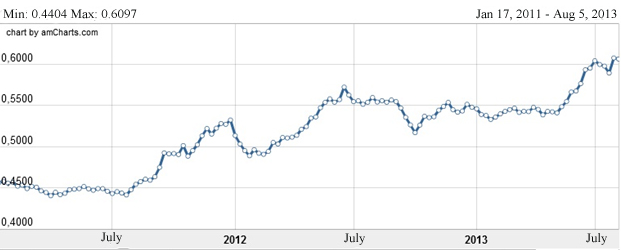
The picture of this summer repeats the pattern of the past in the same way as the texts of analysts. But what is most interesting, it repeats the picture of the year before last as well. There is no need to be an expert in macroeconomics to see the general trend in the graph movement of the rupee, and even the cyclicality of this movement.
Again prices
Rough diamond prices are playing the same game for the second year in a row. January starts at about the same price level. Then prices go up the hill and reach their peak in the spring. Next comes a dip becoming noticeable first of all in the secondary market when boxes from major producers begin to trade at a discount. The only difference is that in 2013 the peak was not in May, but in June - coinciding with the peak of rupee weakening.
Export and import prices for rough diamonds in Belgium *
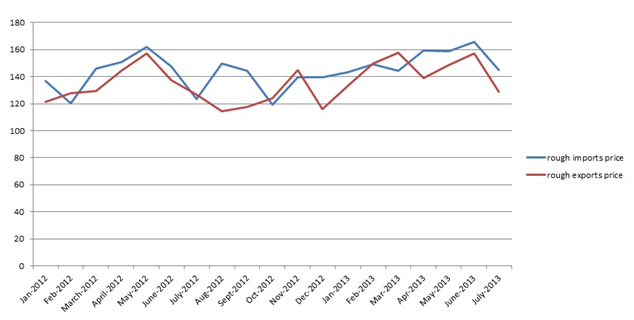
* Designed on the basis of export-import data from AWDC
Data from GJEPC on diamond imports to India in July are only to come. But right now we can assume that they will not be very positive. The results of the India International Jewellery Show (IIJS) held in early August were not too encouraging. Judging by the quotes in the media, exhibitors noted a large gap between the prices asked by sellers and those offered by buyers willing to pay. Moreover, according to media reports diamond manufacturers often preferred to buy ready-made polished diamonds rather than purchase rough and cut it losing the margin.
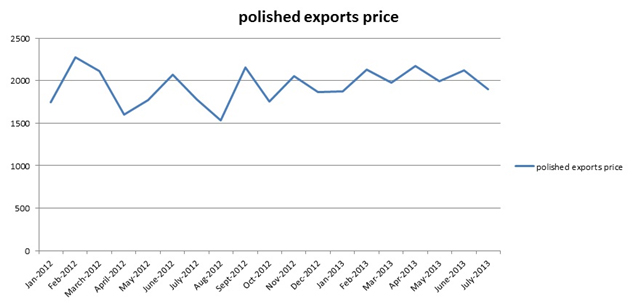
This is not surprising. The polished market is not involved in this "deja vu" and lives by its own rules, once again confirming that rough pricing is divorced from the market of final goods.
Export prices for diamonds from Belgium: *
* Designed on the basis of export-import data from AWDC
Reduced fluctuations are the only thing there is to point out. Polished prices are already not so eagerly responding to the diamond market volatility and instability of the macroeconomic situation in the world as a whole. They hold their own course, but, alas, this course is now on a downward trend. Whereas diamond experts in their analyses are already giving advice to diamantaires to learn how to sell in a falling market relying on the rules of the commodity market.
Again a dip?
If we assume that the events are unfolding in the same way as one year ago, then we are to face a not too optimistic future - meaning a dip in August prices. But there is a good piece of news as well: we've been through it already. And it seems we know that demand will gradually get stronger by the end of the year, if no one will make any abrupt moves in the market now.
ALROSA increased rough prices by an average of 6% in the first half of this year, while De Beers raised them even more, according to repercussions reaching market participants. In particular, De Beers continued to boost prices during several previous sights disguising it as "product mix adjustments." All this has led to many instances of leaving goods on the table at the company’s previous sight, according to sightholders.
De Beers sold $ 3.5 billion worth of rough in January-July this year. On the one hand, this is more than it was in the previous year ($ 3.25 billion), when the company restrained sales giving customers deferrals on payments until March 2013. On the other hand, De Beers posted a sales growth of 8% compared with last year. Only 8%, which is the same growth demonstrated by rough prices since January. De Beers is still not selling much in carat terms and maybe even less than a year earlier. So far, ALROSA does not disclose sales results for the first six months, but it can be expected that they will appear in the financial statements to be released by the company in September.
Currently, diamond mining companies are facing a tough choice. Both De Beers and ALROSA are large companies operating in the market and they cannot afford lower sales totals in the third quarter. Any rise in prices during the coming trading session may trigger rejection of goods for both.
After a bad sight in July the market is circulating rumors that De Beers is going to lower prices in August. But this will not be the best solution either. Collaterals pledged by diamantaires to banks will begin to depreciate. And the company may ensure its sales growth offering lower prices only at the expense of overstocking the market. But even that is not the point in question. If rough trading will start after the traditional August holidays with a decline, this in itself will be a foreboding to the market tantamount to disaster.
The only reasonable way out of this situation is to keep prices at current levels and maintain a responsible approach to the product mix put on sale.
Well, and apparently it would be the right thing to gradually outline the strategy of behavior for the next spring and summer - given that such situations occur with enviable regularity.
Elena Levina for Rough&Polished
