There are at least five network jewelry companies in the U.S. alone, which have driven their annual sales above $ 100 million. Half of them were established less than five years ago. Today, their jewelry and accessories are distributed by an army of tens of thousands of consultants. And for some vague reason, we do not include data coming from such companies into market research results and analysis of the jewelry industry. Here are some lessons of success in network marketing for jewelry sales.
Network Marketing, Multi-Level Marketing, Direct Selling and finally the newest thing, which is Social Selling - all these terms refer to the concept of direct sales involving goods and services offered by independent consultants dealing with buyers first-hand. This model works having at its base a pyramid or multi-level network of distributors, every one of which besides being engaged in direct sales also recruits new consultants to take part in this business. In addition to commissions for selling goods, distributors also receive incentive payments to the tune of some percentage of sales made by recruited participants.
According to the U.S. Direct Selling Association, whose membership covers the majority of companies involved in network marketing, the estimated retail sales for the direct selling channel in the United States reached $ 31.63 billion in 2012. This is 5.9% higher than in 2011, when sales totaled just a wee bit under $ 30 billion. In 2011, sales rose by 4.6% and in 2010 - by 0.8%.
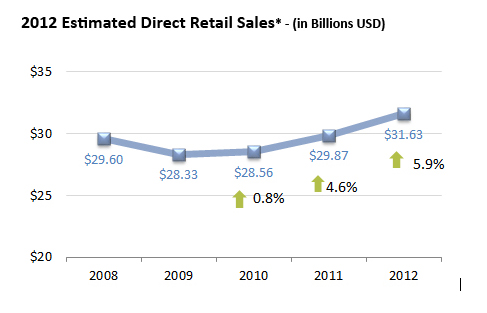 Source: U.S. Direct Selling Association
The volume of network trading may exceed the entire U.S. jewelry industry in the near future. For comparison, the total sales generated by U.S. jewelry stores are about $ 32 billion, according to IBISWorld, a marketing research company. At the same time, the annual sales of diamond jewelry in the U.S. stand at about $ 36 billion, according to the World Diamond Council.
Network Marketing provides jobs for more than 15.6 million Americans, and last year this figure rose by 1.9%. This business is definitely on the rise. According to statistics from the U.S. Labor Department, the U.S. retail formally employs about 4.5 million people. It turns out that the number of people engaged in direct sales through a network of their relatives, friends, acquaintances and others is almost 3.5 times higher than the number of employees working in stores "behind the counter."
Today network jewelry companies become a major force in the market and are actively attracting customers through direct sales, consultants and online marketing. One such company, Stella & Dot, based in San Francisco, occupies a deserving place among the top 500 fastest growing companies in the world. Established in 2006, the company earned $ 175 million in 2011 selling stylish and affordable jewelry. Its founder Jessica Herrin expects the company’s revenue to exceed $ 1 billion by 2015.
Stella & Dot is engaged in selling silver jewelry and jewelry with semi-precious stones in the price range from $ 19 to $ 350, with more than half of the collection pieces sold at $ 50 – a price affordable for everyone.
It is noteworthy that the design team of Stella & Dot is headed by Blythe Harris, who previously held senior positions at De Beers, LVMH and the Banana Republic jewelry line. Being a designer with extensive experience in the field of high-end jewelry, Blythe Harris implemented her ideas in the collection of Stella & Dot made of more affordable materials. And buyers have responded - today the team of independent consultants run by the company has more than 30,000 people.
“There is something so broken about traditional retail channels in terms of selling jewelry,” Harris said to the New York Times by telephone, apparently meaning such inevasible factors as the presence of a glass barrier between the customer and the product, the need to ask the seller to show every fancy-catching trinket and the overall formality of the situation. Besides, the store will most likely fail to offer you a glass of champagne: it is illegal to sell spirits in the U.S without a license.
But you are always welcome to have one at a house party, where you may try on whatever you like and socialize helping yourself to drinks and snacks and having fun. It’s a very pleasant "shopping experience," don’t you think? That is the model used by jewelry companies operating in the field of "social selling." They sent out personal invitations to guests, while jewelry pieces are beautifully laid out for open access where you can try them on and get advice from stylists and friends in a relaxed atmosphere.
By the way, most consultants do not carry complete jewelry collections since buying them from the company would be expensive, while keeping them not very practical and risky. Their weapons are samples, catalogs, marketing materials and online orders put right at the party.
Stella & Dot is a bright, but not the only instance of success in the rapid flow of jewelry sales. What would you say discovering a multi-million dollar company established by a teenager? Meet Origami Owl! Its creator, 14-year-old Isabella Weems, began selling her own designer jewelry in 2010 from a kiosk in a shopping mall located in Chandler, Arizona, to earn money to buy a car for her sixteenth birthday. After just two years, her company has ramified to 50 states and employs approximately 25,000 independent agents, who are called designers in the language of Origami Owl.
Comparison of retail jewelry companies and network marketing jewelry companies
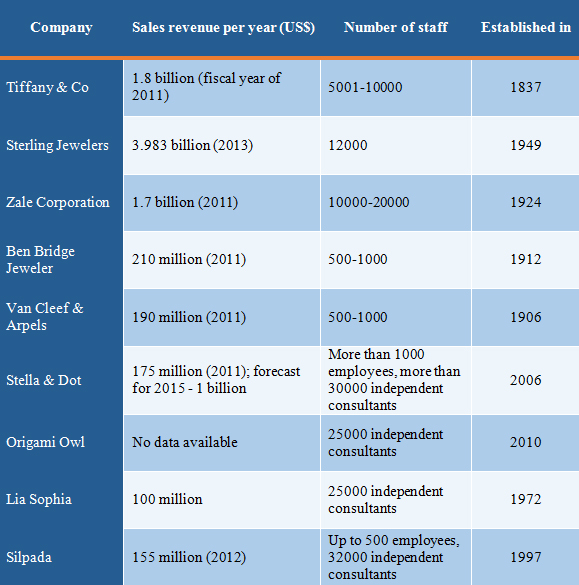
Sources: financial statement of companies, The National JobBank 2010 Business Directory, management data released by companies, LinkedIn
As can be seen from the table, most of the network marketing jewelry companies were founded recently, but were able to achieve great success because they were right in grasping what is needed by modern consumers (and over what many traditional jewelry stores are breaking their heads nowadays). Stella & Dot was created 100 years later than Van Cleef & Arpels, but it catches up with this luxury brand in sales. In addition, the rate of profit achieved by this network marketing company is likely to be much higher, because it does not have to pay for rent, equipment and personnel.
The American "diamond dream" has been steadily losing its luster for the new generation, which comes into full force and is more inclined to unique designer jewelry made of inexpensive but high quality materials. Remember the success of Pandora. An analysis of income and spending among Americans made by Idex Online proves that the average spend on jewelry declined by 3.1 percent between 2001 and 2011.
The lessons of success given by social selling jewelry companies could quite possibly help to brick and mortar jewelry stores to open new sales channels and get closer to their customers.
Olga Patseva, Editor in Chief of the American Bureau, Rough&Polished
