While discussing prospects for the upcoming IPO of ALROSA, industry and market experts largely overlook one aspect of no little importance. Just as large-scale injection of high quality diamonds to the market may devalue the already available stones, the emergence of a stake of shares in ALROSA to be traded in the public field may damage the investment attractiveness of listed miners, the major of which are Dominion, Petra and Gem.
At least, this is unlikely to go unnoticed for that part of the shareholders of these diamond miners, who used to invest in diamond producers being confident about future shortage of diamonds and rising demand for them in the market. De Beers, which is surpassing ALROSA in terms of revenue, went delisted in 2001 and investors are not spoiled by the presence of such companies in their portfolios. Despite the fact that the restriction regarding the trading platform (the IPO will take place only on MICEX) is to a certain extent deteriorating the situation for demand on the part of foreign investors, some of them may "switch camps," experts say.
However, this statement raises a lot of questions, the answers to which can help estimate the scale of such a maneuver. What categories of investors invest in shares of diamond miners? Do specialized players - jewelers and diamantaires - invest in such stocks? How much share prices are influenced by price fluctuations in the rough market? What other factors affect the movement of shares issued by diamond miners?
MULTIPLES TO COMPARE
Despite the uniqueness of ALROSA, the company is undervalued compared to listed diamond miners. According to Metropol, ALROSA will have its price to earnings ratio (P/E) at 7.3x in 2013 compared with Dominion Diamond’s 30.4x and Petra Diamonds’ 29.9x, while its EV/EBITDA will be 5.6x versus Dominion’s 6.6x and Petra’s 23.9x. Hence, the current market capitalization of ALROSA - even though it is 8 times higher than that of Dominion, the nearest listed player in the industry - may have upside potential. This is facilitated by increased liquidity (the company’s free float will increase up to 23% based on the IPO): right now the effective free float of ALROSA – not exceeding 3% of the authorized capital – is limiting the average stock turnover to $ 1 million a day.
ALROSA compared with market counterparts (according to an estimate of Metropol):
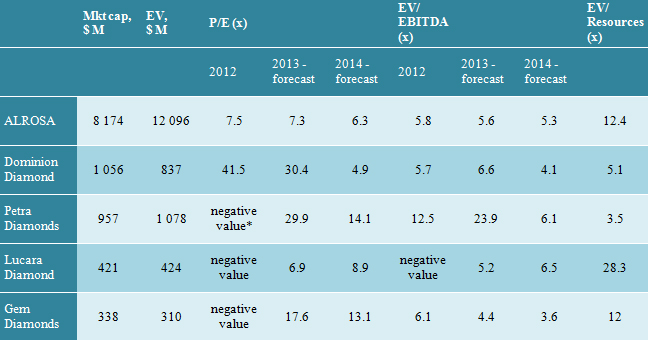 * Due to a net loss for the period
According to the BCS Financial Group, the target level of ALROSA shares is 43 rubles (a 20-percent growth to the current value at MICEX), while the miner’s market capitalization is respectively RUB 314 billion ($ 9.7 billion at current exchange rates). The range of the future IPO is 35-38 rubles per share, which means that investors can expect a minimum of 23-percent growth in equity value. It is not so much for the ruble upside, according to the BCS analysts, but nevertheless, this estimate is closer to reality and contributes to demand.
"In general, the range of 35-38 rubles suggests quite a market-agreeable valuation of the company at 5.8-6.3x EV/EBITDA, although it is somewhat lower than ALROSA’s earlier expectations voiced in the media – 7x EV/EBITDA,” Sergei Filchenkov, an analyst of Metropol, believes. “But to float a mining company in the current market conjuncture at a significant premium to the traded counterparts would be quite a problem, even taking into account its uniqueness, market share and scale."
A less optimistic estimate emerges if you proceed from the price of the 80-percent stake in Canadian mine Ekati recently sold by BHP Billiton (the transaction amount reaching $ 553 million, while Ekati’s EV/EBITDA being 6.7x and EV/production - $ 325/carat) - 262-291 billion rubles or 36-40 rubles per share (up 3-14% to the current price), according to the survey made by BCS.
DOLLAR PER CARAT
If you rely on assessments based on P/E multiples, it can be said that diamond miners are overvalued, Dinnur Galikhanov of Aton says. "Companies in this sector are greatly varying in size, resources and funds, so it is not always correct to compare them relying upon conventional multipliers. The diamond business lends itself better to comparison based on the price of the resource base (dollar per carat)," he said.
According to a recent study by Bain, ALROSA remains the most profitable producer having the largest margin – in 2012, the Russian company had an EBIT-per-carat ratio of $ 46 compared to $ 29 at De Beers and $ 17 at Dominion.
The finiteness of resources held by listed miners is theoretically amendable by a possible sale of the assets at the disposal of De Beers, Aton’s analyst said. Now De Beers is part of Anglo American, which previously offered part of its platinum and nickel assets for sale in the course of a strategic review of its portfolio. "De Beers has a sufficiently large resource base, and I guess there may be diamond fields that after analysis may seem uninteresting to this miner. I would not rule out a possibility of something coming to the market, and therefore it may be said that there is some potential for diamond miners to expand their operations," Dinnur Galikhanov said.
LISTED DIAMOND MINERS
The major shareholders of Dominion Diamond (Harry Winston before 2013) are M&G Investment Management Ltd. (19.6%) based in Britain, as well as Vanguard Precious Metals & Mining Fund (13.8%) and Blackrock (10%), both based in the United States. Dominion Diamond is traded on the Toronto Stock Exchange since the late 1980s.
The major shareholders of Petra Diamonds are Al Rajhi Holdings (13%) and Saad Investments (12%), which are both Arab companies, and T. Rowe Price & Associates (10 %) and JP Morgan (8%) based in the U.S.
The major shareholders of Gem Diamonds are billionaire jeweler Laurence Graff (15%), London-based hedge foundation Lansdowne Partners LP (15%) and the funds managed by the Blackrock Family (about 20%). The presence of Laurence Graff in Gem is perhaps the only major example of participation of relevant diamond market players in the capital of diamond miners.
The movement of market quotations for these largest listed diamond miners over the last 5 years may serve a sufficiently fair illustration of how market conditions for rough diamonds used to take their shape, although there are exceptions. Dominion, Petra and Gem reached top prices for their shares at the peak of the commodity cycle in May-July 2008 and then their equities collapsed to a record low in March-April 2009. In fact, Gem was unable to return to pre-crisis levels and now the company's shares are worth just as much as in May 2009. Dominion and Petra are more volatile: in April-July 2011, the period famous for the inflated rough prices "bubble," these producers had their stock traded at prices exceeding the levels of mid-2009 5.5 times and 6 times, respectively. At that time, Gem also went up in value, but not as fast, just doubling the price of its shares. In November and December 2011, when rough prices fell, all the three companies felt the impact on their market capitalization, and Gem rolled back to the level of 2009, from which it got out only in March and April of 2012, when the diamond market was in its best trim that year. In May 2012, the shares of all the three companies, led by the same logic, went through a series of price adjustments. And the fruits of an improved diamond market in 2013 were fully reaped only by Dominion, which by then had left the jewelry segment and focused on mining. This year, neither Gem, nor Petra could repeat the growth of 2012, when rough prices were at their highest.
DISTRACTED BY LEADER
"Outflow of investors is quite likely – in terms of its market capitalization ALROSA is greater than any of the traded companies in the sector by an order of magnitude," said Sergei Filchenkov of Metropol. "We expect that the more than a billion worth IPO of ALROSA will be in demand among investors, given the fairly good growth prospects and limited investment tools in the industry," he added.
"In theory, investors who are now holding shares of listed diamond miners can diversify their portfolios to include ALROSA,” Alexander Morin of SOVLINK said.
Oleg Petropavlovski of BCS agrees with them and believes that the floating of ALROSA shares may distract some investors in the market from smaller players in favor of the pace-setting company. "But do not forget that ALROSA will be floated only in Moscow, due to which many investors will not be able to switch their funds over to the company’s stock, even if they are eager to do it," Oleg Petropavlovski said.
LIMITATION BY PLATFORM
Indeed, even if the shareholders of listed diamond miners would want to invest in ALROSA, not everyone will be able to do it – the restriction on purchasing securities issued in the Russian Federation for many foreign investment funds will play its role, Denis Gabrielik of Otkritie said. “The IPO to be carried out by ALROSA is a very significant event for investors in the diamond mining industry, so it is possible that it will attract additional attention. But the question is whether the funds holding interest in listed diamond mining companies will have a chance to invest in Russian local equities. I think it will look appealing to them, but whether they will have this possibility is a different question."
Rather, the IPO of ALROSA and its subsequent inclusion in the MSCI index may result in an outflow of investments from Russian securities - for example, from Norilsk Nickel, Denis Gabrielik added.
The restriction effective on this platform will inevitably have its impact - investors would rather prefer a dual listing, Alexander Morin of Sovlink agrees.
INVESTORS MAY BE DIFFERENT
ALROSA and its smaller diamond mining counterparts have different investing communities, and this is why it would not be entirely correct to compare these companies, Dinnur Galikhanov of Aton said. Actually, people invest in small diamond miners in the same way as in any juniors operating across all commodity sectors. One classic example of this approach may be the strategy of the Blackrock Fund, which owns small stakes in many mining companies, including juniors, reckoning that "even if 90% of 50 or 60 companies will go bankrupt, the rest will find something and will turn 20-30 times more expensive."
For such investors the most important thing is the upside potential, not the manufactured product, Dinnur Galikhanov noted. "For those who invest in small companies, ALROSA has no great upside. At best, it can add 50% to its market capitalization in a few years – in case its efforts to launch all of its underground mines will be successful. This is not a significant potential for risk-taking investors and such an offer (ALROSA’s IPO) will not be interesting enough for them," the analyst of Aton believes.
According to him, investment funds adhering to this policy will not play to the detriment of their shares in other listed diamond miners even if they will take part in the IPO run by ALROSA.
"The big players, such as Blackrock and JP Morgan are investing almost in everything, and if they will have an opportunity, they will invest in ALROSA as well, expanding their portfolios and improving diversification in the sector. But they have plenty of inflows without it and will not at all find it necessary to sell the shares of other miners to buy into ALROSA. If they believe in the diamond sector, they will find an opportunity to cut the weight of companies from other sectors in their portfolios," Dinnur Galikhanov said.
At the same time, some part of investors putting money in diamonds and viewing them as an industry with a potentially stable level of demand may go over to ALROSA taking into account its high level of market capitalization, according to the Aton analyst.
Given an opportunity, there may emerge new investors to buy interest in the capital of ALROSA and these may be investment funds, which so far abstained from investing into this sector, said Alexander Morin of Sovlink. "The company’s higher free float and liquidity of its equities will allow it eventually to be included into the MSCI and become a "blue chip," which will attract attention from index funds ( those replicating the index structure of MSCI, as well as those using the MSCI as a benchmark),” he said.
This is also facilitated by the dividend policy pursued by ALROSA. The company may increase dividend payments to 35% of its net profit under IFRS. Now the rate is 25% and in 2012 ALROSA paid about 32.5% of its net income, excluding the revaluation of financial investments.
GROWTH DRIVERS OF DIAMOND MINERS
Perhaps, the IPO carried out by ALROSA would not have any repercussions for its traded industry counterparts, if their stock market quotes could find stronger support during the periods when diamond prices go up. But the question is, how big is the impact of diamond price fluctuations on the market capitalization of diamond miners. In other words, to what extent may investments into shares be considered investments into rough diamonds?
According to Sergei Filchenkov of Metropol, there is a relationship between the diamond prices and diamond mining companies’ stock movement, because in the final reckoning the financial performance of companies and their assessement by the market depends on the price of diamonds.
"However, the relationship is not quite straight, given the difference in the cash cost of various companies, their debt levels and output," the Metropol analyst said.
Macroeconomics and expectations for mining companies to drive up their earnings making their shares a liquid asset appear to be the most significant growth driver for their stock. "Very often mining companies are sensitive to fluctuations in market sentiment, in part because they are compared with natural resource companies, although this is not so,” says Sergei Filchenkov.
Of course, diamond miners’ stock price movement is linked to the price of diamonds, Vadim Astapovich of VTB Capital believes, but buying shares, investors take on the risk/premium ratio that is unique for each company. Buying rough diamonds is difficult in itself – one must be a customer of one of the miners.
In addition to macroeconomic factors, financial performance and diamond prices, prices are influenced by the quality of assets (region, life of mine), costs, growth prospects, operating success and failures, Vadim Astapovich said.
In his view, market-specific players rarely invest in shares issued by diamond miners, as their business is completely different.
There is no sense for diamond market players to invest in diamond miners’ stock, if they have access to rough diamonds, Dinnur Galikhanov of Aton said.
There is no clear correlation between prices for rough diamonds and diamond miners’ equities, just as there is no benchmark for diamonds - because they all differ in their characteristics, which brings about the difference in prices, Oleg Petropavlovski of BCS said.
The dynamics of diamond miners’ shares is first of all determined by corporate events, he says - for Dominion it was the spin-off of a jewelry brand and the acquisition of Ekati from BHP Billiton.
GROWTH PLEDGE
Back to ALROSA, it can be said that the value of this company will increase in the long run due to higher demand and limited world reserves of diamonds, as it is stressed by BCS in their review. The diamond fields held by ALROSA have one of the largest mine life in the industry – 18 years and the company will reach the peak of its production in 2017-2018, which is 41 million carats per year. Currently, despite the high level of capital expenditures ($ 1 billion), ALROSA has a free cash flow yield of 4-5%.
In addition to privatization, ALROSA’s market value benefits from the sale of the miner’s non-core assets, primarily gas assets, which could bring more than $ 1 billion by the end of the year. The company may complete the sale of its non-core assets by the end of 2014 and this will yield a profit and will free the company from part of its social obligations, completely focusing it on diamond mining.
The negative assessment factors include the decline in diamond prices due to the slowdown in the Chinese economy and the weakening of the Indian rupee. According to BCS, the estimate of the company’s gas assets is too high and the buyer, Rosneft, may insist on reducing the price of this deal – in this case, ALROSA will have fewer funds to repay its debt. BCS also notes that the miner’s capex in 2013-2017 may exceed the expected level - for instance, ALROSA estimated its capital spending in 2011-2013 at $ 0.5-0.6 billion, but now it is close to $ 1 billion. Costs are turning higher due to transition to underground mining scheduled for 2017-2018, BCS said.
Boris Ashkenazi for Rough&Polished
