What is the best way for a jewelry company to confirm that gold or gold jewelry, which it buys for manufacturing, retail or wholesale, is not coming from some problem-ridden riot areas, where they serve as a conflict tool and where underage workers die of hard toil in the mines? With all the abundance of regulations, standards and guidelines on how to separate "good" gold from "bad", even I, a journalist who covers the industry, have no clear vision how it can be done. So I decided to look more closely into the matter and find out what is happening to the standards for socially responsible gold.
The U.S. law on conflict minerals, the Responsible Jewellery Council (RJC), the London Bullion Market Association, the Conflict-Free Sourcing Initiative, the World Gold Council, the Fairtrade-Fairmined Producer Standards, the No Dirty Gold - Golden Rules, the OECD Due Diligence Guidance for Responsible Supply Chains of Minerals from Conflict-Affected and High-Risk Areas, the Dubai Good Delivery Standard (DGD), the guidelines developed by companies for their own use (Signet, Tiffany, Zale Corporation)… This list may be continued to infinity. All of them want to establish rules and standards for socially responsible gold supply chains from mines to jewelry stores. What path should the jewelry business follow, what kind of certification should it chase for and why?
Let's start with the basics. The Responsible Jewellery Council covers all the links in the jewelry supply chain from mine to jewelry stores, developing standards and providing certification which confirms the compliance of companies with social, environmental and ethical standards. Established in 2005 with the participation of major jewelry companies and associations, including Rio Tinto, Tiffany & Co, Zale Corporation, Cartier, BHP Billiton, RJC today has more than 450 member companies.
“RJC membership and certification are a means to credibly demonstrate responsible environmental, social and ethical performance”, RJC CEO Michael Rae said in a recent interview to Rough&Polished.
For companies involved in gold transactions and wishing to confirm the purity of its origin, RJC has developed a standard for social responsibility in the supply chain, which is the Chain-of-Custody Standard. RJC requires that members have independent auditors verify their compliance with responsible practices.
The Wall Street Reform and Consumer Protection Act, also known as the Dodd - Frank Act by the names of its developers, comes into full effect next year. Let me remind you that Section 1502 of this law obliges public companies listed on stock exchanges in the United States to submit reports to the U.S. Securities and Exchange Commission (SEC) about the use of one of the four "conflict" metals (gold, tantalum, tin and tungsten) from the Democratic Republic of the Congo, as well as disclose full information about their supply chains, including financial and tax transactions.
For companies it is not sufficient to be certified by RJC to prove the non-involvement of their supply chains with conflict metals. However, the Section 1502 rule explicitly recognizes the provision on gold within the OECD Due Diligence Guidance for Responsible Supply Chains of Minerals from Conflict-Affected and High-Risk Areas. Incidentally, RJC took an active part in the development of this document.
By and large, the OECD Guidelines are a practical instruction aid for companies on how to examine their supply chains. The results of such examination should help them to properly prepare a report in accordance with the requirements of the Dodd - Frank Act. The document containing about 50 pages explains how to identify gold sources used by refineries to produce their gold products, which are further used to manufacture finished jewelry goods and what is to be red flagged and what is not.
In fact, once such requirements have been introduced for major public companies in the United States, small and medium jewelry businesses, too, will have to comply, whether they like it not. Why? More often than not, different-scale private companies are supplying or eager to supply larger firms. And from now on, the latter will start to check all of their contractors and refuse to renew contracts if suppliers are not able to confirm that they are not dealing with conflict gold.
One telling example is Signet Jewelers, which is a well-established and socially responsible company and the world's largest jewelry retailer. In the past few years, Signet did a great job having studied supply chains and holding consultations with its suppliers to develop its own standard to determine the origin of gold, which makes part of the Signet Responsible Sourcing Protocol (SRSP). All Signet’s suppliers are to bring themselves in compliance with this protocol by the end of this year.
The SRSP protocol is also based on the OECD Due Diligence Guidance for Responsible Supply Chains of Minerals from Conflict-Affected and High-Risk Areas; London Bullion Market Association (LBMA) Responsible Gold Guidance; Dodd-Frank Wall Street Reform and Consumer Protection Act, Section 1502; and own experience of the company derived from consultations and interviews with its suppliers.
Be the way, Signet is one of the founders and members of the Responsible Jewellery Council and supports its Chain-of-Custody protocol. However, the company decided to develop its own standard for gold for some reason. Why was the RJC protocol not enough?
Signet recognizes gold only from gold refining sources certified by RJC, because this certification, according to Signet, refers only to the RJC member companies, and not to the entire supply chain.
Recently, Signet recognized a new standard, the Dubai Good Delivery Standard (DGD), developed by the Dubai Multi Commodities Centre Authority (DMCC). In this case, “recognized” means that Signet carried out an independent evaluation - at the request of DMCC - of this standard and announced that it was compliant with the SRSP protocol.
At the same time, the Dubai Good Delivery Standard was recognized by India’s Gems and Jewelry Export Promotion Council (GJPEC). In the final count, this measure should stimulate demand in the United States for jewelry made in India. Indian manufacturers will now be more confident buying gold from sources approved by the DGD, knowing that it is supported by the largest jewelry retailer in Europe and the United States, Signet. This is a gate to the American market. And in the foreseeable future, to Europe as well, taking into account the ongoing discussions on the introduction of a similar law on conflict minerals in the European Union.
Thus, by way of introducing the "American law" on conflict minerals the United States will extend its requirements almost to the entire global jewelry industry. You say you want to supply raw materials or finished goods to the world's largest jewelry market? Then be kind to track your supply chains down to metal scrap.
The purpose is good - to bring gold production to a human level, but not everyone is agree with the means. In September, the National Retail Federation addressed the U.S. government to relieve the retail trade from the requirements to make jewelry manufacturers reveal conflict metals in their goods.
The main argument of the federation was that manufacturers and retailers have fundamentally different goals. It is the task of manufacturers to know the exact content of metals in their products, while retailers who buy such products have a very limited ability to control their sources of raw materials, according to NRF.
The main question is still on the agenda: How can the industry avoid getting bogged down in paperwork, keep up business running and at the same time be efficient in barring "dirty" gold and other conflict metals from the trade.
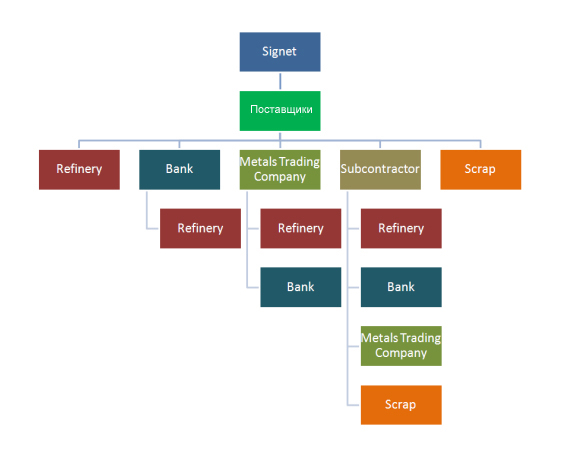
Please, have a look at the Simplified Diagram of Signet’s Supply Chain for Gold to better imagine the scale of the work needed for its examination.
Olga Patseva, Editor in Chief of the American Bureau, Rough&Polished
