The privatization and IPO of ALROSA have become a fait accompli. The sale of shares on the MICEX started with collecting bids from those who wanted to buy shares on October 14, 2013 and ended late in the evening on October 25, 2013. The so-called bid book registered bids from 71 companies. During the IPO Russia and Yakutia each sold 7% of their shares in ALROSA to investors (515,547,593 pieces). All in all, 16% of ALROSA shares were sold at the offering price of 35 rubles per share, which certainly can be considered a great success in terms of the current state of the Russian economy. Of these, the Federal Property Management Agency and the Government of Yakutia held 7% each, while a further 2% was sold by ALROSA itself through its Cyprus-based offshore subsidiary Wargan Holdings Limited. The total purchase price amounted to $1,286 million, of which Russia and Yakutia will receive $ 562 million each, whereas the diamond miner will get $162 million.
Upon the final review of the bid book more than 60% of shares put up for sale went to investors from the United States, 24% to investors from Europe (including 20% to investors from the United Kingdom) and 14% to investors from Russia, according to the internal note released by the government authorities on the results of bidding during the IPO of ALROSA. These figures are somewhat at odds with those of Yegor Borisov, President of the Republic of Sakha (Yakutia), who said in his recent interview that investors from the United States gained 50% of shares, investors from Russia 20%, investors from the United Kingdom 20%, representatives of European businesses 4%, while the rest went to investors from other countries. More accurate data are likely to appear later in the official documents of the company.
Record growth rates demonstrated by indexes of the world’s major stock exchanges, including Dow Jones in 2013, appear to be indirect evidence that the United States is gradually overcoming crisis phenomena and the global economy is slowly recovering. At the same time, taking into account the incipient recession in the Russian economy by the end of the year, it is safe to say that the IPO was carried out by ALROSA in a timely manner and at a high enough price.
The company's role in the economy of Yakutia
If we talk about the role played by ALROSA in the economy of Yakutia, it is difficult not to agree with the President of the Republic of Sakha (Yakutia), who said that this is “all what we have," and this is no exaggeration. Despite the advent of major Russian mining companies to Yakutia, which started large-scale development of oil, gas and coal deposits there, the diamond business wholly dependent on ALROSA remains to be a strategic and major contributor to Yakutia’s budget, taking into account the tax system in Russia (Table 1).
Table 1
The role of ALROSA in the economy of the Republic of Sakha (Yakutia) in the years 2001-2012
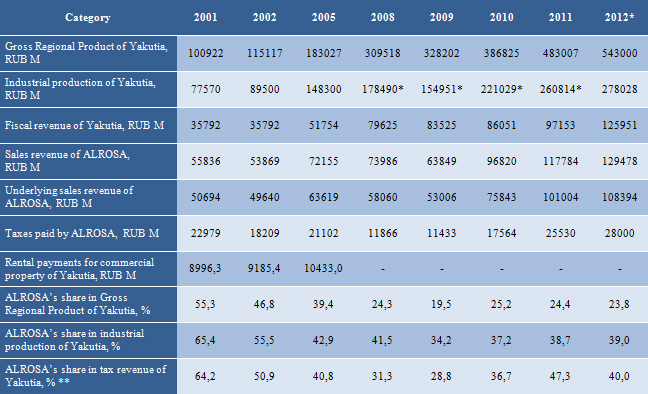
The table is based on the data provided by Russia’s Federal State Statistics Service, its Territorial Agency for Yakutia, reports and documents released by ALROSA in 2001-2012.
*According to the data from the Ministry for Economic Development of Russia and official websites of Yakutia’s authorities.
** Author’s estimation.
Yakutia’s attitude towards full privatization of ALROSA and the importance of the state component in the company's share capital
Taking into consideration the above, one can understand the position of Yakutia’s authorities, its population and leading economists with regard to full privatization of the Russian Federation stake in the company. By the order of the Russian Federation Government issued on 20 June 2012 it was stipulated that the Russian Federation would terminate its participation in the authorized capital of ALROSA prior to 2016 coordinating the sale of shares in state and municipal ownership of the Republic of Sakha (Yakutia) and providing a possibility to direct the funds from floated shares to develop Yakutia’s regional infrastructure.
Besides, the shares of ALROSA remain to be the last major asset owned by Yakutia, which makes it necessary to preserve state control over the company. And as it was shown by practical experience of recent years, it is the state support, which is able to prevent the diamond mining industry from a sharp decline in periods of economic instability and crisis in the global economy, since the main component in the price of goods produced by the diamond mining and diamond processing industries is shaped in the luxury market.
After lengthy negotiations and discussions in the middle of 2013 the authorities of the Russian Federation adopted a compromise version to preserve state control after the privatization of ALROSA’s stock (25% + 1 share for the governments of Russia and Yakutia, respectively). It is basically congruent with the predictions and proposals for the conversion of the diamond company submitted by Yuri Danilov and Yegor Yegorov, members of the Institute for Regional Economics of the North at the Ammosov North-Eastern Federal University, to Yakutia’s authorities in November 2010. In this context, taking into account what was achieved by the Institute’s Department of Subsoil Management Economics in the field of economic research of prospects for further development of the world diamond business and home-based diamond mining companies it would seem appropriate for the Government of the Republic of Sakha (Yakutia) and the management of ALROSA to conclude a cooperation agreement with the Institute and possibly place a state order for further research in this field.
Significance of IPO held by ALROSA to determine the company’s fair market value
ALROSA’s approximate market value could be previously assessed by the value of its stock traded at Russian stock exchanges after the initial company’s listing. However, given the small volume of transactions in these securities it was difficult to determine the capitalization and fair market value of shares of such a large diamond company, because all other public mining companies were inferior to it in terms of production. After the Oppenheimers sold their 40-percent shareholding in De Beers to Anglo American for $ 5.3 billion there emerged a certain benchmark ($13.25 billion) to determine the true market value of a large diamond miner. Based on this evaluation and using a comparative method of valuation, as well as taking into account ALROSA’s major economic indicators and debt obligations, Deutsche Bank and the Federal Agency for State Property Management defined its market capitalization as ranging from $9.3 billion to $10.8 billion.
However, large buyers striving to acquire ALROSA’s stock at a possibly lower price were, of course, using various ways to reduce the company’s value. Perhaps, the sale of an 0.5-percent stake in ALROSA undertaken by Suleiman Kerimov just before the miner’s IPO at the price of RUB 35.00 per share may be attributed to this kind of actions. However, the market did not panic and a further rise in stock prices during the subscription contributed to floating ALROSA’s shares at their best price, in the view of most analysts. The company’s market capitalization reached more than $ 8 billion.
The recent privatization carried out by ALROSA resulted in redistributed shares among its major stakeholders. To say that the stock of this company was not won be a big market player would be premature, because more than 20% of the currently traded shares are held by nominees and the fact that the company’s stock continued to grow in price immediately after placement is just another proof that this package is in the process of ongoing consolidation (Table 2).
Table 2
Major shareholders of ALROSA before and after the IPO
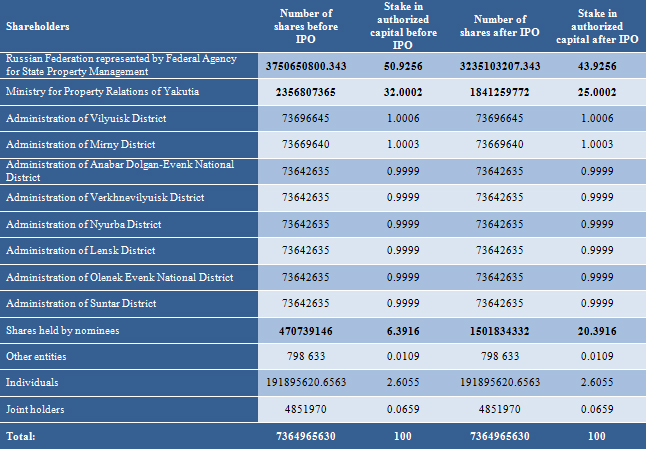
The table is compiled by the author and based on the Notes to Accounting Statements of ALROSA for the year ended on December 31, 2012.
ALROSA in the international market after the IPO and prospects for its further development
As it appears, the leading position of ALROSA after the IPO has gained a stronger footing, because unlike De Beers, which is losing one position after another in the diamond business, the Russian miner has become the largest public company by market capitalization among other diamond-mining companies in the world. It is likely that due to further consolidation of ALROSA’s traded shares by a potential strategic investor their price may rise in the near future and the company’s stock will be one of the blue chips in the Russian stock market.
The funds raised from the sale of a 2-percent stake during the IPO may be invested in research and development of new diamond deposits or in transition to underground mining at the Udachny open-pit mine and also, perhaps, to reduce the company’s debt burden in a significant way.
The successful placement of shares carried out by the company may be a prelude to future IPOs run by ALROSA Group’s subsidiaries including OAO ALROSA-Nyurba, OAO Almazy Anabara, OAO Nizhne-Lenskoye and OAO Severalmaz, which will attract significant investment funds so necessary for the Group.
Mikhail Tarasov, Doctor of Economics, Professor, Acting Director of the Institute for Regional Economics of the North at the Ammosov North-Eastern Federal University
Yuri Danilov, Director of the Department of Subsoil Management Economics, Institute for Regional Economics of the North at the Ammosov North-Eastern Federal University
