Although earlier, most of the analysts considered 4 companies as the top major diamond miners, namely, De Beers, АLRОSА, BHP Billiton and Rio Tinto, in recent years, there emerged the second-tier fast growing companies like Harry Winston (Dominion Diamond), Petra Diamonds, Lucara Diamond and others.
Dominion Diamond Corporation. In March 2013, the Dominion Diamond company (former Harry Winston, and before November 2007 called Aber Diamond Corporation) received the approval of the regulating authorities of the Government of Canada and the Government of the North-Western Territories of Canada for closing the procurement of an 80 percent share in the Ekati mine. The deal was expected to be completed in the first quarter in 2013, but it was completely closed on April 10, 2013 only. On March 26, Нarry Winston sold its luxe jewellery brand Swatch Group Ltd., as the company had taken its decision to focus on the diamond mining and it changed the name to be dubbed Dominion Diamond Corporation. The purchase of BHP Billiton business by Dominion Diamond Corporation and the possible increase in its share in the Canadian Diavik mine would contribute in the mid-term to the strengthening of its position as the largest regional market player in the global diamond mining industry.
Dominion Diamond Corporation is the largest diamond mining company whose shares are listed based on the market capitalization. The company has interests in two major diamond mines located about 200 kilometers to the south of the North Polar Circle in the North-Western Territories of Canada. The company carries out its Ekati operations through the Ekati Diamond mine (where it owns the majority 80% shares, and also it has 58.8% in the adjacent areas having promising resources), as well it owns 40% of the Diavik Diamond mine. The company supplies the rough diamonds to the global market via its sorting operations in Canada, Belgium and India and it ranks fourth in terms of value among the diamond producers (Figures 1, 2).
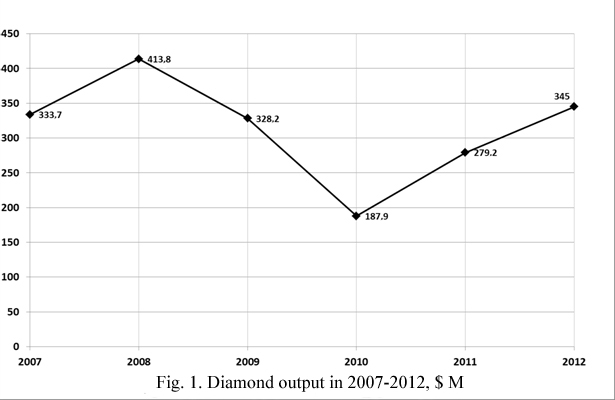
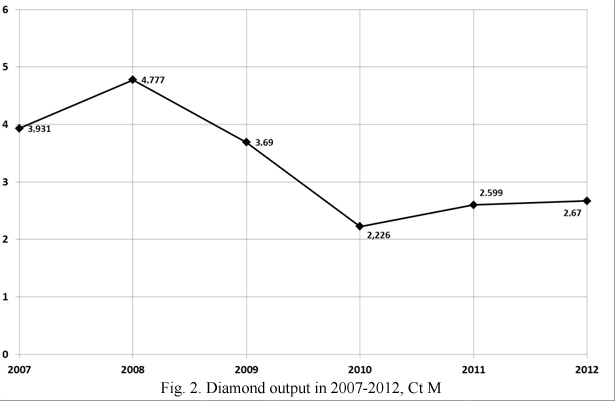 Based on the data of the annual reports of Winston and Dominion Diamond for 2007-2013.
The Dominion Diamond Corporation production structure is shown in Figure 3.
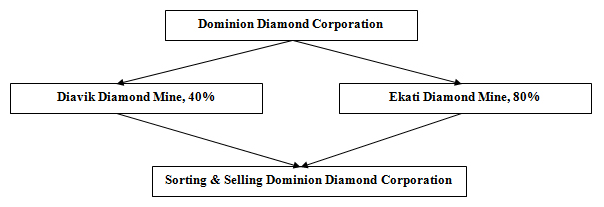
Figure 3. The Dominion Diamond Corporation production structure.
The Diavik Diamond mine is the largest diamond miner in Canada set up in 1994 and 1995 when four diamond-bearing kimberlites were discovered. The deposits are located in the remote areas of Canada on the area of 20 square kilometers near the Lac de Gras, the North-Western Territories, about 300 kilometers away from Yellowknife and just 220 kilometers away from the Polar Circle. The mining at Diavik was launched in January 2003, and in March that year, the company sold its first batch of diamonds. The Diavik diamonds are valued high on the world rough diamonds market. Most of the roughs are 1-carat or higher and are white and good purity diamonds, which makes the Diavik mine one of the significant and profitable diamond mines in the world. Dominion Diamond Corporation does not operate the Diavik Diamond mine directly. The mine is under the control of the Diavik Diamond Mines Inc., a subsidiary of Rio Tinto, one of the largest mining companies. Within the framework of the mutual agreement, Rio Tinto pays 40% of its operational profit from the diamond production at the mine to Dominion Diamond. There are three more kimberlite pipes where the diamond mining is in progress now: A154 South, A154 North and A418, they are small in diameter but have very high quality diamonds and the grade is among the highest in the world. As of December 31, 2012, the Diavik mine had 32.9 mln carats of proven reserves and 19.6 mln carats of prospective reserves, which makes the total of 52.5 mln. So, with the current production rate, the reserves mining could last up to 2022.
The Ekati Diamond mine is the first diamond miner in Canada that uses open-pit mining and underground operations. Officially, the diamond mining launched in October 1998 after extensive exploration and experimental and engineering work started in 1981. Like the Diavik mine, the Ekati mine is located in Lac de Gras area of the North-Western Territories, approximately 300 km to north-east of Yellowknife. High quality gem diamonds are mined at the Ekati mine. The biggest gem quality diamond recovered so far weighed 78 carats and it was mined in 2010 and sold at the auction in 2011. In 2011, the 50 million carats level of diamonds mined was achieved. The company owns 80% of mining output at the Ekati mine and other kimberlite pipes and 58.8% from the buffer zone (development and exploration). In the fist years, the operations were concentrated at six open-cast workings. The current Ekati output is mainly based on the ore from the pit having diamonds of high value and also on that from the lower part of the kimberlite pipe Coala and northern kimberlite pipes. Although the production in the next two years is expected to be lower than the average output for the last five years, the plans are to achieve higher production after their switching over to the shaft method and open-pit mining at the Pigeon mine where – according to the estimates – the diamond grade is higher. At present, the Ekati production plan is for the next seven years till 2019, but there are additional resources that could become economic ones with the growth of diamond prices.
Dominion Diamond Corporation gets rough diamonds through its share in the Diavik and Ekati Diamond mines. After sorting and evaluating the diamonds mined, the company sells them directly to the polished diamonds manufacturers through its sales offices in the largest diamond hubs: Antwerp (Belgium) and Mumbai (India). The company increases the revenue on the Diavik and Ekati rough diamond sales during their sorting precisely evaluating the quality of each and every gem and, consequently, the value of a diamond. The correct evaluation of the gem characteristics is the first step in the maximization of its value during sorting because each diamond is unique. Once each stone is cleaned and sorted by weight, a diamond is checked and estimated individually by the company experts using manual and advanced techniques if required. Some diamonds are valued on the basis of the shape, clarity and colour using standardized techniques and test specimens.
At present, the company does sorting of the rough diamonds in a variety of about 10,000 categories. At this stage, the diamond lots are made depending on the clients’ requirements. The Dominion Diamond Corporation experts implement their client-oriented strategy of diamond selling in the market depending on each client’s requirements. This allows to minimize the change of gems in each lot and to increase the profit due to high price per one carat.
On the whole, the prospects of Dominion Diamond Corporation to join the list of the global major diamond miners are rather high taking into account the existing potential of the diamond reserves and resources of the deposits under development and also their high quality. Already now, it has outperformed such multiproduct BHP Billiton Holding as for the diamond production, and the experts continue to consider it to be the largest due to the revenue received from other minerals production only.
Yuri Danilov, Director of the Department of Subsoil Management Economics, Institute for Regional Economics of the North at Ammosov North-Eastern Federal University
