Are diamonds a luxury, anymore? Such question is not pretentious. Yes, diamonds are still expensive, precious and rare minerals, but this might not be enough to consider them a luxury. Price is what matters to define a luxury product, and price levels have been the bone of contention in the diamond industry.
The quarrel between miners and manufacturers over price differential between rough and polished diamonds is likely to remain one of the industry’s leitmotifs in year 2014. Producing companies have repeatedly tried in to push manufacturers and, by connection, jewellers to increase price, while the latter made clear that they cannot afford to pay more for rough. Eventually rough prices went down, but nobody expect this to be the end of the story. Does this dispute have any basis? Are polished prices really below their optimal level? And if yes, how could they perform better?
An analysis of the historical trend of diamond prices would not tell us much more than we already know. What is interesting though, is a comparative analysis between polished prices and other consumer price indexes. This would tell us how diamonds are performing compared to other consumer products.
The first, most obvious comparison should be made between polished prices and the Consumer Price Index (CPI). The CPI measures price variations in products purchased by an average household. Relations between this index and diamond prices is a good hint on how diamonds are performing compared to general trends. In the chart below, we can see that polished prices (in blue) have generally performed better than consumer goods (in green). The only exception to this is 2008, the annus horribilis of the diamond business and, indeed, of global economy.
That being said, diamonds are not part of the CPI’s market basket, because they are not routinely bought by consumers. Diamonds are a luxury: a kind of non-essential, but highly rewarding product. The luxury market does not usually behave like the CPI. For this reason it requires a different index, with a different basket of goods in it. One of the most consistent indicators of luxury trends is the “Cost of Living Extremely Well Index” (CLEWI), created in 1976 by the American magazine Forbes. The CLEWI gathers price variations in a vast range of high-end products and services. The typical basket includes products like Gucci Shoes, Louis Vuitton bags, bottles of champagne, executive vehicles and spa treatments. In other words, it is the sort of index in which you would expect diamonds to be.
And yet, compared to this second index (highlighted in yellow in the chart), diamonds are not performing well at all. Polished prices were consistently stronger than the average luxury item in the pre-crisis era, but after 2007 they simply could not keep up with the CLEWI. Year after year, diamonds lagged behind the average luxury product. The unexpected 2011 surge briefly brought diamond prices above other luxuries. But optimism was short-lived, as the 2012 rebound effect dragged prices down again and furthered the gap with the CLEWI.
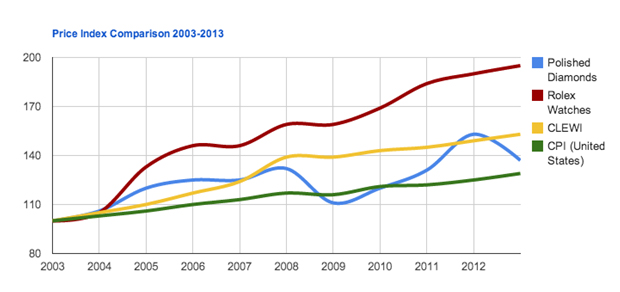 The comparative analysis between polished prices, CPI and CLEWI suggests a few considerations. The first consideration is that polished prices are not in a crisis. Not only they are keeping pace with the general price index, but even consistently outpacing it. The other consideration is that the diamond sector seems to be slipping away from the “luxury” level. Today its performance relegates it in a limbo: better than necessity goods, but not as strong as the luxury ones. A classical case of: “I am fine, could be better”.
It should be clear that prolonging the tug-of-war between miners and manufacturers would not produce any durable impact on this situation. On the contrary, it would only wear out the industry. Marginal adjustments between the rough and polished differential are natural and welcome in a healthy market, and so are small skirmishes between miners and manufacturers. But if the main objective is to realign the general trend to that of other luxury goods, then it is time to think a new strategy.
Jewellery manufacturers will not be convinced to buy diamonds at any price. For sure they will not buy something that impairs their mark-up percentage. We already saw this happening with gold: when prices skyrocketed, the jewellery industry reacted by expanding its collections of silver products, as well as by experimenting with alternative materials.
Jewellers are not the key, nor can they bear responsibility for the status of polished prices. The key is at the end of the pipeline. The key are consumers, for they ultimately decide what an acceptable price level is.
The industry can either accept a situation where consumers autonomously decide what the price of diamonds should be, or try to influence them. This means rethinking the overall attitude towards marketing and advertising.
Today we have some successful examples of what a well-conceived all-around campaign could achieve in the luxury market. One of them is Rolex. The Swiss watchmaker decided to reposition its brand and launched an extensive campaign focused on high quality, innovation, exclusivity by limiting production and sustaining prices. Rolex also linked itself with some of the most dynamic events in sports, such as motor racing and tennis Grand Slam tournaments. The results have been astonishing. In the last 10 years the average price of a Rolex watch (in red) almost doubled, outpacing the CLEWI by a large margin.
Analogously to Rolex, diamond is a luxury brand by itself. Or at least it used to be one. When De Beers dropped its iconic marketing campaign on diamonds, the brand was abandoned to itself. Of course, diamonds possess an intrinsic allure, which will allow them to stay afloat even without proper marketing. But swimming at the top of the luxury sector, that is a different story.
Matteo Butera, Rough&Polished
