Imagine that you met an old school pal, whom you have not seen for 20 years. Often, it all goes along one and the same scenario: after having talked just half an hour you realize that these 20 years brought no change whatsoever in his life and character. And he is unlikely to change in the future. Familiar feeling?
The diamond market gives about the same feeling to a person who is back to view it after six month absence.
About 2013, with disappointment
As it seems, this year was full of all sorts of events going on in the market. Demand for rough diamonds was at times slumping just to bounce back to new strengths, prices were going up and down, India’s rupee dived, diamond banks refused to work, Indian diamond manufacturers suffered from a liquidity crunch learning to adapt to new realities. Life seemed to be in full swing. But if you look at rough prices in the beginning and in the end of the year, you notice that all this flurry of activity failed to produce any result.
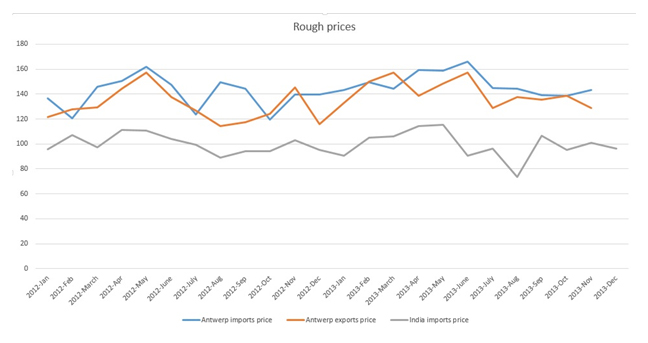 (Based on foreign trade statistics from AWDC and GJEPC)
Rough prices have been actually flat for as long as two years. Rough diamonds from producers come to Antwerp at the price of about $ 140 per carat. Some part of expensive stones remains in Belgium for cutting, while the rest is sold further along the chain at an average price of just over $ 120 per carat. The bulk of the world's rough (about 90%) flows into India at an average price of just under $ 100 per carat. Price fluctuations occur, but in a few months everything is back to normal. Not a single attempt made by miners to raise prices turned into a long-term trend.
Moreover, judging by the AWDC metrics, it is Antwerp diamond dealers who are conducive to curbing prices. Each time diamond miners increase their prices, additional amounts of rough are released from Antwerp’s stocks. Take April, for instance. In April, De Beers raised prices at their sight by 3-8 % (this movement is evident in the graph reflecting rough import prices). Antwerp imported 9 million carats of diamonds at those prices, but its exports were as high as 11 million carats. Due to the additional amount of rough taken from the stock, export prices went down by 12%. All the cases of palpable price reduction during that year were associated with the movement of stocks - in the course of just one year Antwerp’s diamond exports outpaced diamond imports by 11 million carats. One can only guess how large Belgium’s rough stocks are - in 2012, they thinned down by 16 million carats and in 2011 by 8 million carats.
About 2014, with hope
That is why market analysts' reports on the results of 2013 and prospects for 2014 are not sparkling with optimism. In January, we have actually seen a replay of the already familiar scenario. According to sightholders, rough prices at the January sight run by De Beers and estimated at $ 700 million went up by an average of 3-5%, while prices for some categories of rough rose by as much as 10%. ALROSA’s rough sales during the first trading session reached $ 350-400 million, market players said. Both companies observed feverish demand for rough with customers asking for additional amounts during the trading sessions, but their requests were not met. In this regard, ALROSA got a “helping hand” from Gokhran selling to it diamonds off schedule in December 2013, when the state purchased about $ 90 million worth of rough from the company using pre-emptive rights. As a result, boxes from both producers are now being traded on the secondary market at a premium, and all the market players expect a price hike in February as well, which is logical in such a situation.
On the one hand, higher prices at the start of the year is a familiar situation seen more than once. On the other hand, there are some implications evident on the market that may allow this price upswing to become a long-term trend rather than a short-term spike.
The key reason that prevents diamond prices from growing is in the insufficient growth in polished prices. But in recent months, polished diamonds have been gaining value at a faster pace compared to rough - maybe for the first time in two years.
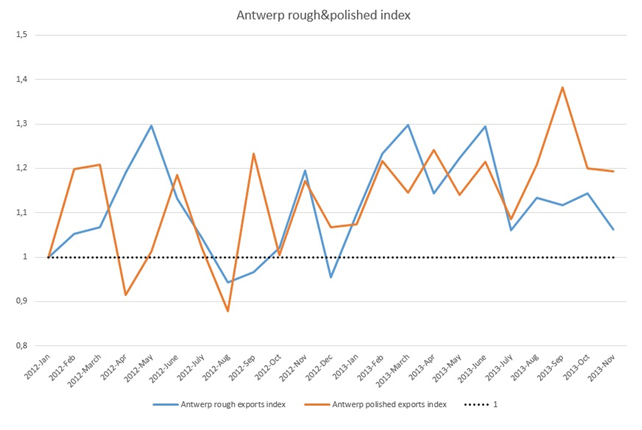 (Antwerp rough and polished index is based on the statistics released by the AWDC, with January metrics taken as the reference level)
Polished prices growth rates are outpacing rough prices growth rates since July 2013. In general, polished diamonds exported from Antwerp grew in price about 20% from 2012. Much of this growth was also supported by the efforts of Belgian diamond cutters and dealers who accumulated 0.7 million carats of polished diamonds in 2013 and another 0.5 million in 2012, according to statistics.
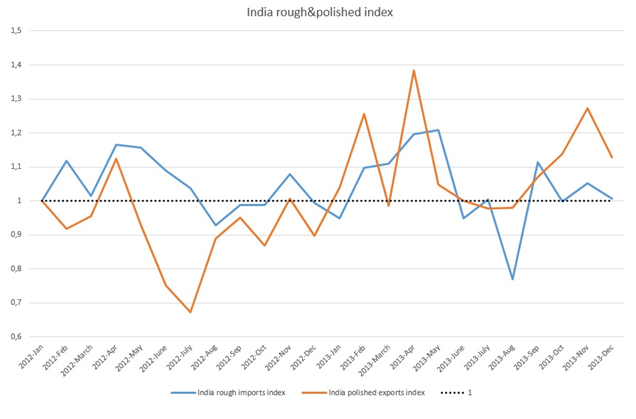 (Price index for rough exports and polished imports in India based on the statistics provided by the GJEPC, with January 2012 metrics taken as the reference level).
Similarly, prices for polished diamonds from India grow at a faster pace due to amounts of goods shipped by this country, and it is worth to go by this growth.
Confident growth in polished prices was made possible because miners were holding back prices for rough in the last 2 or 3 months. Demand for rough diamonds in the coming months will be stable regardless of the price level - there was not enough rough to satisfy everyone in the course of January sales, while there is a need to replenish inventories running low after the Christmas season. A favorable scenario today, perhaps, looks as follows: diamond prices growing moderately in February and then fixed in March. Slightly increased prices for rough will allow diamond manufacturers to maintain margins, and subsequent price stabilization will help diamonds grow in price further on.
Elena Levina for Rough&Polished
