Over the past few years, ALROSA has done much to reduce dependence on the volatility of the diamond market, but the main risk facing the miner now is not at all related to a fall in prices for precious stones. Investors are concerned about the possibility that this government-owned Russian company will be submitted to sanctions by the European Union. Such a possibility has been discussed since the eruption of the Ukrainian crisis, but so far prevailing was the faith in pragmatism, which does not allow the European Union to undermine the foundations of the world diamond market striking at the main supplier of rough. This belief is not yet exhausted, but at the same time it must be admitted that the European Union and the United States have not so much applicable leverage to put into force, which would be able to deliver a blow to Russia's economy and force the Kremlin to abandon its position over Ukraine. Meanwhile, the more you explore the possibility of re-directing the supply of rough diamonds by ALROSA, the more question marks arise.
Belgium, which hosts the world’s largest diamond exchanges, appears to be the main export market for ALROSA. In 2013, Belgium accounted for 45% of the revenue earned by the Russian diamond mining company. ALROSA, in turn, provides 33% of the world’s diamond exports. Full export ban sanctions on exports to Europe and the U.S. would have a very significant impact on global diamond prices and the structure of global auctions. Due to the large volume of exports to the European Union ALROSA, along with Norilsk Nickel, Rusal and Severstal, may suffer the most, if it fails to timely divert its supplies to other destinations, the Morgan Stanley investment bank said in its review of a possible impact produced by sanctions on the global mining and metals industry.
Meanwhile, ALROSA, as well as a number of other Russian players in this industry, will be able to diversify to other markets, primarily to China, Asia and the Middle East, in case of new sanctions from the European Union, United States and Japan, according to Morgan Stanley.
Moreover, this diversification on the part of ALROSA may entail an increase in diamond prices. In the opinion of Morgan Stanley, average prices for diamonds produced by ALROSA will go up by 6% (up to $ 190 per carat) in the short term in case of sanctions, if the company will be able to redirect its exports to Asia with dispatch.
ALROSA will be the main beneficiary from higher diamond prices caused by sanctions. According to the estimate of Morgan Stanley, each additional $ 10 per carat will increase ALROSA’s net profit by 13%. Anglo American, which includes De Beers, will get a 3-percent effect on net income in a similar situation. However, the reason for this difference lies in the fact that diamonds for Anglo are just one of the businesses it runs, while they are the main and only for ALROSA.
Still, Morgan Stanley does not believe in the possibility of a hardline scenario. “We view this scenario as highly unlikely because the US continues to be the number one diamond consumer globally and we expect it will stay number one for many years to come,” the investment bank said in its review.
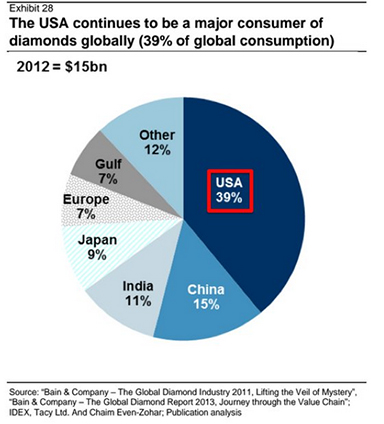 If the importance of Antwerp, which grouped together a host of the world's major diamond bourses, is unconditional and clear, then the importance of the United States, which accounted for only 9% of ALROSA’s diamond supply in 2013, is based exactly on their increasing role in shaping the global demand for diamonds and jewelry. And this appears to be another challenge to the entire scheme of a possible departure of ALROSA “to the East.” The developing U.S. market is one of the main reasons for a positive trend in prices in the diamond market this year, a source close to ALROSA admitted. The fact that there were no spectacular failures in 2014 in the United States facilitated a change in the paradigm well-established over the past few years implying stagnation in the global diamond market in the period from April to September.
And this is not the only transformation that has occurred in the market under the influence of the United States. In 2013, there was a number of signs that diamond manufacturers were turning to a smaller-size product range, but in 2014 the highest demand is for larger diamonds. “Now the market requests goods to manufacture diamonds for sale in the U.S. market, which is currently the driver of the entire diamond business,” the source close to ALROSA said.
Now let us try to figure out how much smooth the reorientation of ALROSA’s exports can be. Keep it in mind that we are talking about one half of the income earned by ALROSA, which amounted to about $ 5 billion in 2013. The opportunities to saturate the domestic market are puny – ALROSA’s customers in Russia were steadily reducing purchases during the last few years (they accounted for 24% of the miner’s revenue in 2013) losing ground to Indian and Chinese competitors due to high costs and the need to pay VAT on transactions involving rough diamonds.
The most obvious targets for ALROSA’s exports are India and China. India has been seeking wider access to rough produced by ALROSA for several years, and the number of Indian companies among the long-term customers of ALROSA is growing. However, Indian diamantaires are traditionally specialized in cutting small-size diamonds – which means that the volume of transactions with them depends on the availability of specific goods to sell. “If the share of small goods will increase, ALROSA will have to find more Indian clients to direct its goods to them. This is because there are virtually no other companies the world over specialized in processing small-size diamonds,” the above-mentioned source said. To sell high quality rough recovered by ALROSA in the Indian market, which for several years was the only place to sell Marange diamonds, would not be the best maneuver, to put it mildly, no matter which geopolitical reasons stay behind it.
There are also questions regarding China's ability to take on additional and significant amounts of rough supplies. It was noted that diamond demand in China was cooling as early as 2013. This process is due to the economic slowdown and the fight led by the Communist Party of China against consumption of luxury goods. Sales in China’s luxury sector in 2013 increased by only 2% after a 12-percent growth in the previous years. According to market participants, China's consumption this year will remain stable, at best. “China has somewhat reduced growth rates, and this was expected,” the source close to ALROSA noted.
ALROSA’s traditional customers in Antwerp are not interested to see the miner leave the European market, the source said. “Belgian diamantaires are the most faithful and loyal defenders of ALROSA abroad. They will defend the interests of ALROSA stronger than the company can defend itself in Europe. The same is true about the United States. Neither diplomats nor politicians, nor lawyers have the potential and resources possessed by ALROSA’s customers. One can only hope that these forces will be sufficient to prevent the need for export maneuvers, the economic justification of which raises questions. In this situation, ALROSA and its customers will have to take great efforts to ensure the sustainability of their business and that of the global diamond market.
Sergey Bondarenko for Rough&Polished
