In early November, Martin Rapaport, the founding Chairman of the Rapaport Group released a message addressed to the entire industry in which he expressed his deep concern about more than 100,000 overgraded diamonds worth more than $ 1 billion and about defrauded customers who bought them at an inflated price.
In a broad article carried under the title "Honest Grading," the European Gemological Laboratory (EGL) was named the main culprit in overgrading diamonds through its extensive global network of independent diamond laboratories. As a result, EGL announced the closure of some of its laboratories terminating the EGL International brand in early December. Who is right and who is wrong in this debate related to the opacity of diamond prices?
Rapaport calls overpriced diamonds, which are certified using the terminology of the Gemological Institute of America (GIA), but which are more than one color or one clarity lower than the original grade when verified by the GIA.
“The damage to the diamond industry by the establishment, acceptance and support of a culture that promotes systematic misrepresentation of diamond quality and the outright cheating of consumers destroys the diamond trade from within,” the Chairman of the Rapaport Group said.
He stressed that retailers, who directly deal with end consumers and who sell overgraded diamonds using GIA terminology and non-GIA grading standards, are at great risk. “When consumers try to resell their diamonds or send them to the GIA for regrading and discover significant quality differences, there will be hell to pay,” Martin Rapaport said. It should be added that in the United States people can sue for financial and moral damage.
According to the article, there are already hundreds of thousands of people who turned to be owners of overgraded diamonds. What will happen if they start to return their diamonds asking for refunds? “In any case, there would be significant damage to overall consumer confidence for all diamonds,” Martin Rapaport warned. “We can expect a publicly driven social media blast against diamonds, the likes of which we have never seen or can barely imagine.”
In his article, Martin Rapaport insists that there is a single system of international diamond classification and it is the classification of the GIA, which means that if their terminology is used for grading purposes then such grading should be done according to the specifications established by the GIA.
The problem is that only one characteristic out of the 4Cs - including carat weight, cut, clarity and color – can be measured quantitatively. The other three are evaluated by man and therefore subjective and differences are inevitable. Recognizing this, RapNet, the Rapaport marketplace, however, admits discrepancies by one grade higher or lower.
It is no secret that certificates issued by different labs may vary, even if the GIA standards and terminology are observed. So, if you want to have a higher diamond grade, the commonly spread - though, of course, unofficial - approach in the industry is to send your diamond to EGL or IGI, and if you need a more prestigious certificate then you turn to GIA, AGS or HRD.
This information is also available on the websites of many reputable retailers and is open to any consumer exploring the market before an important purchase. For example, the website of Shane Company, the largest privately owned jeweler in the United States, is explicitly saying that the IGI tends to grade diamonds looser in color and somewhat looser in clarity compared to the GIA, while EGL International consistently grades diamonds 2 to 2.5 total grades higher than the GIA.
The article "Honest Grading" raises many questions making to look more closely into the current practice of selling diamonds to consumers. I wonder why the article does not discuss big brands, which are also using the terminology of GIA for independent evaluation in their own laboratories and issue certificates on behalf of their trademarks. Has anyone compared their grading results with the results of re-grading at the GIA by way of statistically significant numbers?
Take the best of the best. De Beers’ Forevermark brand, which is grading its stones independently, but using the terminology of GIA, is most likely 100% in line with the assessment of GIA. Still, customers will pay much more for a Forevermark diamond than for a diamond having the same grade, but not branded. This is because the 4Cs do not include branding, market conjuncture and many other factors that influence the price of a stone in a most direct way.
Moreover, premium brands like Forevermark and Tiffany advertise to consumers that their diamonds have unique properties and are rated on a scale above the "simplified" 4Cs, being added such evaluation criteria as symmetry and precision of cut.
The only problem is that when the consumer, confident that all of these additional "upgrades" in a diamond increase its value, will try to sell his or her stone, its value will be assessed using the good old 4Cs and such a seller will probably get as much as for a non-branded diamond with the same characteristics and a GIA certificate. Does it mean in this case that the buyer is overpaying for the brand?
Hearts On Fire, which is another well-known premium diamond brand, often indicates the characteristics of its diamonds not exactly, but within a certain range. For example, they may identify the color as ranging from I to J, and the clarity as varying from VS1 to SI2. But turning to the terminology of GIA the difference here is reaching four grades! That is, buying some item for the same price you may get a diamond having a clarity grade of VS1, VS2, SI1 or SI2 - almost like in a lottery. Can we consider this practice fair to consumers?
Let’s take another example and compare prices for similar diamonds offered by the Jared brand belonging to Signet Jewelers and by Blue Nile, an online trading platform. The Jared website offers a one-carat diamond H, VS1 having a Good Cut and GIA certificate for $ 7,900, while Blue Nile sells the same at a price of $ 5,000 and above. The difference is almost $ 3,000, and probably it is due to that Blue Nile has no offline stores, which are very expensive to maintain. Does it mean that in this case the buyer is overpaying for the opportunity to visit a store and try a diamond on?
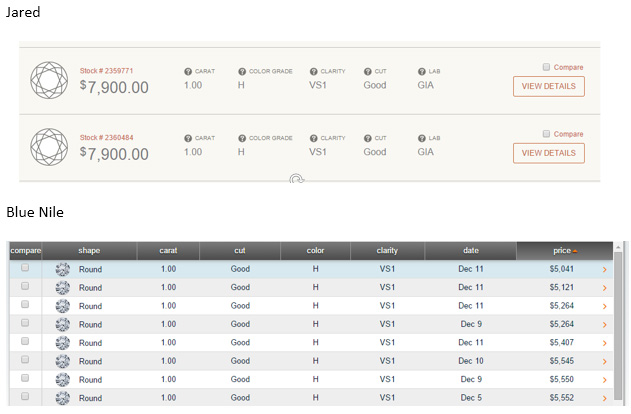
Finally, prices for a GIA certified one-carater of good cut, VS1 in clarity and H in color may vary within a range of several thousand dollars on Blue Nile. The price difference in a sample of diamonds with these characteristics available at the time of my request exceeded $ 2,500.
I asked a Blue Nile specialist for comments. "It may help you to know that we price our diamonds based upon our acquisition cost, not the size or quality of the stone like most other retailers. We work with about 40 different diamond cutters who all have their own unique pricing,” Christina, a customer support manager at Blue Nile, said. “So, you will find many diamonds with identical size and quality characteristics that vary widely in price,” she explained and assured that there was nothing wrong with the lower priced diamonds. “We just paid less for them so you, too, will pay less," Christina said. This is what is called simple and honest relations with customers.
How can you know then, who is right and what the price of our 1.00ct H-VS1 Good-Cut GIA Certificate diamond is? If the purpose of certifying diamonds is to give them a clear, fair and transparent price, these simple examples prove that the 4Cs system, unfortunately, does not offer a one hundred percent proof solution, but rather is a kind of reference book for a customer.
There is a rational seed in Rapaport’s actions aimed at having a single and universal denominator for polished prices while pursuing the noble purpose of lavishing care upon consumers. According to the opinion expressed in the article “Honest Grading,” the 4Cs classification and specifications used by the GIA should become such a universal denominator. It is because so far there is nothing better around. It seems we have reached an impasse.
The industry itself is confusing consumers - on the one hand, advertising the uniqueness of each diamond, the exclusivity of their cut and fire offered by such and such a brand. Incidentally, I have a suggestion for marketing experts to include diamond age in pricing, in much the same way as it is done for vintage wines. It is nice to know that you have a fragment of Creation aged three billion years on your finger.
On the other hand, this same industry strives to make the diamond just a commodity, which can be laid out in purely technical terms, component by component, without any trace of mystery or romance – as a tuna trunk. This is the main contradiction and internal conflict inherent to the diamond industry, which undermines consumer confidence.
Dasha Platonova, Editor in Chief of the Asian Bureau, Rough&Polished
