From 2008 to 2013, the diamond market was noted for "roller coaster" behavior, but in 2013 its trend displayed signs of balancing the trajectory and now it is on the track of sustainable growth in all the segments of the diamond pipeline, as it follows from the annual report on the global diamond industry, "Diamonds: Timeless Gems in a Changing World" released by Bain & Company and the Antwerp World Diamond Centre. The report contains the results of 2013 and the first half of 2014 across the entire diamond pipeline, as well as forecasts for supply and demand.
RESULTS OF 2013
In the past year, diamond sales increased by 2%, which pushed up the proceeds of four of the five largest diamond producers by 5 to 16%. According to the Kimberley Process, small-scale producers reduced their output affecting the results of the year.
Revenues in the cutting and polishing segment reached $ 22 billion, going up by 4%. India's contribution to this figure exceeded 60%, confirming its status as this industry’s pace maker. China has strengthened its position as a growing center for jewelry production, accumulating most of the revenue in this segment last year. The shares of Europe and the United States continued to decline.
Diamond jewelry sales rose 3%, while positive dynamics in the first half of 2014 received further impetus, according to Euromonitor. Growth in the retail sector was driven by continuously higher demand in China and by recovery in jewelry consumption in the United States. Despite fears that this positive picture could be marred in the second half of 2014, the Hong Kong Jewellery & Gem Fair held last September proved that sales in the pre-festive period could produce a positive yield.
Prices for rough and polished diamonds underwent adjustments since their peak in 2011, demonstrating a moderate growth in 2013 and in the first half of 2014 in line with the long-term historical trends. Prices for different categories of polished goods grew at different rates, with small stones significantly outpacing larger ones. For example, prices for diamonds 0.3 carats in size increased by double digits, while prices for those weighing 1 carat and more fell by 3.4% in 2013. Such a disparity in prices continued in the first half of 2014 – diamonds under 1 carat rose in price by 6.4%, while larger stones were losing their value further.
The United States, China and India appear to be the world’s three leaders in the global diamond jewelry market.
WHERE IS THE MARGIN?
Distribution of profits among the segments of the diamond pipeline in 2013 remained unchanged.
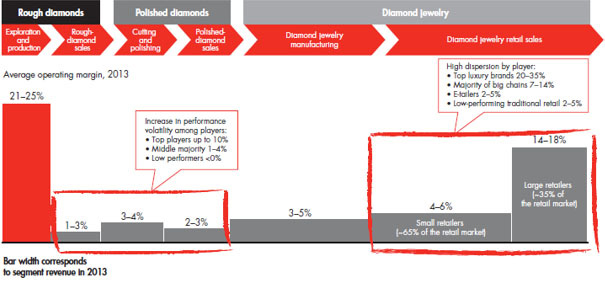
Jewelry retail stakeholders account for the bulk of profits in the diamond pipeline - a little less than half of the total. The margins earned by retail players are strongly differentiated, varying from 20-35% gained by luxury-brands to 2-5% gained by online sellers and small brick-and-mortar stores. On average, large retailers have a margin of 14-18%, while their small-scale counterparts (making up 65% of industry players) managed to secure 4-6%.
The retail group in terms of profit is followed by miners, who account for almost a quarter of the profits in the diamond pipeline. Margins in diamond mining reach 21-25%. Growth in profit margins in this segment can be explained by higher production on the largest diamond fields, assortments changed to include better quality stones and operational improvements.
A complicated situation is observed in the cutting and polishing segment. Although the operating margin in this segment and among traders is maintained at an average level of 1-4%, it is more diversified than before. On a background of rising labor costs, real estate and fuel prices, petty diamond cutters declare zero profitability or losses. On the contrary, several major players were able to increase efficiency and take advantage of the existing trends in the diamond market driving their margins to 10%. Basically, these are large integrated companies operating in the middle segment, making polished diamonds and jewelry.
MINING
In 2013, global diamond production reached $ 130 million carats, having increased by 2%, against 4% in 2012.
The major part of growth was contributed by Russia - 3 million carats. This was due to ramped up production at the Aikhal underground mine (which reached its nameplate capacity), higher diamond grade at Yubileynaya, as well as because ALROSA bought Nizhne-Lenskoye. Production in Australia increased by 2.5 million carats due to expansion of Rio Tinto’s Argyle mine. Botswana also added 2.5 million carats to its output due better performance of Debswana.
The Democratic Republic of the Congo and Zimbabwe decreased their production by a total of 7.4 million carats. Diamond placers in these countries tend to deplete and they have to switch over to more expensive underground mining.
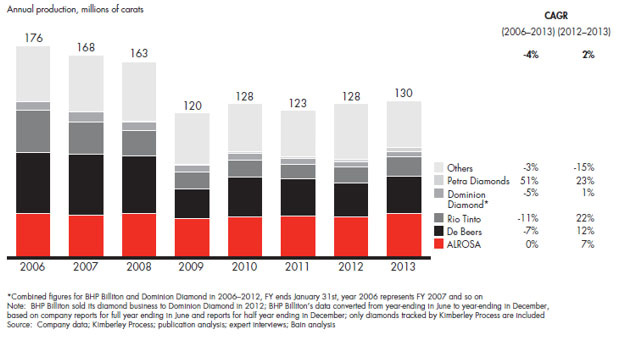
Despite the fact that the average increase was moderate, all the five largest diamond producers maintained higher output, while three of them increased it by more than 10%. ALROSA was once again the leading miner in this group having produced 37 million carats (an increase of 7%).
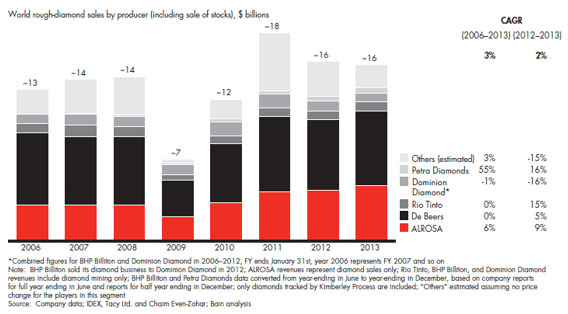
De Beers, having increased sales by 5%, remains the leader in terms of revenue. The five largest diamond-mining companies accounted for 85% of the revenue earned across the industry. Petra Diamonds marked the greatest growth in revenue (16%). Rio Tinto’s diamond unit gained a 15-percent higher revenue after commissioning an underground mine at Argyle. ALROSA’s earnings went up 9%. Dominion had a poorer earnings gain sliding down by 15%, which was comparable with the results of other miners.
Progress of the largest diamond miners changed in the first half of 2014. ALROSA’s output went down by 7% due to the scheduled shutdown of the concentrators at the Aikhal and Udachny mining units. Rio Tinto and Petra Diamonds decreased their growth rates to 2% and 4%, respectively. Dominion Diamond production increased by 7%. De Beers maintained a 12-percent growth due to higher performance at Venetia facilitated by the recovery after flooding and by increased production at the Jwaneng factory.
PROFITABILITY RATING OF COMPANIES
Revenue growth and higher prices for diamonds led to an increase in profitability of all the major producers, both in absolute terms and by price per carat factor.
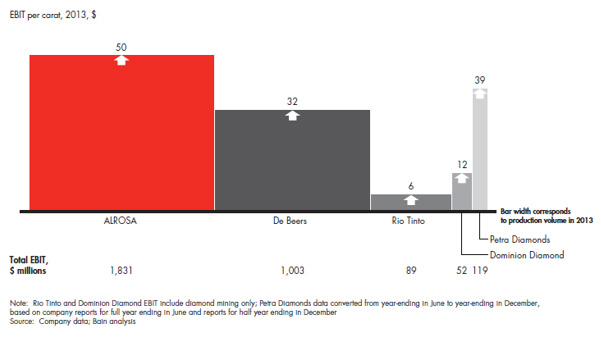
ALROSA is still leading the pack in terms of EBIT ($ 1.83 billion) followed by De Beers ($ 1 billion). ALROSA is also ahead in terms of earnings per carat ($ 50), the second place being held by Petra Diamonds ($ 39), but not De Beers ($ 32). Dominion Diamond and Rio Tinto lag behind demonstrating modest $ 12 per carat and $ 6 per carat, respectively, though this is a positive result, given that one year ago they had negative numbers.
The trend for higher profit margins continued to be maintained in the first half of 2014.
The main risks currently facing diamond producers include depletion of reserves, environmental problems, higher operating costs and social responsibility (the latter being related to the beneficiation program run by De Beers and focused on employment and development of diamond cutting business in Africa, as well as to possible development of this sector in Russia under the auspices of ALROSA).
DIAMOND CUTTING
The diamond-cutting sector started to demonstrate growth in 2013 after a dip in 2012 - its total revenue reached $ 22 billion, up 4%. The growth is based on the performance of India, which has strengthened its position by increasing its revenues by 12%. China was moving in the opposite direction and reduced revenues by 6%. India turned a neat winner helped by two factors, which were lower production costs due to technological improvements and the outflow of rough from China. Indian banks continue to maintain liquidity in the industry, while tighter funding in Europe, Israel and the United States is forcing market players to reduce purchases. It turned out to be costlier to cut smaller diamonds in China than in India, and besides Chinese companies have limited options to raise funds.
Companies based in Belgium, Israel and the United States reduced their sales by 2% in 2013, which, however, is much better than the 8-percent drop that occurred every year since 2006.
At the same time, Bain notes the increasing trend to change the historical limitations, which until recently prevented Indian and Chinese diamond cutters from being engaged on a broad scale in processing high-end rough, which was almost exclusively the privilege of their colleagues from Europe, Israel and the United States. Technological development and improved skills enable Indian and Chinese companies to compete in the market dealing with larger and more expensive stones. This logic of events forces the "traditional" manufacturers to revise their business patterns, because the gap between the associated production costs continues to widen.
The diamond-cutting segment is facing three major challenges, which are the continuous improvement of operational efficiency to mitigate the pressure on margins caused by rising costs for raw materials; financing; higher requests on the part of jewelers asking mandatory certification for diamonds purchased from manufacturers. The introduction of strict regulations, such as Basel III, is forcing banks, which used to finance the industry, to reduce credit lines. Fears of "synthetics" penetrating jewelry prompt higher demand for certification, which increases the processing time in diamond manufacturing.
JEWELRY NETWORKS
Bain points to three significant trends in the jewelry retail market highlighting recycling of polished diamonds for further use; a growing share of online retailing; and the desire on the part of the largest retail networks to integrate into diamond mining.
Recycling is becoming attractive to a growing number of retailers, and is gaining popularity in the United States. Even some of the largest retailers now practice buying diamond jewelry from their customers. Through the International Institute of Diamond Valuation (IIDV) De Beers is running a program with a limited number of retailers in the United States, the purpose of which is to assess the effectiveness of resale and study the conditions in which these operations will be more beneficial to the consumer. This activity, in addition to strengthening the position of Forevermark, can enhance transparency and increase liquidity in the market. After a surge in recycling during and immediately after the financial crisis, the turnover of such transactions decreased and is now estimated at $ 1 billion.
Online stores, such as Blue Nile, and online auction platforms like Amazon.com, Alibaba.com and eBay are strengthening their positions in jewelry sales, which is logical on the backdrop of a growing share of e-commerce in general. Currently, online trading in the United States accounts for 13% of total jewelry sales. This process opens up new prospects for the diamond industry, but also promises certain challenges. On the one hand, online trading is an additional sales channel; on the other hand, greater transparency in prices and expanded assortment of goods pose a threat to traditional retailers, allowing customers to compare diamonds and diamond jewelry quickly and easily. Furthermore, this business has lower operating costs. Probably the online channel represents the greatest threat to small networks with opaque jewelry pricing.
Over the past few years, fashion retailers, including Tiffany & Co. and Chow Tai Fook, expanded their operations in the diamond pipeline diversifying into diamond cutting and polishing. Chow Tai Fook recently opened a fourth diamond cutting facility in Botswana. Signet Jewelers, one of the largest jewelry retailers in the United States and United Kingdom, acquired a diamond cutting company in Gaborone. Despite the fact that their own businesses are so far able to meet a small part of these retailers’ needs, this trend is a very important step for the industry. The sector saw several major deals closed in 2014. Last May, Signet announced the completion of the deal to buy Zales, which resulted in significant consolidation of this network operating in the U.S. market. Chow Tai Fook acquired Hearts on Fire, a manufacturer of expensive diamonds promoting its own brand.
In general, China has strengthened its leading position in the segment of jewelry production, taking into account that such major players as Chow Tai Fook and Chow Sang Sang continue to consolidate diamond manufacturing and jewelry production with retailing in order to better monitor the efficiency of their operations and ensure their reliability.
FORECAST
Global diamond supply will grow by an average of 3.5-4% to 2019 and then decline by 1.5-2% in the period to 2024 as a result of aging diamond fields and transition to underground mining.
According to the Bain report, supply will reach 163 million carats in 2019 and will be below the pre-crisis diamond output, which was 177 million carats in 2005, but fell to 163 million carats in 2008.
As estimated by Bain, demand for rough diamonds will grow by an average of 4-5% per year over the next ten years. In particular, diamond consumption in the United States will continue to increase following the trend established over the last few years. Diamond demand in China will double by 2024 spurred by the expansion of the middle class, urban population growth and a sharp increase in personal wealth, promoting sustainable high growth rates in the diamond jewelry market. There is a revival of the economy in India, and it is projected that by 2024 the number of middle class there will increase 2.8 times, due to which the jewelry market will grow by almost 10%.
Bain believes that the gap between supply and demand in the global diamond market will reach 5 to 6 percentage points by the beginning of 2019 and will increase due to reduced supply of diamonds and higher demand for them as a result of higher well-being and more numerous middle class in both developed and developing countries.
Sergey Bondarenko for Rough&Polished
