Do the world's diamond exchanges have a responsibility to help create business for their members or is it each to his own and the survival of the fittest? According to the trade fairs that have been held at several of the world's diamond exchanges over the past two years or so, it seems clear that they strongly believe the bourses have a role to play in helping to create trade.
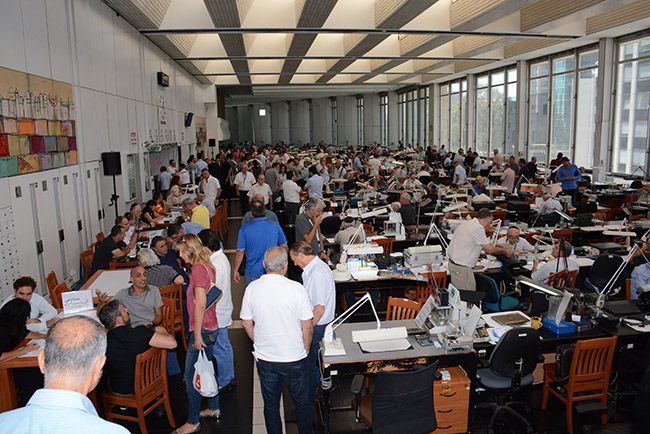
The latest such event was held at the Israel Diamond Exchange which held its second 'Blue and White' polished diamond fair in the rough diamond trading hall on October 28. The first show took place on July 15 and the IDE plans to organize the events on a regular basis.
Unlike the IDE's International Diamond Weeks which are held twice a year and feature buyers from across the globe, but especially from bourses in New York and Antwerp, the exchange's 'Blue and White' events are a purely internal affair.
The aim is relatively simple, to encourage IDE members to display their goods in the Trading Hall and for members in general to come and see what's on offer, and create a business environment, said IDE President Shmuel Schnitzer.
The latest 'Blue and White' polished diamond fair had been a reasonable success, Schnitzer commented, adding that in the current global market conditions nobody should expect to see exceptional results.
"We saw diamantaires who never usually come down to the rough diamond trading hall coming to look around in order to get a better idea of what's happening in the market and what was on offer. It's ironic that diamond companies who take part in the fair and those who are just looking around often do business with each other at this fair, and at the International Diamond Week. Even though they may have offices on the same floor or just a few floors apart, they almost never come across each other," Schnitzer said.
"This is very typical of the modern way of doing business. Even though we have a large and well-equipped trading hall, people prefer the comfort and convenience of their own offices. As a result, they rarely visit the hall to do business. But a fair such as this one brings people together and creates a lot of interest. I am not saying that huge amounts of business were done and that an event like this can turn the situation around, but it has a positive effect on morale, it puts people together and increases peoples' awareness of what is available. We need to also remember that these events are provided free of charge to members who exhibit. This is one way that the management of the bourse is trying to act for the benefits of its members."
Meanwhile, Yoram Dvash, the Chairman of the IDE's Industry Committee, whose company, Dvash Diamonds exhibited at the fair, was also positive about the outcome of the show, saying that it served to create a sense of action and community. "We all know that the market is difficult both in Israel and every other trading center. One show is not going to turn the market around, but if it brings about positive contacts, then it has value."
Not everyone was positive about the trade fair. Indeed, several company representatives surveyed felt that the fair, while being a good idea and having its heart in the right place, would not make much of an impact.
"We took part because there is no cost and very little effort required," said one company owner who requested anonymity. "Will it make any difference to the amount of business we do? I doubt that very much. There was some foot traffic at the beginning, but from just after mid-day it turned quiet. Just about everyone we saw at the fair are people we already know, so the likelihood of anything coming of it is pretty minimal.
"But I don't want to be negative because the move has to be applauded. The management is thinking of ideas to bring about some movement. It is cost-efficient and aims to bring people together."
Another diamantaire displaying goods at the event also said it was important to keep an optimistic perspective of the fair. "Nothing is easier, especially at times such as these, than to be cynical and say that nothing has been achieved. It is true that not many people were doing business. But it gave us a chance to meet and exchange information. That kind of thing sometimes brings about changes in the way you do business or where you are selling because it can make you re-evaluate your trading patterns. That is important because we tend to get stuck in our ways and not think about reaching out in new directions."
Clearly, the polished diamond fair has a value, less in terms of transactions and business and more as a morale-booster. Does it do any harm to walk the floor of the trading hall and spend several hours holding discussions with counterparts? There is an obvious advantage in that business information or intelligence can be gleaned.
And as many diamantaires pointed out, this information can often be useful at a later date in pointing businesses in a different direction.
By our Israel correspondent Abraham Dayan
