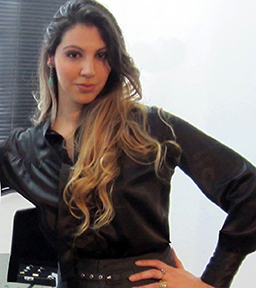
 Ali Pastorini, the newly appointed Vice-President of the World Jewelry Hub and senior vice-president of the Panama Diamond Exchange, answered questions from Rough & Polished concerning the prospects for the development of the diamond and jewelry markets in Latin America, as well as the key issues of the global diamond industry.
Do you agree with the statements that the share of synthetic diamonds in the global diamond market is growing steadily? Do you see this as a threat?
The fact that synthetics’ share of the diamond market is expanding is self-evident, given the fact that they started from almost nothing several years ago and still certainly are in a growth phase. But extrapolating that they represent a major share of the market is far-fetched. Nonetheless, they are certainly a factor in the marketplace that has to be taken into consideration.
Because they can be confused with natural diamonds, it is imperative that synthetic diamonds be properly disclosed, and under no circumstances be mixed into parcels of natural diamonds. That not only is deceptive behavior that will be sanctioned by the diamond exchange, but it is also probably be grounds for criminal prosecution.
Tell us, please, about the achievements of Latin American jewelry designers.
It is worth noting that Latin America is a massive region, encompassing 20 countries and 23 islands, each with their own heritage, history and cultural legacy. Jewelry has been produced in the region for literally millennia.
So I would caution against pigeonholing all designers in the region under one category or label. There is a wealth of a talent, working in a wide range of a disciplines and styles. What is a true though, is that to a large degree their exposure has been limited, and it is only recently that a larger number of local designers are becoming better known outside of South America, Central America and the Caribbean.
While quite a few Latin Americans became household names in the fashion industry, like Óscar de la Renta, Carolina Herrera and Manolo Blahnik, in jewelry the process has been slower. But today, with spring-boards like the World Jewelry Hub and Panama Diamond Exchange, they are be-coming more accessible in the international markets.
I have personal knowledge of the process. Several years ago I established with a partner a jewelry brand in Brazil called Del Lima, producing both high-end and more commercial items, containing gemstones and diamonds set in 18K gold.
Today, our products are sold not only in Brazil, but also in the United States, the United Arab Emirates, Panama and France, and for that work I was named earlier this year as one of 2015’s top 10 women entrepreneurs in Brazil, by the prestigious Guia do Empreendedor publication, which publishes a list each year.
What diamonds are most in demand among jewelers in Latin America?
There is a market for the full range of goods, but with the growing strength of Latin America’s middle class, and the increasing tendency to favor diamonds as op-posed to alternative items, it is reasonable to believe that the standard fair will be round cuts in commercial qualities and sizes. That is not to say that there are no markets for larger diamonds, fancy colored stones and fancy cuts. All those niches exist. But the fastest growth is occurring in the midstream of the market.
Who are the main buyers of jewelry in the region?
The two largest countries in the region are, of course, Brazil and Mexico, and it was about two years ago that Mexico replaced Brazil as Latin America’s most valuable luxury product market.
But there are a number of countries rising quickly in terms of luxury product consumption, with Colombia possibly being the most prominent. Indeed, I recently saw figures that indicate that it may be moving into the number two spot.
On the more informative experiences that I have had over the past several months have been the roadshows that we have organized to various Latin American markets on behalf of the members of the Panama Diamond Exchange. They have provided the opportunity of meeting with representatives of the jewelry industry and seeing first-hand the rapid growth and increasing sophistication of the various national markets.
I see great opportunity in many of the places we visited in addition to Mexico, Brazil and Colombia, including Chile, Peru, Bolivia, Ecuador and the Dominican Republic, where they are catering not only to fast-expanding local market but also to the tourist trade.
Do you see a decrease of the demand for diamond jewelry in Latin America?
I believe we are seeing exactly the opposite, and I feel that the role being played by the Panama Diamond Exchange is key. For a long while, diamonds played second-fiddle to other colored gemstones in region, in part because they were less readily available.
But today, with the platform being provided by PDE, we are seeing greater demand both for loose diamonds and diamond jewelry.
Do you agree with the view that global demand for diamond jewelry this year is likely to stop growing and will be almost at the level of the previous year, due to the slowdown in the Chinese economy and the strengthening of the U.S. dollar?
According to De Beers, last year diamond jewelry sales passed the $80 billion mark for the first time, so consequently, even if growth is stagnant, it is would be a gross exaggeration to describe the market in purely negative terms. It is also worth noting that the slowdown in the Chinese market, which reduced sales growth, was offset by the rise in the value of the U.S. dollar, particularly during the first half of the year.
China is a maturing market, and is under-going evolutionary change. We must be patient. Goldman Sachs, in a report released last month about the diamond market, said it expects average polished prices to de-cline about 3.4 percent this year versus 2014, and then to hold steady in 2016.
In Panama, we take the longer view. At the World Jewelry Hub, we are overseeing an infrastructural project, and consequently are less concerned about short-term fluctuations, both up and down, and more in the long-term prospects for the market.
And there we are most positive. Almost all indicators suggest that demand will out-pace supply over the coming 10 years, and will inevitably lead to a strong appreciation in the value of the product.
What is your attitude towards the practice of mixing synthetic and natural diamonds?
As I stated earlier, under no circumstances should we tolerate any mixing of natural and synthetic diamonds. It is a deceptive and deeply unethical practice.
What do you think of online shopping jewelry?
Online shopping is now a permanent fixture on the commercial landscape, and is an integral component of business in the 21st Century. So we need to develop the tools and procedures required for trading online, and so do the brick and mortar stores.
How fair, do you think, are the prices offered by diamond miners? Do they need any correction?
Clearly, with De Beers and Alrosa cutting prices in recent months there has been a correction. This, in and of itself, shows how the market has matured. In years gone by, the thought of leaving sight goods on the table was practically unthinkable.
I believe that it is best that the market set price levels. It is not up to me or any other pundit to say what is correct. When rough diamond buyers feel that that they can earn a decent profit on the prices being offered, and as a result the situation stabilizes, then we will know that the full correction has taken place.
Is there interest for Russian diamonds in Latin America?
Most definitely, and we are confident that the Russian industry will play a critical role in the growth of the gem and jewelry industry in Panama, and as a result in Latin America in general.
During a recent visit to New York City, I had the opportunity of sitting down with several representatives of companies in Russia, and they expressed deep interest in using the trading platform that we are establishing in Panama as a base for their operations in the region.
From a marketing perspective we are planning on stepping up our activities in Russia, and we are planning an official trip to Moscow during 2016.
Alex Shishlo, Editor in Chief of the European Bureau, Rough&Polished
