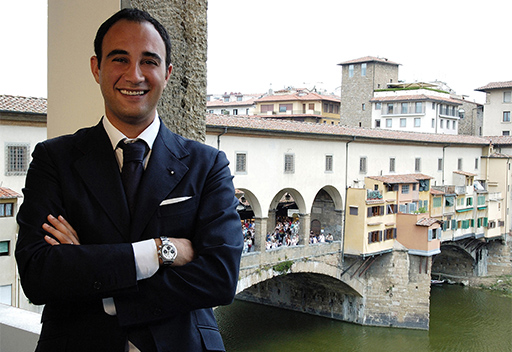
 The theme of innovation has been a central one in the diamond industry. While everyone seems to agree with the fact that innovation is crucial for the business, few companies have come through with revolutionary ideas. Among them is Amin Luxury, a company based in Italy and New York. Rough&Polished asked Bobak Nasrollahi, CEO of Amin Luxury, about the company's strategy and his personal views on the diamond industry.
Mr Bobak, could you please tell us something about the history of Amin Luxury?
I come from a Jewish family, three generations into the diamond business. We come from ancient Persia, from where we had to leave years ago. I grew up with diamonds all around me and this business is in my DNA. At some point, around 12 years ago, I felt that buying and selling diamonds was not enough for me. I felt that there was something more that I could do. Therefore, I decided to change my way of doing business and, from being a trader, I became an entrepreneur. Having a particular attention to details, I began reflecting on what lessons I had learned during my previous experience and came to the conclusion that the diamond retail sector was lacking in something.
Being a supplier for some of Italy’s big jewellery brands, I decided to go and study how they were promoting diamonds at the retail level. At that time many jewellery shops were exhibiting diamonds in a plastic box, with a handwritten note taped on them reporting the diamond specs. Aesthetically speaking, the packaging was horrible to look at. These people already knew me as the guy who was selling them diamonds, so I began to provide them also with professional information tools, like short videos explaining the 4Cs and zircons on a rotating display stand to show the effects of light reflections. Jewellers began to develop a “diamond area” in their shops, which made their business look more professional. I wanted to give them the right tools to explain the product.
You mentioned packaging. What did you do about that?
In the last ten years we saw an increase of sales for loose diamonds. Italians have a long standing tradition for giving gold as a present for baptisms, confirmations and graduation ceremonies. When the price of gold began to rise around 10 years ago, people started to look at diamonds, even just a small one, as a precious gift to make on such occasions. As a first step in that direction, we realised a blister package with a red ribbon, so that the product looks beautiful enough to be sold as a self-standing gift.
 Then you decided to launch the “Happy” line. Can you tell us a bit more about it?
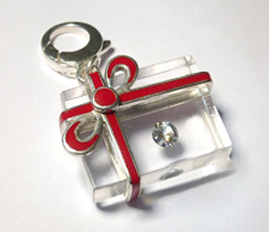
Blistered packages had a strong limitation in that they could not be worn every day. All you could do was putting them on display or lock them inside your drawer. Therefore, I decided to develop a product that would allow our customers to decide whether they wanted to wear it or not. We miniaturised the product and enclosed the diamond into a transparent resin component. This allow the stone to be visible at 360°, something which is not possible when a diamond is mounted on a jewellery piece. This product can be used as charm, with a bracelet or pendant. Following this, we realised the “Happy Love” version, meaning a version containing a heart-shaped diamond. Finally, we launched a black-ribboned version for men, to be used as cufflinks.
Can you explain us what the “Diamond Luxury System” is?
We have had an economic crisis for several years now, and our sector is suffering. I was looking for a way to help jewellery retailers. Now, suppose you want to buy a 1 carat engagement ring and you go to a shop to view some of them. You would expect the retailer to show you a selection of at least 7-8 rings, so that you can pick the one you like the most. Eight one-carat diamonds are huge cost for him. So what I did was developing a jewellery design that allows stones to be rapidly changed. A jeweller can easily transfer the diamond from one ring to the other and show it to the customer. Later on, we developed this idea into a full parure. In this way, the owners can transfer stones from earrings to pendants, rings or bracelets at home by themselves. Therefore, not only the jeweller can save money by buying less stones, but he will also have a loyal customer, who will go back to his shop and buy new jewellery pieces or stones that are compatible with the Luxury System.
You have also been developing a new cut: the “Da Vinci”. What are its characteristics?
I have always been fascinated by the golden ratio, which is also known as “the divine proportion” because it is often found in complex natural structures, from sunflowers to star galaxies. Leonardo da Vinci, who widely used this system in his drawings, was a master in combining mathematics and beauty. One of Leonardo's pupils, Luca Pacioli, wrote a book titled “De Divina Proportione”. The final part of this book contains a series of polyhedrons of different shapes. Starting from these polyhedrons, and with the help of an expert cutter, we realised in 2006 the first version of Da Vinci diamond. The diamond has a pentagonal table, presenting a peculiar star-like shape. When we first compared it with cuts that are widely available on the market, we realised that not only our diamond had more fire, but it was also shining whiter than its actual colour grade. On its final version the “Da Vinci” has 57 faces, so that we can directly compare it with other more common cuts and show that it's simply better.
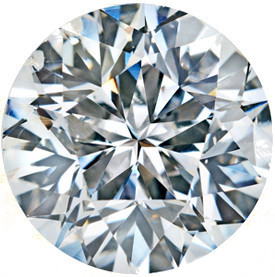 In 2015 we held a world premiére in Vinci, Leonardo’s town of birth, and we are organising some joint events with the Leonardo Museum. We also signed a deal with sightholder Niru Diamonds, with a view of commercialising the “Da Vinci” on a global scale.
The Da Vinci is not the only special cut in your collection…
Correct. In the last 10 years we saw an increase of around 70% in the number of new diamond cuts being developed. I wanted to understand why, and came to the conclusion that this is because in the world there are some customers who already have everything and do not know what to buy. New cuts give them a chance to find something different, something that nobody else has. That is why we also decided to differentiate our offer by acquiring exclusive distribution rights on some newly developed cuts. I work in Italy, which is the land of creativity and innovation, and I thought that by presenting this kind of products to our master goldsmiths, I would have been able to stimulate their creativity. We are talking about high-end, very exclusive products.
And finally there is the “Diamond Luxury Memory”, which aims at bringing together diamonds and technology.
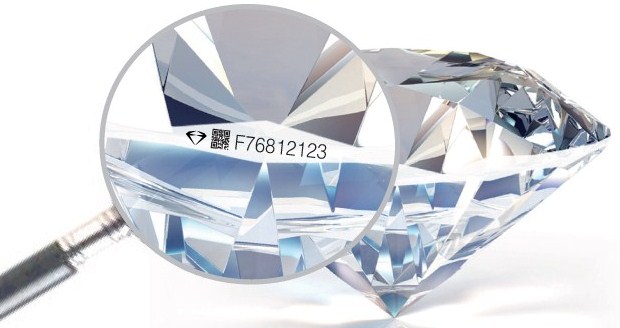
One of my unrealisable dreams was to shoot a light beam through a diamond and be able to project a moving image out of it. With the help of technology, we were able to do something similar. It's called “Diamond Luxury Memory”. What we did was inscribing a QR code and an unique serial number on the diamonds’ girdle. The diamonds are sold with a magnifier so that our customers are able to see them whenever they want. Then, we developed an app that allows smartphones and tablets to read the QR and show information on the diamond, including its certificate. This provides both a guarantee of the authenticity of the diamond and a proof of ownership in case of theft. More than that, customers can add a personalised short video, like a wedding proposal, to be played through the QR code. People usually buy diamonds for special occasions in their lives, and my idea was to capture that moment forever inside the stone. Finally, on this year’s VicenzaOro, we presented a new high-tech packaging system. When the box is opened, it activates a beam which projects the film you created for your fiancée or wife. What I really like about the Diamond Luxury Memory is that we were able to bring together the world of technology and ours, which is centuries old.
Do you think that younger generations are less interested in diamonds?
It is true that today's younger generations are not as interested in diamonds as the previous ones. For the generation that came straight out of the Second World War, diamonds were above all a status symbol, a way to show that these people were living a successful life. But I believe that nowadays women still love diamonds, and they do because they are beautiful.
Today young people are always on their smartphones. They are bombarded by all sorts of information and it is very hard to catch their attention. I know that, when they look at a shop window, I have no more than three seconds to make them interested in what they are seeing. I believe that our products are going in that direction. We should also consider that most of the young customers have limited financial resources. This is why our product range starts at around .25-.30 carats. A young man can walk into a jewellery shop for Valentine's day and be happy to find something valuable in his price range; and if the jeweller is smart enough, he will have made of him a customer for life.
Does the diamond industry have a marketing problem after De Beers cancelled its generic advertising campaigns?
Well, of course the more diamonds are publicised, the more everyone can benefit. But I do not think that that kind of advertising is essential. Let me remind you that diamonds are a classical product, which is centuries old. People certainly don't need generic marketing to remind them how precious diamonds are. Today customers are more informed, and want to know more about diamonds, and therefore advertising should aim at giving them more information.
Effective marketing is also about giving people the right product at the right time. If I had developed the Diamond Luxury Memory idea ten years ago, it would have looked like it was coming out of a Star Wars movie; but if I had waited another ten years, it would have looked prehistoric.
What is today's biggest challenge for the industry?
Today the industry has become static, robotic. It's all about the Rapaport list, about wanting to trade diamonds like we trade metals. What I am trying to do is the opposite. My father used to tell me: “Bobak, our job is to bring happiness into the people’s homes”. I consider this to be a great privilege. We want to bring emotions back into the life of two persons and we do that by personalising their love message, which is a very modern, very contemporary idea. We have technology, and we have our old, precious world. Being able to bring them together is what fascinates me.
Matteo Butera, Rough&Polished, from Italy
