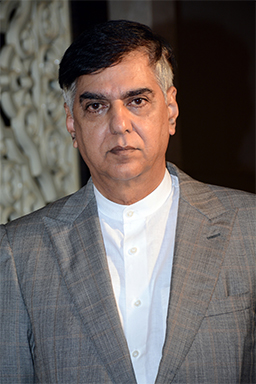
 Having been through a stint earlier as Chairman of the Gem & Jewellery Export Promotion Council (GJEPC) of India from 1996 to 2000, Praveenshankar Pandya, the recently elected Chairman of GJEPC, comes more than well-equipped to head the Gem & Jewellery Export Promotion Council of India (GJEPC); and steer the now distressed Indian industry, which is going through its most difficult time, back on the fast track.
A qualified Chartered Accountant, Praveenshankar Pandya is a Director of the Shankar Group of Industries. He is also the founder Chairman of Diamond India Ltd. (DIL) from 2002 to May 2013 and presently a permanent Director of DIL.
Praveenshankar Pandya is associated with the Indian gem & jewellery industry in various capacities - as Chairman of the Gem & Jewellery National Relief Fund; trustee of the Friends of Tribal Society member of the National Board of Trade set up by the Ministry of Commerce & Industry, GoI; Director of the Indian Institute of Gems & Jewellery; and many more humanitarian and Charitable causes.
Here, in an Interview with Rough&Polished, Praveenshankar Pandya elucidates on the numerous challenges before the Indian gem & jewellery industry; throwing light on areas that need to be redressed; Council’s initiatives to bring back the industry to its robust condition and more…
Difficult times for the Indian gem & jewellery industry – plagued by multiple problems and hurdles seem to be weighing down on the industry, going by its export performance in recent times. Can you throw some light on the steps taken by GJEPC to bring the Industry back on track?
The current scenario of the industry is the result of two factors which can be classified as external factors and internal factors. The external factors that have affected the industry is the slowdown in major consuming markets like China and Europe, which led to low demand for diamond and diamond jewellery. The industry will see a revival in trade only after there is improvement in the economic condition of these countries and see an improvement in demand for our products.
The internal factors that have been affecting the industry are the imbalance in rough and polished diamond prices and policy related issues. The establishment of IDTC in Mumbai, India, is an achievement for the industry. But currently, we have achieved only 50% as the government has permitted only diamond viewing in SNZ. This will be achieved in totality only after sale of diamonds will be permitted, otherwise the trade will lose a lot of money due to auction as prices will be hiked up.
Other than this, the industry has already drawn the attention of the Government of India to put back the industry on track. Some of this issues include:
- Introduction of presumptive taxation scheme for diamond industry
- Inclusion of gems and jewellery sector under 3% interest subvention scheme and Merchandize Exports from India Scheme
- Bridging the gap of 2% import duty between gold bars and Doré bars to ¼%
- Re-start of replenishment scheme thus providing a huge relief to jewellery sector
Though recent reports of polished diamonds prices going up is making news, on the whole the Indian diamond industry seems to be hard hit with stagnant/low polished prices, high rough prices, slowdown in most of the consuming markets, high inventory of polished stones and a host of other problems. How are all these stumbling blocks being addressed? Do you see any ‘light at the end of the tunnel’, in the near future?
We will have to wait till the storm passes. Although we address the internal issues like high rough diamond prices, we will have to wait till there is an improvement in economic condition of the major consuming markets and see a demand for our products. All the stakeholders need to be positive about the revival of the industry, hopefully by end of the 2nd quarter of 2016. By then the industry should be ready to meet the demands by solving all internal issues. Also by then I expect all the stakeholders would have come together to support generic marketing of diamonds as a category.
With no or less demand from most consuming markets across countries, India seems to be looking towards the US market for sustenance, but is not very satisfied. Are the Initiatives taken by the Council in the US showing positive results? Do you see a turnaround in the US market in the coming months?
USA is a significant market for the Indian industry, and has started showing signs of positive economic growth. Although, the 2015 was a difficult year for the Indian diamond industry, the overall exports of gems and jewellery to USA was pretty decent. The overall exports of gems and jewellery in 2015 accounted for US$ 8.73 billion as compared to US$ 8.29 billion in the previous year.
The Council has been organizing India Diamond Week in association with Diamond Dealers Club (DDC), and the fourth edition of the DDC held from 18-21 January, 2016 was a huge success. The Council, every year, participates in some of the largest, glamorous and most prestigious trade events across the world. For the 12th consecutive year, GJEPC presented the India Pavilion at JCK Las Vegas, held last year in May 29th - June 1st, 2015. These shows play a significant role not only in improving existing trade relations but also builds new ones as both the buyers and sellers get to know each other and take better business decisions.
While the efforts put in by GJEPC /BDB and other industry organizations to detect and check mixing of lab grown/synthetics diamonds in natural is widely appreciated, but general perception is that the problem is not easy to tackle, given that mixing is done by greedy and unscrupulous people who cannot be restrained or keep in check. Can we have your opinion on this please?
In our society, to maintain law and order, we have forces and institutions who keeps a check or prevent any harm to our society from anti-social elements. Still there are crimes and criminals are being punished as well. Mixing of synthetic diamonds with natural diamonds is a crime, and industry is clear that it won’t tolerate such activities as it erodes the consumers’ confidence in natural diamonds. The industry has formed Natural Diamond Monitoring Committee (NDMC) and Diamond Detection & Resource Centre in Mumbai and Surat to keep a check on greedy and unscrupulous people who involve in such activities. If we find any person involved in mixing of synthetics with natural diamonds, then strict action will be taken by the trade, as per the law and order.
Additionally, in the recently concluded Diamond Detection Expo & Symposium, the industry got to see all leading manufacturers of diamond detection machines, and researchers and scientists conducted seminars to make the industry aware of the latest technology available for detection of synthetics. The industry has kept our concern in front on them and have asked the scientists to make machines that are cheap and accessible to all.
The recent ‘overgrading’ fiasco in GIA labs in connivance with TCS staff was something that shook the confidence of jewellery consumers in a big way. Is there a solution to stem these disturbing trends, lest consumer confidence is lost forever?
I am glad that GIA handled this very well by invalidating the reports and asking to return the reports to GIA for further inspection. However, I am sure that GIA would have taken the required steps so that such things doesn’t happen in the future.
Despite the numerous machines available for detecting synthetic/lab grown stones, there’s still apprehension about the effectiveness of the machines. Another aspect is the problem of detecting such stones from studded jewellery especially smalls diamonds, to enhance consumer confidence. Your take on this?
At DDRC, we have machines that can rapidly detect Synthetic stones in parcels of small diamonds ranging from 0.01-0.20 cts in a cost effective manner. At the recently concluded Diamond Detection Expo & Symposium, we brought together all leading manufacturers of diamond detection machines; also top-class researchers and scientists conducted seminars to make the industry aware of the latest technology available for detection. During DDES, the industry has explained the problems to researchers and scientists, with a request to manufacture machines that are cheap and accessible to all.
What is the current situation in the Indian diamond industry, in terms of polished diamond prices? How has the reduction of prices of rough as well as a convenient purchasing mode for the rough buyers by mining companies affected the Indian Industry? Some sections of the industry think that rough diamonds sold with high discounts by some African countries is one of the reasons behind the polished prices softening. What are your views?
Due to high prices of rough during first half of the year, majority of the manufacturers decided to reduce the production drastically from June 2015. This step had positive effect on the polished diamond prices. Post Diwali polished prices recovered due to scarce supply of polish and demand from USA and China.
And, due to sluggish demand of diamonds and jewellery, the manufacturers asked less rough from the mining companies, which helped restrict polished diamond prices to fall further and brought stability in polished diamond prices. Miners also accommodated by allowing the sight holders to buy less rough than their allocated quota. Currently price corrected from various miners are in relevance to the current polished prices.
Globally, due to meltdown and weak economies in China, Eurozone, Middle East, the prices of diamonds and jewellery fell sharply. This forced the manufacturer of diamonds to reduce production drastically. This resulted in reduction of demand of rough diamonds, because the rough supplied by some African countries in form of tenders/auction fetched less prices. The manufacturers were able to recover some of the losses incurred during 2015.
The need for generic marketing is being discussed by global leaders in every conceivable meeting, but there is no consensus reached on the subject. Do you feel the DPA should take the initiative, so that the others in the pipeline, too, can collaborate and support this effort? What is next in GJEPC’s agenda, given that the Indian diamond industry is now going through the toughest of times?
We have “World Diamond Mark” and “The Diamond Producers Association” who are engaged in the groundwork to unlock the consumer insights that will help us to show how to engage with the millennial consumers. These associations need to be fueled with the required capital to get the desired results. It is high time that the upstream, midstream and downstream stakeholders in the industry come together and invest in generic marketing of diamonds, as there is high competition from other luxury products also. India, being the largest cut and polished market, is the most effected by the slowdown in major consuming markets. From our end, we will be doing everything possible to support this initiative. During the recently concluded IDTC inauguration function at Bharat Diamond Bourse, Mumbai, I had also asked Hon’ble Minster Smt. Nirmala Sitharaman to fund the Generic Marketing of diamonds. If we get funding from government, then it would be a great help for our labor intensive industry.
The diamond industries of Namibia and Botswana have seen their share of success, but do you see them sustain long-term growth? Is the Indian diamond industry involved in the beneficiation initiatives in these countries in setting up manufacturing units?
The Indian government supports beneficiation in African Countries and the trade has agreed to build an Indo-African Diamond Institute in Botswana under Government of India patronage.
Diamond financing has always been a bane to SMEs in the Indian diamond industry. What is the situation with the bankers currently? How is GJEPC helping industry players to meet the many challenges they are facing besides low profitability, bank finance, etc.?
Yes, hardly any SME is getting bank finances in the diamond sector. The reason behind this is:
a) In the opinion of the Council the parameters of the credit rating agencies are not consistent and somewhat not transparent and so, rating of the SMEs by such agencies are questionable;
b) Mostly banks are dependent for financing the diamond industry on ratings given by such credit rating agencies;
c) Banks are also asking for more than 100 % (sometimes 150%) collateral from the SMEs against financing, if the company somehow qualify the rating criteria.
What is the situation with the bankers currently?
Banks are hardly financing any SMEs currently. They are insisting the SMEs to go for corporatization to avail the bank financing at liberal norms.
How is GJEPC helping industry players to meet the many challenges they are facing besides low profitability, bank finance, etc.?
The GJEPC is continuously discussing with bankers to evolve with their own due diligence mechanism and consider their (banks) own internal rating of such SMEs for sanctioning the limits.
In addition, the GJEPC is also trying to convince the banks to give the % of collateral discount to the corporatized company. GJEPC is trying to pursue with ECGC so that they continue with ECIB for whole turnover policy with SMEs with turnover up to Rs.200 cr at old rates.
The council is also trying to pursue with IBA to support our contention that based on RBI directive for bearing by the banks of the policy premium for whole turnover, they should continue to bear the post shipment premium in case of Individual Turnover ECIB policies also as they serve the same purpose.
Meanwhile, GJEPC is planning to organize the Annual Banking Summit-2015 very soon to mitigate the other ongoing banking and financing issues of the industry, including the SMEs financing.
Aruna Gaitonde, Editor-in-Chief of Asian Bureau, Rough&Polished
