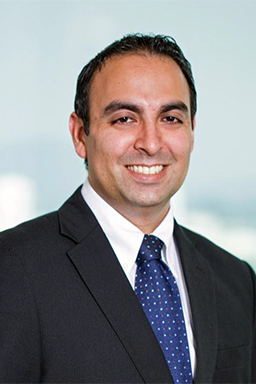
 Mahesh C Khemlani, President, World Jewelry Hub FZ (Panama Diamond Exchange) has an extensive background in business and government. He spent six years at the Ministry of Economy & Finance of Panama, most recently as Vice Minister of Finance.
Prior to this, Khemlani’s many stints include Vice President of Finance and Business Development at Optynex Telecom; a member of the Technology Investment Banking Group at CIBC World Markets; and a financial analyst at Standard & Poor's Portfolio Management Data Group; and at Grupo VerdeAzul, a private investment firm in Panama, where he is currently Chief Investment Officer.
A Finance and International Business graduate from Ithaca College, Khemlani also comes armed with a Master’s in Business Administration from Universidad Adolfo Ibáñez in Chile; and a Master’s in Public Administration from the Kennedy School of Government at Harvard University.
Here, in an interview with Rough&Polished, Khemlani talks extensively about PDE, the Latin American market, the current status of the PDE project and a host of other related issues.
It’s a little late in the day but I’d like to congratulate you on being elected President of Panama Diamond Exchange (PDE) some months back. To begin with, what are your plans for PDE for next few years, given that it is on its first leg?
As a young diamond exchange operating in a developing market, our primary mission is two-fold. First, we need to consolidate the position of the Panama, and the World Jewelry Hub in particular, as the center of the diamond, gemstone and jewelry business in the region, and second we must educate the Latin American trade as to the benefits of functioning within the framework of a dedicated gemstone and jewelry business structure, which is anchored by a recognized diamond bourse. In other markets this may be a given fact, but in a region where no bourse has existed, this is a process of learning.
I am not starting at zero, of course. Over the past year, since the opening of the first phase building of the World Jewelry Hub, we have implemented an intensive marketing and educational campaign, internationally and more specifically in South America, Central America, the Caribbean and Mexico.
Since taking office, along with my team and the leadership of the World Jewelry Hub, the business plan has been reviewed, fine-tuned, and new elements introduced.
Our outreach program will continue, with the goals of expanding our network of buyers being served by the bourse, and also the companies supplying diamond, gemstones and jewelry. One of the lessons we learned during the review process is that Panama is serving as a multi-faceted center, serving diamond trade, and also the colored gemstone trade, and the jewelry trade. We are not only a diamond center; we provide expert services to all sectors of the industry.
Membership of our diamond exchange is a critical element, and we are currently upgrading our website, adding functionality, with the objective of assisting those going through the membership process. We will roll that out within the very near future.
How do you intend to tackle the many challenges that might arise in the coming years? As a new project, will attracting international buyers be a herculean job? More so as the South American gems and jewelry market is still in its infancy?
I think it is important to correct a misperception. While all of Latin America, and not just South America, can most definitely be considered a developing market with tremendous potential, it is hardly in its infancy. There has been a tradition of gold, silver, gemstones and diamonds that stretches back many hundreds of years, and in the case of gold and colored stones most probably predates jewelry produced in Europe.
What is true, however, is that the established jewelry trade, as it was established in Europe and North America, and later Asia, was relatively under-developed in Latin America, as was the business structure. That is the vacuum that we are working hard to fill in Panama.
What is important is that, not only are we providing an infrastructure and trading environment that will help the local trade develop, but we also are creating the environment that will allow international suppliers and buyers set up shop in the region. They often were reluctant or nervous to get their feet wet, because they felt that Latin American trade was disorganized, or at the very least operating to processes with which they felt uncomfortable. Our new trading center remedies that situation.
It is widely believed that Latin America is not a member of the FATF (Financial Action Task Force on Money Laundering), nor is it bound by treaties on mutual legal assistance (MLATs); and it does not recognize court rulings of other countries. Do you see this as a convenient environment for doing business? What difficulties do you anticipate in the future?
You refer to Latin America as if it is a single judicial and legislative entity. But you are talking of a vast region with a population of about 620 million individuals, comprising 20 countries and 23 islands, all operating independently with their own governments, legislatures and judicial systems.
One of the objectives of our organization is to establish a trading environment that meets the strictest standards demanded by the trade and the financial authorities. For that purpose, there has been a strong commitment from the Panamanian government which has cooperated with the FATF for many years. I was part of this effort as early as 2013 when I served as the country´s Vice Minister of Finance.
Panama passed its first AML law in in 2000, and following that was removed from the FATF black list. In February 2014, the FATF published a report that pointed out certain deficiencies in the Panamanian regulations, and in June 2014, the FATF itself reported that the Panama made a high-level political commitment to work with the FATF and GAFILAT, which is the Latin American equivalent of FATF, to address the strategic AML/CFT deficiencies that had been pointed out.
Over the course of the next year, Panama made amendments to the criminal code, passed a new AML/CFT law, and the legislature enhanced the framework for international cooperation. This all was recognized by FATF, and the dialogue with the organization is ongoing.
Panama’s new AML law strengthens two important government institutions whose objective it is to prevent irregular transactions from taking place in the country. The first was a commission against money laundering, terrorism funding, and the proliferation of weapons of mass destruction; and the second was a financial analysis unit that will collect and analyze reports of suspicious operations.
The law also expands the number and type of entities to be supervised to include accountants, auditors and notaries, casinos, enterprises operating in the Colón Free Zone, money exchange firms, pawnshops and real estate agents, among others.
In the initial stages of the diamond hub project, people felt it was too ambitious and that ‘depending on the country’s burgeoning middle class and higher purchasing power of the population’ was just wishful thinking. Your take on this?
Of course, it is an ambitious project. We are proud of that. But we do not believe that it is too ambitious, for our plans are carefully formulated and based on an intimate knowledge of the region.
There is a mistaken belief on the part of some that our project was somehow transplanted from elsewhere, like some sort of foreign object. That simply is not the case. The group that is involved is Panamanian, and it is one of largest developers in Latin America. Over the years, it has established and developed several ambitious projects in Panama, which have changed the landscape of the country.
This project, like others before it, was undertaken after extensive research, based on models built over many years, and one of the factors definitely considered is the growing middle class in Latin America, which is associated with a rising standard of living and more disposable income.
If you visit Panama City and you see what is going on around you, you will understand immediately that this is not wishful thinking. The skyline evokes images of Dubai, Hong Kong and New York, the standard of living that can be enjoyed in the city competes favorably with that of a Western country.
How is the demand for the project faring in the regional market? How enthusiastic are they with the future growth of the gems and jewelry / diamond market in the country?
As we have learned from our road trip program, as well as from the continuously growing number of buyers visiting the complex for the first time, and by the continuously increasing volume of requests and queries sent to the diamond exchange, interest is growing fast.
It is a process and one cannot expect the number of office space buyers to increase from one to one hundred overnight.
Growth-wise there is enthusiasm, but that enthusiasm needs to put in the context of the global macroeconomic environment as well as the state of affairs in our industry. Economic times are tough in certain regional markets, like Brazil and Venezuela.
This, however, is not a short-term venture, and the market understands that. It is a long-term investment both in the physical and business infrastructure.
With Latin and South American market being just an emerging market, how does it compare with traditional markets catered by the diamond exchanges of Antwerp, Ramat Gan, Dubai, Shanghai, etc.?
As I said earlier, we are a multi-faceted complex and exchange, handling diamond, gemstones and jewelry, while most of the other centers deal predominantly in diamonds.
A person visiting the World Jewelry Hub will discover an array of companies, meeting the needs jewelers across the board. We provide a trading umbrella for a companies that are dealing in diamonds of course, but also in emeralds and other gemstones, and jewelry and watches.
It is understood that PDE has the status of a free trade zone and all transactions executed on this exchange are exempt from any customs duties and taxes. What other incentives does it offer? Do you see an influx of international businesses due to this attraction?
Just to clarify the point, the area of the World Jewelry Hub is a recognized as Free Zone, meaning that good imported directly from outside of the country, and exported directly from it, an exempt from duties and tariffs. Furthermore, companies registered in the Free Zone are not subject to corporate tax.
The Panamanian government also has enacted a series of measures that aim at enabling foreign corporations set up operation in Panama, including preferential residential requirements for company owners and their families, as well as employees bringing expert knowledge into the country.
For this reason, a large number of major foreign corporations, not necessarily related to the jewelry or gemstone business, have established Panama as their Latin American or regional headquarters. I certainly would expect to see a similar influx in our sector.
With the global slowdown being faced across countries, what are the strategies being undertaken to keep the morale high for PDE’s growth?
I think we need to keep our eyes on the ball. Economies are cyclical, although there are long-term growth trends, and that would certainly appear to be the case for diamonds, gemstone and jewelry, especially here in Latin America.
What we are doing is putting the building blocks together of a trading center that not only will sustain that long-term trend, but also will accelerate and strengthen it. We need to do that deliberately and steadily, structure by structure, member by member, client by client.
Can you brief us about the project PDE and what it offers; the current status; and is businesses already operating from there, and so on?
As of the beginning of the last year, the first phase of the World Jewelry Hub has been operating. It is a secure two story building that houses the offices of companies, as well as the administration and trading floor of the bourse. With the opening of the building, the free trade status of the World Jewelry Hub also went into effect.
The next stage is the construction and population of the tower on the site. It will be an iconic structure that will provide a long-term solution for the Latin America diamond, gemstone and jewelry trade, with ample room for growth and development. While offices in the first phase building are leased, office and commercial space is being sold in the second structure.
When the second phase building is complete, the diamond bourse will move into dedicated facilities in the new building.
To wrap up, where do you see PDE, say… 10 years down the line?
Our plans have always been ambitious. Our goal is not just to establish a complex and facility that will serve the domestic or regional trade, but we see ourselves as becoming a full-fledged world center in all its facets. The name “World Jewelry Hub” was not picked out of thin air. It indicates a vision and an intention.
We do not expect it to happen overnight, but we strongly believe that, over time, as the professional trade learns about the physical infrastructure that is being created, the fiscal and business-friendly environment that already exists, the wonderful weather, beautiful countryside, excellent standard of living, and first and foremost the growing volume variety of business opportunities, our center in Panama will take its place among the leading centers in the world.
Aruna Gaitonde, Editor-in-Chief of Asian Bureau, Rough&Polished
