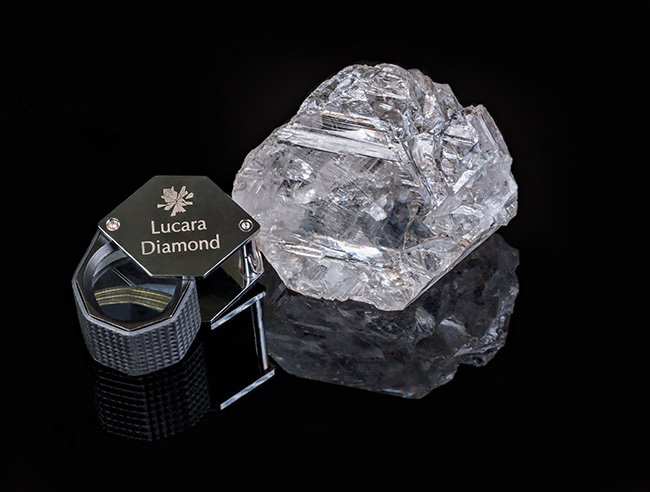
 Lucara Diamond, which recently recovered a 1,111 carat diamond regarded as the second largest diamond in the world since the 3,106-carat Cullinan diamond recovered in South Africa in 1905, is hoping to establish another mine in Botswana.
The company was awarded two high-potential exploration licences in Botswana two years ago and these licences host at least three known diamondiferous kimberlites, BK02, AK11 and AK12.
Lucara had already constructed and commissioned a bulk sample plant for the BK02 kimberlite.
Applications for the material extraction from the AK11 and AK12 kimberlites were in progress together with the mandatory permits to allow drilling on the respective sites.
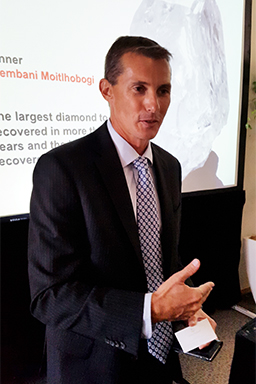
Company chief executive William Lamb told Rough&Polished’s Mathew Nyaungwa in an exclusive interview on the sidelines of a mining indaba in Cape Town early February that the recovery of the 1,111 carat stone from the Karowe mine made Botswana a target for more foreign diamond exploration companies.
He said chances were high that the company will continue recovering larger stones in Botswana, but within the range of 300 carats to 500 carats.
Lamb also reviewed that Lucara was debt free, thanks to the findings of large stones at Karowe that allowed the company to settle its debts.
Below are the excerpts of the interview:
How optimistic are you of finding larger diamonds at Karowe?
Very, and I don’t base that on just a fly-by-night answer…if you look at the statistical confidence we have got in recovering 100, 200, 300 carats and now a very large stone (1,111 carats), I think the ability to predict that we are going to have large stones in future, maybe not a 1000 carats, but large stones in the 300 to 500 carats range, is pretty strong.
How many large stones have you recovered to date since you started mining at Karowe mine in Botswana?
Our largest stone was 239 carats; it was recovered in April 2013. Since then we have recovered more than 100 stones weighing over 100 carats. Our mine is relatively small, and we produce only 2.5 million to 3 million tonnes of ore per annum recovering between 380 000 and 400 000 carats of diamonds. We expect to sell between 350 000 carats and 380 000 carats this year… Currently, more than 50 percent of our stones are larger than 100 carats.
When are you likely going to sell your 1,111 carat stone?
We are doing an analysis of the stone at the moment and we are looking at the best process. Nobody has actually sold a 1000 carat stone since the Cullinan [a 3,106-carat diamond found in South Africa in 1905] and that didn’t go through well, so we are looking at the best mechanism, how we get access to the right people. So we are looking at having the stone sold before the end of June.
Any projected price for the world’s second largest diamond ever?
Because of the historical significance, it’s too difficult to put a price on it, so my standard answer is the diamond will sell for what somebody is willing to pay for it and I think if we look at the collector side of things: if somebody is willing to own a piece of history then it maybe a high price we will get versus a standard sale.
You also have two large stones that you recovered at the same time you found the 1,111 carat stone last November. When are you going to sell these?
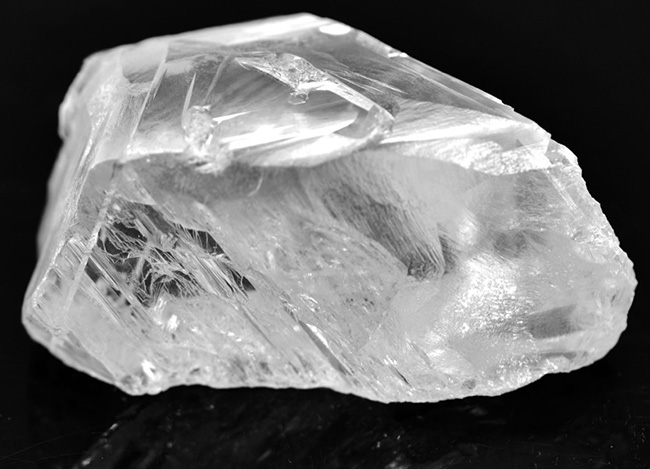
We announced an exceptional tender [on February 8] that will feature 10 diamonds with a combined weight of 1,525 carats and none of these 3 stones (an 1,111 carat stone, 813 carat stone and a 374 carat stone) will be sold as part of the tender. If you look at our balance sheet, very strong balance sheet, we are the only diamond company that has no debt. So we are not forced sellers, we don’t need to monetize the stones, so our focus at the moment is on the sale of the 1 111 carat stone and once that is done, I think it will give us a lot greater insight into the best process for ‘do we sell it?, do we polish it?, do we partner?’. There is a number of those options that we can look at.
You said you are the only diamond company that doesn’t have a debt, what is the secret behind this?
I think it’s a bit of luck, we have been very lucky with the recovery of the stones. Once we actually recovered the first stone, it was at that point that we started making changes to the process to ensure we didn’t destroy value. So when we recovered the 239 carat diamond, straight away we changed the top size of the screen to the maximum size that the downstream could handle and then we started working on where is the technology which would enable us to go to larger sizes, again to protect the value? It is through that process that we actually managed to strengthen our balance sheet and remove or eliminate our debt…
Are you weathering the storm that the diamond market is currently going through?
Yes, I think a story like this is good for the diamond world, it created a little bit more interest. If I look at the diamond market, it’s a two-barrel problem in that consumption needs to increase, you can’t continue to mine, continue to process if you are not getting money at the end of the pipeline. With the Diamond Producers Association, with the ability that they have to do some generic marketing, with the results that we saw from the De Beers marketing over Christmas, I think the model has again proven itself that marketing is definitely a requirement to drive consumption and then we can get into a better balance between supply and demand.
What is your projection of the diamond market from now going onwards?
I think it’s going to take a while, if you look at the large stones – that is fairly stable –, which is great for Lucara, but if we look at the regular stones, we see that Alrosa, De Beers and even Dominion have actually been stockpiling because of lower volume sales to the backend of last year. I think taking that into account plus the current status, even though it’s usually very buoyant this time, we do see it sort of slowing down at the backend of the year, taking a bit longer than people would like to actually get into that supply and demand fundamental, where demand is outstripping supply.
You started selling your diamonds in Botswana, what was the reasoning behind that move?
We had an agreement with the government that for the start of production, because you want to get access to as many diamantaires as possible, so for the first three years we were allowed to sell our diamonds in Botswana and outside. So we had our sales in Antwerp. We had said to the government that along with their strategy of almost building a secondary diamond industry in Botswana that we would move our sales to Botswana only and it has actually been brilliant. The sales and marketing team that we have in Botswana have really excelled. We are now seeing the same level of clients attending that has also worked for us because people are willing to travel to Botswana to buy diamonds, [I mean] serious buyers, so we actually have a very large client base and very loyal people…
Do you have any prospects of finding new diamond mines in Botswana?
Exploration especially for diamonds is possibly the most challenging ever; we do have two prospecting licences that we are working on at the moment. We would love to build another mine. We would love to see more foreign invest, more exploration in Botswana, more people hoping to do the same thing that we did. The recovery of the 1,111 carat stone is actually going to be very good for Lucara, but it could be far better for Botswana and we need to work with the government to make sure that actually comes out.
Last year in May you indicated your willingness to exit Mothae in Lesotho and Paragon Diamonds had shown interest in the kimberlite. Can you provide an update on this deal as I understand Paragon had problems raising the required funds?
So with that one the government had given us a one-year option to sell the project. Paragon told us that they had gone far down the road to bring in an investor…and they struggled to close a financing. So that option with the government expired on the 14th of December 2015 and the licence then reverted back to the government. So I know that the country’s mines minister…is looking for someone who can pick up the licence and develop it further.
Mathew Nyaungwa, Editor in Chief of the African Bureau, Rough&Polished
