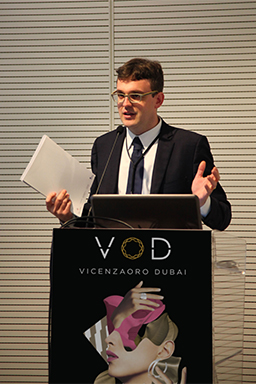
 The jewellery industry is always looking for new geographic areas to operate in, and the Arab Gulf, with its thriving luxury market, low import barriers and excellent hub infrastructures seems to provide all the right characteristics. It is therefore not by chance that VICENZAORO, Italy’s leading jewellery event organiser, chose the United Arab Emirates as a venue for its largest initiative outside Italy. Between 14 and 17 April, VICENZAORO will be returning to Dubai for its second consecutive year, with a renewed and larger exhibition. Rough&Polished discussed with VICENZAORO DUBAI (VOD) General Manager, Mr Emanuele Guido, the perspectives for this new initiative, as well as his views on the international jewellery market.
Mr Guido, could you please tell us something on how the event is being organised?
VICENZAORO DUBAI is organized by DV Global Link, a joint venture between Fiera di Vicenza and the Dubai World Trade Centre (DWTC) and it based on a cooperation agreement with the Dubai Multi Commodity Center (DMCC), the Dubai Gold and Jewellery Group (DGJG), L’Azurde, the Gem Jewellery Export Promotion Council (GJEPC) of India as strategic partners and DAMAS as exclusive retail partner. Finally the main players of the Dubai Jewellery Community with brands such as Dhamani, Lamarquise, Jawhara Jewellery, Malabar Gold and Diamonds and the 7Cs, be present at the four-day event.
Our goal is to present VOD as the unique networking platform for jewellery, gold, precious stones and diamonds on the international stage, joining some of the world’s main players in the jewellery industry and provide them with access to strategic markets.
What kind of resources and strategies can you count on?
We created a dedicated team, based in Italy and Dubai as hub destination for the luxury sector. However, we were also very keen to undertake a roadshow this year, to extend the network of our selected contacts and to provide an excellent opportunity to set up new relations with the most established buyers in the trade, showcasing new products of exhibitors who will be present in Dubai. The promotion and the road show campaign to introduce VICENZAORO DUBAI is taking place across 23 countries and 31 cities in total with a specific door to door direct visit to retailers in 13 countries, 21 cities (UAE, Kuwait, Qatar, Bahrain, Oman, Saudi Arabia, Iran, Pakistan, Bangladesh, Sri Lanka, Egypt, South Africa) and a direct tele-calling campaign providing the opportunity for VOD to reach out to top buyers from 10 countries (Nigeria, Tanzania, Kenya, Angola, Ghana, Zimbabwe, Singapore, Indonesia, Malaysia, Philippines) and discuss business opportunities ahead of VOD 2016.
Will you be focusing only on the Arab and Middle-Eastern markets?
VICENZAORO Dubai aims at being a global event and in its second edition there will be an even stronger international focus, not only on the region. As a matter of fact, one of the ultimate goals is to unite some of the world’s main players in the jewellery industry and provide them with access to strategic markets including the Middle East, Russia, Africa and Central and South-East Asia. By connecting with key players from the jewellery industry on a global level, we will provide a unique opportunity for businesses to forge collaborations with markets overseas to further strengthen their ties and networks internationally.
How many buyers will be present at the exhibition?
We are going to select over 400 buyers, twice the number from last year. This should guarantee sufficient trade volume during the fair, but we also expect these buyers to act as “ambassadors” for VOD, and spread the word about the event. Most of the buyers will be coming from Middle-Eastern and Arab countries, Africa, and Central Asia, but we also reserved some spots for Russia, China and South America. We are also inviting a particular category of semi-professional operators, which is Arab women who organize showrooms in private residences. This is a common activity in countries such as Saudi Arabia and Kuwait. This type of buyers possesses significant spending power. Finally, on the last day of the event, we will invite all jewellery wholesalers in Dubai to visit the exhibition and the show will be open to all the public.
What kind of products will manufacturers bring in Dubai? Are we going to see different collections compared to Vicenza?
Manufacturers usually try to bring new collections to Dubai, as well as a selection of their best products already on the market. There, buyers will find collections that are closer to the local taste. I would therefore exclude minimalist jewellery, as well as the use of semi-precious materials. We will see larger pieces compared to Vicenza, and mostly made in gold, diamonds and gemstones. This kind of products better suits the preferences of Arab, Russian and African customers.
Earlier on, you mentioned Russia as one of the countries for which buyers will be present. How important is the Russian market for Italian Jewellery?
On a global perspective, Russia is the fifth largest consumer of golden jewellery. Considering that Russian women traditionally like to wear several jewellery pieces and full parures, that market has strong potential. We usually divide the wider Russian market into two separate areas: European and Asiatic. The European area is mainly developed around the Moscow-Saint Petersburg axis, which attracts 70-80% of the luxury sector. That area has a rather European taste, and a large portion of high-end jewellery is actually imported from Italy, even though Hong Kong for diamond jewellery and Turkey for lower-end golden products are also relevant exporters. Today, due to well-known geopolitical turbulences, trade with Russia has decreased compared to a few years ago. The ruble is going through a phase of reduced purchase power, and this is having a big impact on mid-to-high end jewellery import. Hence, we have Italian manufacturers who used to work predominantly with Russian buyers, and are now in search of new markets to preserve their sales volume. Nonetheless, the Russian market remains of fundamental importance for Italian jewellers.
The Asiatic area of the Russian market encompasses not only vast portions of Russia, but also several Post-Soviet republics, which are strong jewellery consumers. Countries such as Kazakhstan can count on strong private buyers, on the same level as Bahrain or Saudi Arabia. Their taste is closer to that of the Arab countries, as both prefer more sumptuous pieces. It is a very dynamic area and we want to further develop our contacts there.
And what is the relationship between VICENZAORO and Russian buyers?
As said before, not only the Russian market, but all markets in Eastern Europe and the former Soviet area are crucial for us. In the short term, jewellery export may be influenced by factors such as diplomatic relations or the price of gold, but our interest is towards long-term goals.
The international situation is going to change in the future, and we want to create solid relations with our customers. This is why we recently decided to add a Russian-speaking element to our team, so that we can have a 365-days-a-year interaction with Russian buyers.
In the last years, VICENZAORO has gone through a process of internationalization: apart from Dubai, where you are directly organizing the event, you will also be present at JCK Las Vegas, Hong Kong and Mumbai. Why has the VICENZAORO brand not been able to penetrate the Russian landscape yet?
There are certainly some limiting circumstances. The first one is, most obviously, the language barrier. The second element is that jewellery events in Russia follow a different concept than ours. They are partly consumer and partly professional, meaning that they are open to the general public and tend to sell directly to customers. As a consequence, exhibitors at those fairs are usually local import companies or Russian jewellery manufacturers. The VICENZAORO model is a bit different, in the sense that we are mostly interested in working with professionals. A second limit is that of trade barriers. In the past we have had some issues in sending our material through the customs, despite that material being just printings for promotional purposes. You can imagine that, should the same thing happen with valuable jewellery products, it would be problematic.
Do you see any other possible form of cooperation?
Yes, we have been looking closely at the jewellery manufacturing sector in Russia lately. Traditionally, local manufactures have been working mostly for their internal market. Today though, we see that they are becoming increasingly interested in exhibiting their collections abroad. At the Hong Kong Gem and Jewellery Show, as an example, we saw that a Russian pavilion was launched, which means that the country is finally embracing an export perspective. This is important for us, because we are interested in providing a platform for those Russian premium manufacturers who would like to exhibit at our events.
Matteo Butera, Rough&Polished
