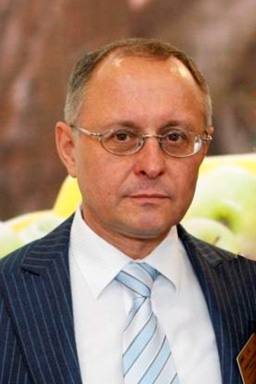
 Being a media holding in the field of jewelry and watch industry and trade, RESTEC JUNWEX combines such activities as holding exhibitions and conferences, publishing magazines, operating Internet resources and providing consulting services. It runs Russia’s largest jewelry exhibitions, offers extensive programs to promote jewelry companies in the market and takes proactive part in the World Federation of Diamond Bourses (WFDB), being one of its members. In anticipation of the spring and summer show season, Valery Budny, CEO of RESTEC JUNWEX tells about the work being done by the holding and about the problems facing the jewelry industry today in an interview to Rough & Polished.
Last year, RESTEC JUNWEX signed a strategic partnership agreement with the Russian Jewelers Guild and Russian Jewellery Trade Club. This is not the first agreement of this kind. Will it have any positive results and if it will, what may they be?
Agreements are signed and then terminated - this is life, but it is people, who actually determine everything. I have a hope that the general public has put such persons at the helm of the Guild, who are really working and thinking about the future, and I hope that now we will implement the agreement. And this is happening today. Together with Gagik Gevorkyan, Chairman of the Russian Jewelers Guild we are carefully following how our jewelers enter foreign markets – currently, we are really fully competitive in terms of prices. We have long been growing quantitatively, but now, given the current situation in our jewelry industry, and perhaps, thanks largely to our sworn friends and their sanctions, we have made a fantastic step in quality. The Russian jewelry industry mastered all the subtleties of design, all the technologies. Our leading businesses ran rings around the Italians, switching over from Italian equipment possessing ‘Italian tricks’ (meaning that such machine tools would not work in Russia without Italian setup personnel) to more modern and better equipment - from Germany and Japan... Earlier we looked upon the Italians as being the legislators in jewelry fashion and technology, but now we have mastered all this and, paying a tribute to the Italian design, we have learned to produce creative things ourselves, and even on the Chinese scale.
Tell us, please, how these sanctions affect the industry in general.
Of course, they are affect the industry significantly, despite that they are essentially political. But in fact this issue is more related to economy. Carrying our costs in rubles, we are tied to metal prices, which are still dependent on the exchange rate. Metal prices based on currency rates are pulling us back. But these same exchange rates had a positive effect. The positive impact of sanctions, paradoxical as it may be, lies in the exodus of imported goods from the Russian territory. The process of import substitution due to sanctions turned into reality. To date, jewelry imports to this country are at a minimum level. There is a very narrow range of businesses and two or three companies handling small-scale assortments, which managed to establish point-to-point services, buying things there and bringing them here to service, clean, repair and replace... The process of import substitution is really going on, and it is evident at our exhibitions that there remained very few jewelry importers in the country. Their place was taken by Russian jewelry makers. Russian stands at jewelry shows feature amazingly beautiful collections. Only five years ago there was suspicion that almost half of all the products displayed on such stands were imported to ‘dilute’ domestic goods to add them a better sparkle. This year, we took part in the Hong Kong jewelry show and the Russian national stand surprised overseas buyers taking their breath away by the showcased goods. And this was also true even with regard to technology: for example, a dispute erupted among a group of Hong Kong visitors at the stand of Alfa-Karat, some of them saying they saw such goods in Vicenza. After a long discussion it turned out that it was actually Alfa-Karat, which they came across at the Italian exhibition. Here we should also mention Sadko, a company based in St. Petersburg, which is operating high-tech equipment and managed to create a range of products enjoying demand from Southeast Asian markets. And this is in the area where there are the Chinese with their prices...
And their industriousness...
Yes, with their industriousness. But to date, thanks to the sanctions, we have not just come on a par with the Chinese in terms of labor cost per one gram of gold, but also turned in a better position. Of course, it is also necessary to recognize the negative aspects to this picture: real wages of the Chinese are growing, while the standard of living in Russia is falling... But in terms of mastery of technology and design, and improving productivity, we have grown. We produce ready-made jewelry collections quite competitive on world markets. And this can help the jewelry business grow further. And the ball is with our lawmakers at the State Duma, which, as people joke, “stopped thinking” and maybe even seeing.
Regardless of the higher dollar and euro, we are still using domestically produced rough materials, and diamonds, as well as gold shed some percent in their prices. How does this impact the position of jewelry manufacturers?
Here we have to make some calculations: for example, gold prices may fall on the one hand, but exchange rates may rise on the other, and this may offset the high cost of some raw materials. But in any case, today production has become more expensive - due to the exchange rate and raw materials depending on it... Separately it should be said about jewelry inserts: here we are at a great disadvantage. Despite all our attempts to prove to the prevailing authorities that it is unwise to suppress domestic manufacturers by taxes and customs duties levied on inserts, which are absent in Russia and imported from abroad, this got us nowhere. We pay the VAT at the beginning of the process, when we purchase metal - in many ways, of course, this reduces the margins of our business, affecting its results. But they do not hear us, though, it would seem, it is a simple thing and the whole world works differently. But the state machine is keen to attach a ‘fifth wheel’ to everything...
What is the major problem for the jewelry industry, in your opinion?
Legislation. Just think – recently, our legislators introduced amendments to the law on precious metals and precious stones, which again, as in the 1990s, theoretically put jewelers into the position of criminals, making them to choose between 14 or 15 years of imprisonment. Whatever direction you choose to go, you face a prison, no matter how hard you work... Remember the saying, “The law is like an axle: you can turn it whichever way you please if you give it plenty of grease”? So, laws are written exactly that way - not for work, not for life, but for officials. And an official armed with such laws, while checking a production outfit - in the jewelry industry and generally in any Russian business - can still nail you for criminal activity. I remember laughing a lot in the period, when the law said: “It is permitted to work without cash registers at exhibitions, except...” and the exception put in brackets included ‘’exhibitions held in covered pavilions, with booths, with lighting...” In short, everything written in the first half of the sentence was refuted in its second half. Any official could use either the first or second half of the sentence in this law and you will always be guilty, unless, of course, you will manage to appease him.
But Anton Siluanov, Finance Minister, Andery Yurin, Head of Gokhran and Alexander Markin, Head of Assay Chamber take part in jewelry forums and conferences and there are joint committees...
I'll tell you without prejudice: somehow it turns out that every official taken individually looks like a normal person. But taken together, they seem not to hear and see the people. I was once speaking to a forum in Ufa and ventured a joke from the rostrum that together they look like a herd, and got an applause, including from government officials - each of them is a good person, but taken separately. Apparently, they need a good shepherd.
Recently, the peak of sales came to its end – it was the most lucrative and active season. What do you expect from this year as compared with the previous one?
We have recently exchanged views with the participants and visitors of the latest exhibitions, and the experts of RosYuvelirExpert conducted their traditional surveys and we see that buyers’ interest towards precious gifts is not lost. But consumer demand has changed - of course, everything depends on the ability to pay and the size of the purse, which is not so big. Therefore, people request silver, ‘lightweight’ gold and new tech things: for example, silver with gold plates, hollow chains, other products - airy, impressive in size, but very light jewelry. Of course, today there are very good synthetic inserts and visually beautiful Swarovski crystals. This is the range of goods which is popular. Of course, people also buy expensive goods. In a poor country, the rich are only getting richer, so this segment has become a bit reserved, but, nevertheless, expensive products are being sold. We have lived through a period when we were growing quantitatively, and today we are growing qualitatively – not only in terms of quality, but also in terms of money. We sell less in kilograms and tonnes. Unfortunately, we have decreased our production by weight twice as much against 2008 and consequently our sales went down as well – this is an interdependent process. But we sell more by value in rubles, although any economist or businessperson may call me a layman, because it is difficult to consider business in rubles when this business is tied to the exchange rate.
The situation is complicated, but life goes on. Maybe you need to remember a phrase of one famous contemporary jeweler, describing the optimism of Russian jewelers. He says: “Jewellers are like small children – they are crying, but growing.” They learn to struggle and survive. Unfortunately, today there is another truth, which is increasingly gaining momentum: if three years ago Vladimir Putin and Dmitry Medvedev said to stop "nightmarizing business,” a year later this nightmare grew exactly twice in real life. Take the statistics and you will see how many businesses were closed or brought to courts... Business is not being nightmarized, it is being quashed. In these circumstances, more and more people realize the true meaning of another jeweler’s joke: “The golden rule of jewelers is to avoid shining.” And I am afraid that this situation may simply drive this business back to the 1990s, to the black market, to shady dealings. Or even worse, this may 'squeeze' it out of the country, against which we are fighting, appealing to conscience... But patriotism and conscience are possible if based on reciprocity from authorities and if present on this side and on that side without fail. There are simple concepts important for life, such as profitability and ability to work in the domestic market... However, we have such a feeling that our business is being squeezed out abroad. Right now, after the opening of the Customs Union, there have been opened ‘new opportunities’: it turns out that it is more profitable to work in Kazakhstan, Armenia or Belarus - business is breathing there freely, labor is cheaper, there are no customs levies, it is easier to obtain raw materials. So, you can manufacture there and bring your goods here! Meanwhile, we have spectacular examples of how gem-cutting was ruined in this country thanks to Russian officials. At one time, they were supported by Smolensk-based Kristall apparently in an effort to obtain monopoly. Unfortunately, the market does not work in this way. Today, our diamonds are cut by others, and in addition we sell our rough to them offering guarantees and discounts. The changes introduced to legislation have led to the fact that we are faced with an entirely new problem: the vast majority of enterprises in recent years purchased refining equipment and are able to carry out refining at their own plants. But in our case, if people are closer to governance, the richer they are. Since those involved in the refining business are closer to gold mining companies, they have, to put it mildly, lobbied them over legislation. If previously we struggled with the terms of assay testing, agreeing them with the Assay Chamber and finding ways to reduce the terms of "gold freezing" in the process of state control of jewelry, now after solving this problem we have to stand in line for refining for a month and more. Who was the wise guy to pass this law?
A person far removed from production?
Absolutely. Unfortunately, this is manifested in everything. They destroyed the amber market and even admit this, saying that they injected such prices into the marked on purpose just to see what happens and to let it 'twitch' out there - in a hope that maybe everything will get balanced by 2018 and the market will set prices right. They forced up prices for raw amber 5-6 times, and now I see Chinese companies asking to give them place at our exhibition, because they are going to sell raw materials. Indeed, Chinese warehouses are stocked with our raw materials for the next three or four years. Now they will hike the price at which they bought it in Russia two to three times and earn some money here in Russia once again.
Having sent prices up in a purely empirical way, they tell us: well, why should we listen to Russian market players, we have consulted abroad. Apparently, they have been consulted by those famous "amber kings," our former compatriots, who are now being wanted by the police. Like consultants, like business - and apparently, their interests are also there. As always, they say one thing and do another.
And what happens to diamonds and diamond jewelry? Is there a hope that the situation is not as deplorable as with amber?
Large and good stones of good clarity have always been in short supply and they remain scarce. Of course, diamond collections have a different turnover cycle in the market. And if 30-45 days are the average turnover period for mass production, cast or stamped pieces and ‘gemless’ jewelry, diamond collections require not even 90-day periods, but much longer. Time is changing the diamond market. Today, buyers have lower purchasing capacity. And along with innovations in technology this is transforming the face of the diamond segment. Sales of products bearing small diamonds are carried out only at the expense of discounts. Judging by the ’48-percent’ discounts offered by diamantaires at a recent exhibition, they have reduced their margins: you have to stay alive and avoid shutting up shop. And maybe the unjustified overpricing of diamonds in recent years makes it possible to offer discounts. However, there are other problems emerging: this wave of discounts, this process of reducing margins in diamond business coincide with the advent of synthetic diamonds to the market and it is very difficult to distinguish them from the real thing. Their production technique is such that you can reach any characteristics, adding various artificial inclusions, and even the best experts are not always able to identify such stones - we have such examples. There is another thing and it is ‘treated’ diamonds. The techniques applied to ‘cure’ diamonds - laser cleaning, elimination of some inclusions, increasing color saturation and transparency – cannot be discerned by the human eye.
All these types of diamonds hit the market en masse. The honest business, which does not play off artificial things for natural and does not hide ‘cured’ gems, finds it difficult to compete with these challenges. We see very different prices coming. Apparently, the war between these three diamond businesses will have a significant impact on the market leading to a general price adjustment. We must be prepared for the fact that the price of diamonds, the marginal cost of this business will be more close to life in the coming years. Doing business will be more difficult. And subsequently it will be much more difficult to raise prices. The buyer gets used to things, and this purchasing memory has a long history and long inertia.
That is, diamonds as a means of investment might not work?
You know, I do not want to say so. It's complicated. And we must not forget that technology is developing not only in production but also in quality control, in identifying the origin of stones... Everyone used to know that natural carrots taken from his or her mother’s garden-bed were more sweet and delicious than carrots grown on fertilizers and bought at the store. Mineral resources are turning less frequent in the earth, and in any case there will come a time when the depleted natural resources, including diamonds, will remind humanity of the value our nature has.
Agree. And how does this economic situation affect the exhibition activities?
You know, I would like to add only one thing: I really believe in Russian entrepreneurs, in our merchantry if you wish. Whatever funny or hackneyed it is, but we are the people able to survive and adapt in a good way. See how many sales methods came to life lately... As soon as it was no more possible to sell jewelry by kilograms, people started to sell more jewelry pieces, which are lighter and more numerous, right? Our jewelers quickly grasp the modern design; some people say that they are being copied, but we copy adding national peculiarities, adapting what we make to demand, and to the buyer’s eye... We quickly notice all fashion trends, we feel the commitment to new colors, new stones. We use it quickly and learn to compete. We are already ripe for the world market. Of course, what is being copied by Chinese manufacturers capturing the world on a grand scale and adding to this the multitude of technologies they bought in the previous decade, which are now working for their benefit, all this weighs a lot… But the resourcefulness and inquisitiveness of Russian people, I think, will help us not to stay on the sidelines. Our optimism will not let us die. We will survive and will be successful. That's what I want to wish to my colleagues, jewelers, to those who spend wakeful nights venturing new marketing solutions, as well as design and sales techniques... We shall survive! I'm an optimist.
Galina Semyonova for Rough&Polished
