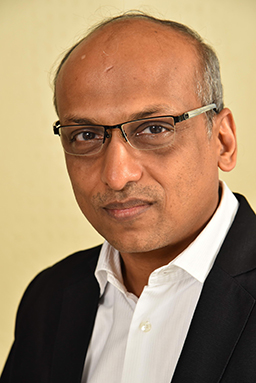
 Venus Jewel calls themselves ‘Leaders in Solitaires’ and rightly so, given that they are one of the leading Indian companies dealing in solitaires.
Rajesh Shah, Partner at Venus Jewel, takes great pride in the fact that the company has 20 years of leadership in online sales, and is able to sell 50 percent of the company’s goods through their website.
Passionate about the diamond industry, environment, company’s employees, ethical standards, and most importantly customers, Rajesh Shah’s other interests are ‘designing and architecture’.
Here, Rajesh Shah speaks to Rough&Polished, about his company as well as the current scenario and issues that plague the diamond industry.
We understand that way back in 1997, when internet marketing was still in its infancy - at least in the Indian diamond industry - Venus Jewel was the first company to begin online sales of polished diamonds. How did this come about? For the benefit of our readers, can you take us through the company’s journey from inception to the present?
My Uncle and my Father founded Venus Jewel in 1969. Since inception we have been very much focused on manufacturing the best polished diamonds as well as ensuring a fair, simple and transparent sales methodology for our customers. Rather than competing externally, we focused our energies on continually refining our processes and systems. As a natural result of this practice, we were able to pioneer numerous business trends that are today considered industry benchmarks... key amongst which are our Single Piece Packaging, Fixed and Rational Pricing, and our own internally developed Venus Grading System (VGS)®.
When the Internet movement started in the late 90’s, we saw it as a novel way of expanding our reach not only to customers around the world but also to those in remote locations. We believe that the diamonds we polish are truly superbly manufactured and utilizing our current best practices such as single packet sales, the Venus Grading System (VGS)® allowed us to explain our diamonds to our customers very effectively. I need to say, we were THE FIRST B2B Company to sell diamonds online and are quite proud of this fact. Initially no one understood why we did it, and naturally there was strong resistance to the idea, but today, most major companies are trying to adapt to this methodology of selling diamonds online. However, what makes our selling proposition unique is that our unique and fluidly harmonious fusion of human skills and modern day technologies; which has allowed us to:
- Precisely manufacture each diamond we polish to the most exacting proportions.
- Examine critically all our diamonds on the basis of more than 200 parameters that are made up of 20 grading attributes and 180 sub-attributes.
- Provide high resolution Images and Videos of all our Diamonds.
- Create the diamond DNA of each stone which provides the critical information of each stone in one place.
All of this information available on www.venusjewel.com empowers our customers to buy the specific diamonds they want when they need it, thereby streamlining their businesses to a much leaner and effective one. Engaging customers on our website are yet another one of our creative innovations - online auctions of recently manufactured and certified diamonds – a platform that offers a win-win equation to customers as well as us. This Auction system gives our customers a fair and equal chance to bid for stones they desire; and in doing so, giving us an indication of how demand trends are moving in markets across the world.
If it was not for our relentless pursuit of excellence in creating brilliance in everything we do, we wouldn’t be manufacturing >15% of the global footprint of +1 Cts Gem quality diamonds.
How did Venus cope with the flat polished prices in the past? Have the polished prices picked up now? Do solitaires, that Venus specializes in, get acutely affected in the fluctuations that occur in polished prices? Which market does Venus Jewel’s cater to largely?
Given our global distribution, we have a very evenly balanced spread of customers across a lot of markets. Additionally, we have devised our own price book on the simple economics of supply and demand micro economic trends within our industry. Updated on a daily basis, coupled with our online sales systems and great long-term relationships with our downstream partners, it offers us the unique flexibility of tweaking our sales process dynamically to ensure continuity of sales even during difficult times.
To answer your question, we believe that if the market continues to behave responsibly, we will see stability in diamond prices and will start seeing a slight improvement in polish prices overall. We are already seeing this in small niche areas that are in demand, but as the polish stocks go through to the end consumer, we hope to see entire segments improve in prices.
How has the global slowdown and weak demand affected Venus in particular? China’s slowdown especially has hit the Indian industry badly. How is Venus faring in this front? What strategies is the company using to overcome this period? Does the demand from the Indian domestic market sustain your company in such times?
As said above, our global distribution model which has given us a very evenly balanced customer spread across world markets has proved very beneficial. It is true that there has been a decrease in demand for certain types of goods in Mainland China and Hong Kong, but there is still decently good demand from surrounding countries in the region and even China, but in different types of goods.
What changes have you witnessed in the Indian diamond industry through the years? Has the ‘trust’ factor, which is unique of the Indian industry, still a major component in business or have changes taken place in recent years? Your opinion…
In the past decade or so, more and more companies have moved towards modernizing not only their business practices and processes, and realizing that how business was managed in the past cannot work in today’s fast paced world. Though trust is still an important factor in our business, it is modernizing and becoming more structured around financial accountability, stable business practices and long-term business planning.
After about 15 months of downslide in business, the diamond market has stabilized in last 2 months but remains cautious. Is it too early to say that the market has embarked on the road to recovery?
I think we should always be cautious. We as an industry have to focus on our core competencies and ensure we execute on them every day and most importantly that we are honest with ourselves about it. It is true that profitability in our industry has changed and it has been very difficult for many companies in our sector. But those companies who focus on their core competencies and skills have been able to be successful through good times or more difficult ones. Have we recovered? It is difficult to say where the industry is today. There is still a polish overhang, though not as great as the previous years, rough has been sold into the market, though not as much as it was in the same time last year and liquidity for a lot of businesses in the market is quite tight. Yet, if the entire value chain behaves responsibly and manages their business based on what they absolutely need, we can have a good year with positive growth. This however can change if any part of our pipeline decides to oversell, over manufacture or over stretch themselves financially.
With production picking up in cutting centers, the market will now see an influx of newly cut diamonds. But, with demand still weak in most consuming markets (except US which is stable), how will this play out for the industry’s health eventually?
Once again, as I have said above, all industry members regardless of their position in the diamond pipeline have to ensure that we operate our businesses prudently and avoid overstretching the pipeline. Diamond demand is surely there. Agreed that it is not the same as it was 2 or 3 years ago, but with the help of generic marketing involving the DPA, global diamond industry bodies as well as key members of the manufacturing as well as retail segments, the situation can be greatly improved.
Of late, the Indian industry has seen many disturbing incidents like ‘mixing’ of synthetics with naturals; CVD lab-grown diamonds offered with GIA natural diamond certificates; GIA/TCS fiasco where Indian companies were involved in the ‘upgrading’ certificates issue? Is it the huge size of the industry that has made it vulnerable for frauds to take place and reputation be marred? Your comments please.
I really can’t comment on what specific factors are driving some in the industry to behave in this manner, but if not prevented, it can surely prove to be detrimental to our entire sector. From whatever details came out in the media about these incidents, these appear to be consciously executed acts. In other words, the onus is on us, i.e. industry members to act and behave responsibly keeping long-term sustainability in mind rather than short term benefits. I am happy to say here that even though a large majority of our rough purchases are directly from mining companies, we at Venus Jewel still go to great lengths to proactively ensure the integrity of our processes to offer our customers the assurance that we only sell natural and untreated polished diamonds manufactured completely in-house at our Surat facility.
Which lab does Venus use to provide services for its clients in terms of certificates? Do certifying labs, like say GIA in the recent 2 cases, need to be more assertive and think of better ways to provide services without loopholes, so that they are not misused? What are your suggestions?
First it is important to note that before we certify our diamonds with external laboratories, we use our Venus Grading System (VGS)® to create the Venus Grading Report for every stone that we manufacture. Thereafter, depending on what specifically do our customers want, we send our diamonds to the GIA, Forevermark, IIDGR or HRD. Our core focus in doing this ‘double’ grading exercise is to provide our customers with our precise, consistent and in-depth report, which gives them a comprehensively detailed report of our diamond. As a result, they buy with full confidence, knowing exactly what they are purchasing is 100% what they were looking to buy. With such steadfast assurance of complete trustworthiness, I am delighted as well as proud to share with you that since the past 7-8 years, more than 50% of our annual sales are transacted through www.venusjewel.com, with many of purchases in the millions of dollars. Such purchases allow us to believe our online sales system and process is just as good as in-house viewing of the stones.
How and from where does Venus Jewel source its rough requirements? India’s import of rough indicates an increase of late. What effect will restocking of rough diamonds have on the price? De Beers and ALROSA reduced their supplies by about a quarter last year to stop the decline in prices. What changes do you foresee this year? And, what will this lead to for the Indian diamond industry, say in 2017?
We are very honored to be direct long-term contractual customers of all the major mining companies of the world - De Beers, ALROSA, Rio Tinto and Dominion Diamonds. I think it is important to note that everyone needs to be able to be profitable in their businesses. Most mining companies and manufacturers did what was right for their business and I do hope that we all continue that practice into 2016 and 2017 as it will allow us to continue to be successful in our industry.
Aruna Gaitonde, Editor in Chief of Asian Bureau, Rough&Polished
