 The Kremlin Assumption Belfry housed an exhibition of Russian jeweler Ilgiz Fazulzyanov, "Jewels Inspired by Nature."
Visitors still cherish the memory of other jewelry exhibitions held in the Kremlin earlier, like "Diamond in Russian Avant-Garde", Faberge, Bolin, Cartier and Lalique, so this is the first modern domestic jeweler, whose solo exhibit was welcomed by the Moscow Kremlin Museums.
Ilgiz Fazulzyanov received academic art education at the Kazan Art School. Later he took part in and won numerous international jewelry contests and worked with the Christie's and Bonhams auction houses.
The jewelry works of Ilgiz Fazulzyanov won the Grand Prix of the International Jewellery Design Excellence Award in 2011 and in 2013. His brand, Ilgiz F. enjoys great popularity among connoisseurs, and his clients include many celebrities.
It is not often that the Moscow Kremlin hosts jewelry exhibitions. How is it that your works are presented in such a prestigious place?
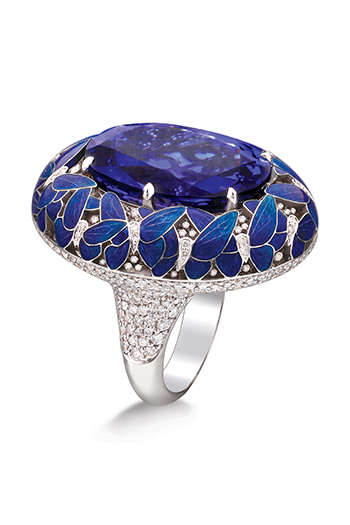
It was an offer from the Directorate of the Moscow Kremlin Museums - I myself did not venture any initiative in this respect. Elena Gagarina, having got acquainted with my work, offered to make an exhibition in the Moscow Kremlin Museums. And at the same time, the Kremlin Museums bought five of my works: the "Crows" and "Butterflies. Eclipse" sets, which won the Grand Prix in Hong Kong, then the "Dragonflies" and "Burdocks" (a necklace and a ring).
In one of her interviews, Elena Gagarina called you a genius, and some call you a Russian Lalique. What is your attitude to such epithets?
My attitude is ordinary and impassive. As I sit at the bench, I take this as a public side of my work. You can't do without public relations and advertising: during the five days of the show you are facing a steady stream of people, you give interviews and you are being filmed, you hear pleasant and beautiful words. Besides, the fact that these jewelry pieces were made in Russia wakes patriotic feelings in many people. Many are pleased that we are able to produce such things.
T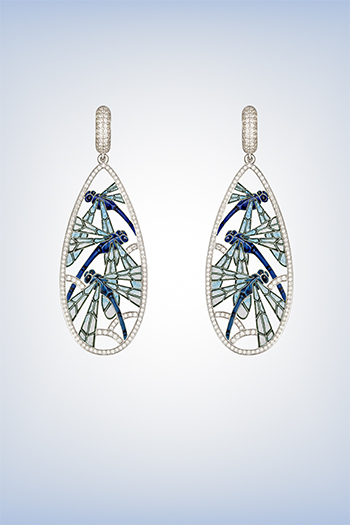 his is understandable: of those jewelers, whose works were exhibited in the Moscow Kremlin, Cartier is not ours, while Faberge (and Bolin) lived a long time ago...
Well, by and large Faberge is also not ours. Faberge was a shrewd businessman, who brought together many craftsmen and workshops in one place and created a group under the name of Faberge. It included a huge amount of splended artists, including such names as Perkhin, Ovchinnikov, Sazikov and many others.
You worked in France, your brand is presented in Paris, Geneva, Tokyo and New York. Now you paint the dials for Swiss watches «Bovet», and you are called a Russian artist. Where do you belong? What is your own feeling about it?
As you know, overseas all those from Russia are automatically considered to be Russians, and people there are not going to understand who you are by nationality. I consider myself a man of Russia, I feel close to all nations living in this country, and I can easily use their traditions in my work.
What helps you in your work?
Knowledge of the fine arts. My teacher was a pupil of Nicolai Fechin (my favorite artist), so I'm more a painter. I like the Victorian Art and the style of art-nouveau favored by French artists. They produced colorful masterpieces full of pliant and mild lines.
And how did you come to the jeweler's art?
After the art school, I established my first jewelry workshop in the Kazan Kremlin. I turned to jewelry from stained glass and batik and realized that it was my art. I started to work with precious metals and stones, doing everything myself, starting from sketches. I was attracted by the complexity of jewelry making – I mastered all the techniques on my own. In 1994, I won a Grand Prix at the international contest of young jewelers in Pakistan, and after that collaborated with the Armory Chamber and Diamond Fund of the Moscow Kremlin, studying the works of old-time jewelers and mastering all the techniques, unaided.
Once you said that if you had classical jewelry education, you would feel squeezed within these frames, unable to do much of what you are doing right now.
When operating techniques are ingrained in the course of learning, people follow them, without deviating from the knowledge gained. But if you have no such techniques, you try to master your own, breaking the canons and technological limitations - as it happened to me. The technique that I use is almost contrary to all the technological rules established at jewelry schools.
As they say, “it isn’t done that way."
Yes, but I do it and I think it is correct. I am not a technologist, and each new job means new knowledge, research and new technological methods. I do not think about how to make, I am just gaining an insight of the image I have. In my works I use old techniques, which were practiced by Faberge, as well as new and different styles and materials. However, I prefer to work with hot enamel.
Now all jewelers have to switch over to anti-crisis programs, reducing costs, using hollow gold or Swarovski crystals, while you are using diamonds and seem reluctant to save on materials...
The artist may face only one type of crisis – creativity crisis. And if you need materials to create an object of art, including diamonds, you should get these stones, in spite of any crisis, and use them in your work. I have never thought about the price. For me, it is important to create what is born in my mind.
Have you ever found it a problem to look for a buyer, support your family?
Fortunately, thanks to the fate when I needed money for something, it is always found. This does not mean, of course, that some "golden rain" falls on me. Usually, this means the emergence of some interesting project. I have twice in my life became bankrupt - remained flat broke. However, I was not frightened, but rather stimulated. And I immediately bounced back to my usual level. It seems to me that it all depends on your inner attitude. I need some kind of emotional uplift and my body gets tuned to it. I grew up in a house, which was located at the confluence of two rivers, the Volga and Sviyaga. There was forest around us on all sides, and I spent all my free time near the water or in the woods. I consider myself a man of nature. My works reflect life situations, emotions, states. Each of them is like an entry in a diary, communicating with some person. This is creative energy, an obsession to create something.
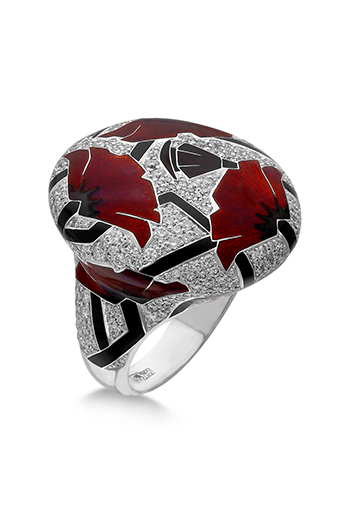
You combine enamel with diamonds, which is quite unusual. One of your awards was a diploma for the best jewelry piece graced with diamonds, the "Poppies" set. You use diamonds almost always, even when it seems you could do without them, since they are tiny or there is just a small scattering of them. What is it that diamonds add to your jewelry?
This is the background, all this work is based on contrast. Contrast is any situation in life, it is good and evil, light and shadow, it is the warmth of poppies and the cold of diamonds, the scarlet color and neutrality. Diamonds for me are all the same, but I can’t do without them. It is also a kind of living stone. I have tried to insert synthetic stones - some zircon, but it was not the right thing. Diamond has such a property – it knows when to shine. If it deems there should be a glimmer, it gives a glimmer and if it deems there should be bright light, or sparkle, or flash, or fire play - it gives all this as well.
You mean, it shows self-determination - in addition to the role that you allot to it?
Of course. When used properly, diamond always plays into your hands, as if turning alive.
You mentioned zirconia - it is believed that even experts find it difficult to distinguish it...
Zirconia, if it shines, it shines always: it will not sometime fade and sometime sparkle - it is such a dead light. And diamond is live, and they both are completely different things.
And why do you not use, for instance, Swarovski crystals? Is it because you are a perfectionist and you like the best?
I do not use them and will never do it - I use live things.
How about cut glass, is it not live?
May be it is - by its nature, but in terms of light it is closer to synthetic things, than to natural ones. I think that this happens after specific treatment it is subjected to.
And have you contemplated using colored diamonds? They have pretty rare hues.
I use them, though not so often - they are generally rare in nature, and as far as artificially colored diamonds are concerned, I do not like them.
Can you see it? Or do you feel it?
Mostly, I feel it.
Since diamonds are a symbol of wealth, status and prestige, does it affect your using them in many of your works?
Of course, diamonds ad solemnity and an aura of power and luxury to jewelry pieces. They are always present in my artworks, but they may be surrounded by inexpensive stones as well. I want to show the beauty of all stones.
If a person buys a piece of art or a unique piece of jewelry, both should contain worthy stones.
Galina Semyonova for Rough&Polished
