 Etan M. Müller, CEO and Partner- DFI, has more than 25 years of experience in the financial industry. Before setting up DFI Switzerland AG, Etan Müller worked for 12 years in the private banking sector as a senior investment advisor for Ultra High Net Worth (UHNW) clients for the two of the largest Swiss banks in Zurich.
He has also filled executive and trading positions at Credit Suisse First Boston, Merrill Lynch Capital Markets, Zurich Kantonalbank and Swiss Cantobank Securities in London.
Currently, Etan also serves in a non-voting capacity on the Board of Directors of DFI Switzerland AG.
Are you considering diamonds as investment vehicles? Etan is here to tell you all that you need to know and more in an interview with Rough&Polished.
Excerpts:
There is considerable uncertainty in the traditional financial markets currently. More so now, when diamonds are looked at as investment vehicles. How comfortable do you think an investor should be while investing in diamonds? Are there any factors on which one should be concerned about? Your thoughts please.
Real assets should provide investors with a sense of a safe haven. But today, the image of financial products related to gold, silver or industrial metals, which are hedged with physical assets and should therefore provide investor protection, is damaged.
Investors have started to look for alternatives that can never lose their entire value, because the economic framework is still beset with significant risks. The high level of debt, the low or even negative level of interest rates, stock exchanges driven only by liquidity and a number of political conflicts are but a few of the potential dangers which investors currently face.
A changing world requires a range of long-term, value-protecting alternatives to hedge financial investments. On top of this list should be investment diamonds, held in physical form. Investment grade diamonds provide an increased degree of stability and flexibility in a diversified financial portfolio. In the middle of a dark system of financial repression, shining polished diamonds represent a natural protection of assets for eternity and lasting values for the next generation.
The purchase of diamonds as a financial investment should be assisted by experts, as it should be with all forms of alternative investments, like fine art and coins. The key questions in an investment decision are where, how and when to invest into something.
Certain key long-term themes are driving supply and demand for diamonds. Global supply of diamonds is mostly a result of the rise and fall of diamond mining operations in response to the discovery and exhaustion of diamond deposits, but it is also influenced by political conflict in key producer and consumer regions, economic crises, changing consumer fashion tastes and the growth of developing markets, with the two most notable in recent times being China and India. Through all that, we have historically seen general price stability, and steady, if not spectacular, growth.
But there are cases in which all products are negatively affected. Here I refer to what can be described as of a “supply-shock”, due to extreme liquidity needs in the real economy. Under such conditions transaction prices may be significantly lower. However, what we also know about diamond prices, is that they have remarkable ability to recover considerably faster after a crisis than other product categories.
For our readers’ benefit, can you just run us through your company’s history from inception? Is investing in diamonds still in its infancy or has picked up in the past few years? What has been the enquiry quantum to DFI from investors? In short, how do you see this trend moving ahead and what does the future look like?
DFI is a Swiss-based services company, founded 2012, specializing in the provision of professional advice concerning investments in physical diamonds, and their actual implementation and storage. The professional knowhow, expertise and strength of the world of finance and diamonds were merged into one company.
DFI understood it was entering a new and very challenging business venture with an underlying product that is beset by clichés and ignorance. However, in a short time the company was able to earn the financial industry’s trust and recognition. Thanks to the acquired know-how and feedback from market participants, the company was able to increase investors’ acceptance for investments in diamonds. We want to become the benchmark of investment diamonds.
Diamonds are not an investment for speculative purposes in the short term, but an investment for asset preservation in the long run. Eight years after the end of the global financial crisis of 2007 and 2008, the future has become again more clouded than ever, and the chances have increased that a normalization of the financial and real markets is still many more years away. In the diamond market, indications continue to be that the positive performance of diamond prices over the past decade will not only persist, but most probably accelerate. Simply stated, global demand for polished natural diamonds is expected to rise at a rate that is significantly higher than the potential increase in the supply of rough diamonds.
What type of portfolios or programs does DFI offer investors in diamonds? Can you name a few and explain how they works? How have your programs performed till date? Any new programs in the offing from DFI soon?
DFI does not run a “one size fits all” fund structure! We create bespoke, individually tailored, diversified investment portfolios (“Diamond Shield”) of physically-held diamonds that are created according to the client’s appetite for risk, and his or her investment horizon and target returns.
With our state of the art securitization program of physical diamonds, investors can even hold a personalized diamond instrument (Diamond Backed Security) alongside with their other ordinary bankable assets, without having to worry about any of the physical aspects of ownership of diamonds.
“Diamond Shield” portfolios differ from most of the other players in the investment diamond space, who typically manage diamond funds. Our portfolios are not actively managed strategies; therefore, the performance numbers are dependent on the chosen underlying diamonds.
Generally speaking, diamond prices are currently inexpensive, at a three-year low, but they have outperformed the traditional financial market with a much lower volatility over the last decade.
For a first time investor in diamonds, how concerned should he be regarding price aspects? Also, how does your earlier program ‘Diamond Shield’ compare with ‘Top 7’ as a better bet for a novice investor? What are the major differences between the two, in terms of returns on investments?
Primarily it is essential for diamond investors that the purchase must be conducted through the most liquid wholesale market. This is two or three times less expensive than purchasing a diamond at retail over the counter. The purchase should be fully documented, transparent, without conflict of interest and at market rates.
Jewelry-grade cut diamonds are available in literally hundreds of different categories based on the 4 Cs. Out of this variety we selected, based on a historic value and liquidity analysis, those personalized “Diamond Shield” portfolios which investors own outright.
To increase the attractiveness of diamond portfolios for financial advisors, DFI has created the Diamond-Backed Security, a financial product with an initial value of USD 250,000 and a maturity of seven years, which can be easily included as explained before in the asset management process. For this specific product we selected 7 stones, therefore we called the portfolio “Top 7”.
Price volatility is a major concern to investors looking at diamonds as an investment vehicle. What advice can you offer them? Taking inflation into consideration, how has diamond price stood up in the last decade or so, and what is the percentage price rise during that period?
It is important to understand that diamonds are not an investment for short term speculative purposes; they represent a value-retaining investment for the long term. Short-term price fluctuations are always possible. However, compared to any traditional and established asset class, diamonds are the one with the lowest volatility.
High quality diamonds with two or more carats in weight have increased their value quite impressively in the last decade and outperformed the MSCI Global World Stock Index (see attached chart).
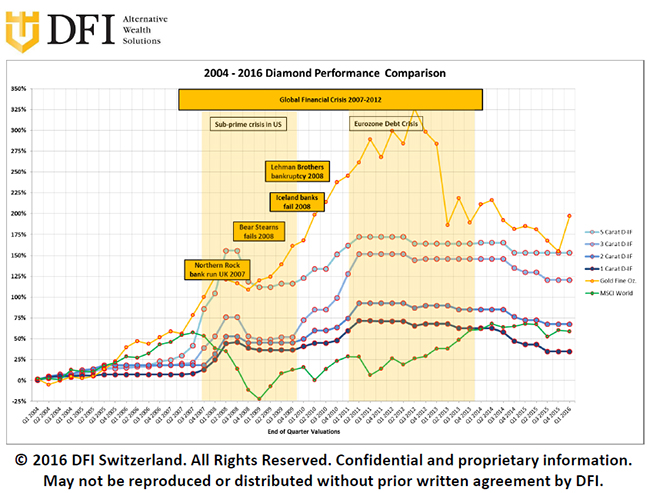
How has the current global slowdown affected DFI’s business in terms of demand for its services? According to reports, rate of increase in diamond prices has slowed down. Will that wean away investors to the more profitable investment vehicles that bring better returns? How do you see the future panning out?
Diamonds are seen as storage of wealth due to their natural capital protection. Financial market participants, who do not trust the liquidity driven stock markets and lost faith in the future of the monetary system are open for new alternatives. As a result, DFI is very active in its business field. Actually the current difficult diamond market environment gives a lot of opportunities for investors. Winston Churchill is rumored to have once said: “Never let a good crisis go to waste”.
The advisory and research firm Bain & Co. expects for 2016, that jewelry will show a value increase of 6%, thus becoming the most value-producing category in the luxury goods segment of the market. Diamond necklaces are seen to be more and more a safe asset in an unsafe economic and financial environment. And do not underestimate the fact that a diamond as a present for loved ones is still the most important demand driver in this market.
Gold has always been an investor’s choice when it came to investment preference for its price transparency as well as price growth. Does marketing ‘diamond as an investment vehicle’ that much more hard, especially as there is no standard fixed price vis-a-vis gold? How do you deal with gold as a competitor?
Basically I do not see gold as a competitor to diamonds. Gold lost its shiny myth. Stories of price manipulations or the high market volatility paled the glorious reputation of gold. In contrast, diamonds hardly move in relation with other assets. The small, zero or even negative correlation to other asset classes makes diamonds an attractive source of diversification and an effective tail risk hedge by lowering portfolio volatility.
Although investment diamonds are not accessible for the man in the street, there is an ongoing, permanent and regulated trading facility, and that is the more than 30 diamond exchanges around the world, where trade continues 7 days a week!
What is your opinion on synthetic or lab grown diamonds (LGD) being excessively pushed into the markets of late? How do you think it will affect natural diamond industry? You think LGD sector will make a mark for itself; and even perform on par with natural diamonds, gold, etc., in the future as investment vehicles? Your comments…
The working assumption of some is that synthetic diamonds would help shift the supply-demand imbalance in favor of supply, and so may depress diamond prices. However, we are not convinced that this is the case.
Currently the synthetic price point is not sufficiently low to significantly threaten the natural diamond market.
Synthetics are not a new phenomenon in the gemstones business. The knowledge and tools that produce them have been around for decades. Throughout this period, there has been no evidence that the trade in synthetic colored gemstones suppresses the trade in natural gems. What is essential, however, is the development of tools and legal frameworks to ensure that they always remain separated.
There is a theory that synthetics eventually will be considered of benefit, in that they enable the business to maintain price points for younger, less financially able consumers. The buying of diamond jewellery is addictive, meaning that the first purchase is critical. If synthetics provide younger consumers the ability to get a foothold in the market, we all may turn out to be beneficiaries.
In any respect the diamond industry is primarily driven by bridal, and, when it comes to bridal in particular, there seems to be a discriminatory desire for natural stones.
How does the ‘investor demand’ for colored diamonds (where price fluctuations is often evident), compare with whites? What changes have you witnessed in investors’ preferences over the years? Will colored stones carry more premium, given that they are rarer than whites?
Any investment should primarily satisfy the investor’s personal liquidity requirements. Therefore, the most recommended investments into diamonds are colorless (“white”), round (“brilliant cut”) diamonds of high quality, which make up the most liquid segment in diamond market. Extravagant and unique diamonds such as colored diamonds, which can be difficult to resell, should be excluded as the prices are particularly sensitive to market demand.
This uniqueness can be compared with works of art, or a real estate object. Accordingly, the process of price discovery is similar and primarily subject to demand and supply.
As a former banker, what are your thoughts on the current ‘diamond financing’ scenario by banks globally? With major diamond financing banks leaving the industry in recent times, the diamond industry is badly hit. Especially in India, the situation is worse, as banks ask for 100 percent collateral to dispense loans. Your comments please.
With the introduction of Basel III rules, risk-weighted asset and regulatory capital requirements were progressively tightened, and smaller diamond companies increasingly found themselves cut off from regular bank financing.
Crowdfunding platforms or the new Fin Tech industry started already to fill this gap, and is bringing adequate financing tools to consumers, and also to smaller industries.
New forms of credit facilities are even being offered through very efficient online tools. DFI for example has good relations with some of those Fin Tech nerds, and is investigating whether there is a way of bringing back the missed liquidity to the diamond industry. There are promising talks for the future.
However, the fact of the shrinking credit facilities forced the market to deleverage positions basically is a healthy process for investment diamonds. New investors will feel more attracted under these circumstances.
Aruna Gaitonde, Editor-in-Chief of Asian Bureau, Rough&Polished
