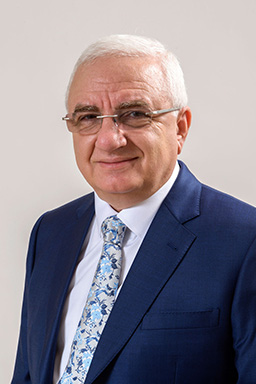
 The World Diamond Congress is the most important forum of the global diamond industry, which, in the words of Ernie Blom, President of the World Federation of Diamond Bourses (WFDB), gives its participants an opportunity to express their views on the problems facing the industry. “We will be discussing how to create sustainable, long-term growth in the diamond supply pipeline, while bearing in mind the need for transparency, the highest levels of ethical behaviour and corporate social responsibility,” he said in the run-up to the congress. “We also want to advance across-the-board support for generic marketing of diamonds via the WFDB's World Diamond Mark initiative and to create stronger links with the Diamond Producers Association.” Alex Popov, Chairman of the World Diamond Mark Foundation (WDM) while sitting for an interview with Rough & Polished told about the issues to be raised at the Congress and about the work done by the WDM and its plans for the future.
The 37th World Diamond Congress opening in Dubai announced transparency, responsibility and sustainability as the main themes to be discussed. Why are these issues highlighted by the diamond industry these days?
There are objective reasons for this. The first is that we have a banking crisis on our hands in the diamond supply pipeline. It is no secret that banks and other financial institutions have been reducing their credit extension to the diamond industry. Unfortunately, not all players involved in the industry, including diamond bourses, diamond manufacturers and diamond traders have been struggling to adjust to these fundamental changes. So the level of uncertainty is high, and on top of funding problems, we've also seen a number of bankruptcies and ensuing bad debts. I think it is the first time that the industry is facing across-the-board financial troubles in such a short period of time.
In addition, international law enforcement agencies also have been displaying an interest in the diamond industry and trade. The financial industry is taking note of this as for them transparency is now more important than ever before. It should be noted, however, that a recent OECD meeting, which was attended by Louise Prior, Executive Director of the World Federation of Diamond Bourses, took place in an atmosphere of dialogue, not confrontation.
So today, these are probably the most sensitive issues. They are even more important than marketing - because without sustainable funding, there will be no industry, and marketing will be of no use to anyone.
Another reason for choosing 'transparency, responsibility and sustainability' as the theme of the 37th World Diamond Congress may stem from the voices that opposed to holding the event in Dubai, and from the opposition, in particular from NGOs, against electing the United Arab Emirates as the chair country of the Kimberley Process. These two things are interrelated.
Therefore, the emphasis on transparency, responsibility and sustainability, among other things, also constitutes a clear message from the Dubai Multi-Commodities Centre (DMCC) that they are ready to discuss these issues, and wish to demonstrate that they are like all the others and keep with the best in the industry. I think that it will be to the benefit of all stakeholders to discuss these issues and come to some conclusion, taking into account the positive efforts being made by the DMCC and the Dubai Diamond Exchange in this direction.
The World Diamond Congress will be attended by the representatives of all leading organizations of the diamond industry, including the World Federation of Diamond Bourses, International Diamond Manufacturers Association (IDMA), delegates of major mining companies and countries, as well as by the World Diamond Mark. What will be your contribution to this Congress?
I should say diamond mining countries and major diamond mining companies have always been welcome not only to this Congress, but at every diamond industry event. However, it is the first time for mining companies to attend a biennial World Diamond Congress as members of the Diamond Producers Association (DPA), as this body did not exist until recently. Of course, diamond miners must be part of the overall process of change we are experiencing, and with their proactive involvement there is finally a chance that the entire industry will and can speak with a single voice and speak the same language. This is a very positive development.
Now let's talk about what the World Diamond Mark takes to the Congress. Here it should be mentioned that the Diamond Producers Association has set itself a task to develop a plan for promoting diamonds in the market. This plan will be unveiled to all on June 3rd in Las Vegas. I think that there is a genuine desire on the part of the DPA to cooperate with the midstream and retailers. At the same time, it is unlikely that the budget they allocated for this purpose will be increased, and even if it will, it will rise by a small amount only and will afford a very limited campaign to promote diamond goods. Ultimately, the DPA will have to go for money to the constituents of the WDM, i.e. the diamond bourses, as well as midstream players and retailers, since they make up 85% of the entire industry. This is where the World Diamond Mark may play a role, since the financing scheme we proposed last year is attracting increasing interest.
Meanwhile, the WDM has begun to raise funds for its programs and since we have gained some experience and know-how in this area, some seed funding for generic diamond promotion has been raised.
Obviously, you cannot build a generic diamond promotion program without a budget. The WDM recognized early that it needed to put in place a sustainable funding system, if not a self-funding system, by which we can generate proper and continuous financing for diamond promotion in the world market.
Mining companies, sightholders and diamond bourses can only offer a limited amount of funds for this purpose because, firstly, their numbers are limited and, secondly, they can allocate limited funds. It is estimated that on a turnover of $29 billion, the industry can allocate about $14 million to this program. With retail jewelers positioned at the heart of the WDM programs, we believe that we can increase and expand our funding by means of participating retailers, who will be paying up to $1,400 annually to participate in our programs. That offers great potential for exponential growth of campaign and program funding.
Could you describe in more detail how this system works?
Our program is called the WDM “Authorised Diamond Dealer” and it is based on the following premises. A reputable store selling diamond jewelry and willing to join the program must subscribe to the principles of the Code of Conduct, developed by the World Federation of Diamond Bourses, except for one item, which is arbitration (applicable only to the members of diamond bourses). After signing up the stores - until now we have signed up retail jewelry chains and a number of high end stores - they pay a certain annual fee, which is again helping to support the WDM's work! This is how we, also today, have a regular, albeit still modest revenue stream. The pace of new Authorised Diamond Dealers joining is picking up week after week.
During the past year we have done a lot of work to tie down our organizational structure. Now we do not live from one event to another as in the first year. We have launched several projects and they go on in their due course. Currently, we are creating two websites for consumers - Passion.Diamonds and Trust.Diamonds. These domain names make their purpose clear. We should have this job finished by September. It will be a portal, which will be visited by everyone who wants to buy diamonds. Our main goal is to awaken the whole gamut of human emotions related to diamonds.
It must be noted that we do not give the status of Authorized Diamond Dealer to stores selling synthetic diamonds along with natural diamonds. That is our decision. We will not promote stores that sell synthetics.
What are the tangible benefits given to a store, which becomes an Authorised Diamond Dealer?
Such a store receives from us the so-called “Blue Box”, which contains all the attributes indicating that this store has turned into an Authorised Diamond Dealer. In addition, we teach its staff how to sell diamonds by means of a free-of-charge training course offered by HRD Antwerp. The Authorised Diamond Dealer stores are listed and encouraged to advertise themselves on the above mentioned websites. But the most important and remunerative thing about it for the store is that it is approved by the World Federation of Diamond Bourses as a retail business worthy for selling diamonds to the consumer. In essence, the certificate of Authorised Diamond Dealer is a certificate of trust.
Are you going to tell about this at the Congress in Dubai?
Firstly, I will tell that we have come of age and now stand on our own feet. Secondly, I will tell about the tremendous positive feedback that had been generated by activities on the social networks. We conducted several experiments in different countries launching four small ads on the Facebook – about the Authorised Diamond Dealer program, about trusts and so on. In a matter of ten days, these ads were seen by 774,000 people. I did not believe my eyes. But it is a fact. Traffic on our website went up six-fold.
What does this mean? This proves that people are interested in diamonds. Please note that these were not business visitors, these were ordinary people – consumers! This experiment cost us just $1,300. For this money we have received something for which people pay a lot more spending funds on advertising. We make all this available to our authorised diamond dealers. We also give them free images to advertise their goods, because not every store has enough money for this purpose. Further on, as soon as we will have a small but critical mass of stores within our program, we will provide them with special contracts from companies offering services to the diamond industry, including credit card businesses, banks, logistic companies, exhibitions, mass media and so on.
In addition, we are currently working on the creation of a diamond museum. This project will be launched during the 37th World Diamond Congress in Dubai. Our museum will be called “The Facets of Mankind.”
What is the objective of this project? There are about five hundred big-league diamonds currently known to the world that are of interest to people due to their fascinating history. At the same time, there are about two thousand pieces of diamond jewelry of the same cultural and historical or emotional level. We need to photograph and describe all these stones and jewelry pieces. This will be an audio-visual museum located “in the cloud.”
After all, a lot of information about diamonds is hidden from people. It often happens that we know very little either about a special diamond or about its owner. The photos will be high-quality and three-dimensional, so that one can look at the stone from all sides. The process of selecting exhibits for this museum is endless, and the museum will exist forever. But to expose all this on the Internet is not enough. In addition, we are creating a traveling exhibition, which will be moved from country to country and hosted by the world's major museums. The exhibition will display rough diamonds, polished diamonds and jewelry, which are of interest to a particular region. This program will appeal to everyone, no matter where they are, and will be an ongoing effort.
It is not the first time that financing of the diamond industry is discussed at the World Diamond Congress, but now these issues will be given special attention. Do you think the industry will be able to find common language with banks leaving it these days?
Banks are not leaving the industry out of fear. They have plenty of money to work with the industry. But today, the industry does not meet the requirements of banks. After the recent downturn, the banking system underwent great transformation in terms of transparency and reporting, taking into account the requirements adopted within the banking regulatory framework in Basel.
Banks are now demanding full accountability and transparency from their clients. And our industry is not entirely ready for it. Take, for instance, compliance with banking procedures, which many diamond market players do not yet know how to cope with. And the task of the WFDB is to ensure that diamantaires understand this and act transparently in relation to themselves and to banks. This is a very serious issue, and it will be widely discussed at the Congress.
Vladimir Malakhov, Rough&Polished
