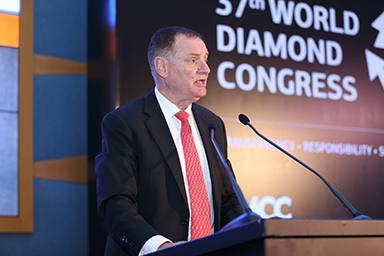
 The 37th World Diamond Congress in Dubai carried to completion on May 19, 2016 zoomed in on the most challenging issues facing the global diamond industry with a special focus on transparency, responsibility and sustainability. The World Federation of Diamond Bourses (WFDB) and the International Diamond Manufacturers Association (IDMA) widely represented at the Congress recognized the importance of higher integrity in the global diamond supply chain in order to boost consumer confidence in diamonds. In an interview to Rough&Polished, Ernie Blom, President of WFDB unanimously re-elected for a further two-year term, describes the discussions, which took place at the Congress and the results achieved.
The three main themes of the World Diamond Congress in Dubai from May 16 to 19 were Transparency, Responsibility and Sustainability. Why were they selected and how did the Congress focus on them?
We knew ahead of the Congress that these themes related to all the challenges and issues facing the diamond industry. They included the problem for manufacturers in securing credit, and also the fall in profitability which reached a point where manufacturers were producing at a loss.
Then there is the topic of overgrading of diamonds which potentially poses a huge problem as far as consumer confidence is concerned. There is also the problem of undisclosed mixing of synthetic diamonds with natural mined goods which is also a consumer confidence issue. Also on the agenda were the policy of producers and the issues of tenders and price lists.
The generic marketing of diamond jewelry is also a huge issue and was raised again and again at the Congress. As you can see, these all-encompassing themes covered all the subjects that were on the agenda.
What were your conclusions following the Congress?
It was clear to me, firstly, that these regular meetings are critical. I was very pleased with the large attendance at our sessions and the joint meetings. Every session was full and the interest and seriousness shown by the many delegates, along with the quality of the speakers was very clear to all. The bourse presidents and delegation members were fully engaged in the debates and spoke with great passion.
Although we are all in contact by email and phone and Skype on a regular basis, there is no substitute for holding meetings regularly in one place and hearing a widespread range of views. This allows us to cover a number of issues and, most importantly, we have the time to hold very lengthy and in-depth talks. It is critical that we hear global perspectives and the views of all members of the diamond pipeline and direct them into implementation plan.
I came away from the meeting with a feeling of optimism after holding frank discussions with a wide range of delegates – WFDB and IDMA (International Diamond Manufacturers Association) members as well as industry stakeholders.
In addition, the Congress also saw progress in the development of our international Young Diamantaires group. These are members of the younger generation of diamond firms from all the main diamond centers, including Israel, India, Belgium, the United States and South Africa, who are taking responsibility for taking on the challenge of leading our industry in the future. I am delighted that we have young people who are bringing their specific generational skills and outlook into the industry.
One of the main issues facing the diamond and jewelry industry is that of generic marketing. What discussions were held on this topic at the Congress?
Nobody in our trade is in any doubt that this is a vital issue. The diamond industry has fallen behind in the luxury goods market over the past few years in the competition for consumers' disposable income. This is a result of a lack of generic diamond promotion and marketing. De Beers ended its generic global promotion campaigns almost 10 years ago, and the diamond industry has failed to come together and produce a unified approach until the last year or two.
Marketing our goods to consumers must be done every day of the year. If you're not in front of consumers all the time, then they will simply forget you. Generic marketing of diamond jewelry was raised both in the formal sessions as well as in the informal meetings that we held, and that shows its importance for industry members.
We heard from World Diamond Mark Chairman Alex Popov on the work of the WDM which was launched by the WFDB three years ago. It has made momentous progress in creating consumer awareness of diamond jewelry and helping retailers to sell more.
We also heard a speech from Diamond Producers Association CEO Jean-Marc Lieberherr on its research which is focusing on attracting the Millennial generation of 18-35 year-olds who have grown up with smartphones, tablets and other electronic gadgets and are fans of so-called “experiential” activities, such as vacations in unusual destinations. I am very keen to see cooperation between the WDM and the DPA because this is a huge job of work.
It's no secret that securing financing is a growing problem. How was the important issue tackled at the Congress?
This is, as you say, one of the most important challenges for the diamond industry. It has been said many times that bank credit is the oxygen we need to keep our businesses going and expanding – and this is true. Our aim is to enable the banks to see that we are a low-risk industry. Banks and diamantaires are not always totally aware of each other's needs and requirements. The banks want more transparency and careful use of finance.
It is for these reasons that the WFDB will launch a Know-Your-Client (KYC) initiative for our members. The plan is to establish a platform to increase transparency in the diamond business. The 'KYC Bank’ initiative was established by the Gems and Jewellery Export Promotion Council to bring value to all members of the diamond pipeline. There are no clear industry-wide KYC standards, so this will ensure the diamond trade is better-prepared to deal with all eventualities. KYC will enable diamond businesses to receive important information about their customers or suppliers to confirm their authenticity and that of their transactions. This is critical because all banks follow a KYC process.
The WFDB is aiming to establish itself as the industry's most authoritative voice. What are the WFDB's advantages?
The WFDB is the world's largest diamond industry body, with 30 affiliated bourses and around 20,000 members of those exchanges dealing in around 95% of the diamonds traded worldwide. We have excellent relationships with other stakeholders, including banks, producers, labs and others. And the strength of our position allows us to have influence on the big issues such as when we made it clear to the diamond manufacturers last year that rough prices were completely out of sync with polished goods.
We work in a completely transparent way, upholding the tradition and reputation of the global diamond industry and representing it on a wide range of international bodies to ensure that our voice is heard, for example, in meetings of the Financial Action Task Force and the Organisation for Economic Cooperation and Development (OECD).
We also have an effective arbitration service where complaints can be dealt with in a professional way, finding an excellent compromise. And, in cases of wrongdoing, diamantaires can be expelled from the bourse to which they belong and cannot trade at any of our other bourses. This is a very strong punishment.
What are your predictions looking forward to the rest of 2016?
In my many years in the diamond industry, which now comes to more than four decades, I have learned not to rely on predictions too much because situations can change so quickly. However, I can say that I am always hopeful and optimistic because the diamond trade always comes back from a decline.
We have seen strong rough diamond sales since the start of this year which is a hopeful sign. De Beers reports that its fourth sales cycle came to $630 million, meaning it alone has sold in excess of $2.4 billion of rough stones in the January-April period.
By our Israel correspondent Abraham Dayan
