 With a net cash position of $144.3 million at the end of the first quarter of 2016, Lucara Diamond, which operates the Karowe Mine in Botswana, says it intends to invest the cash and increase the size of the company either through a merger, acquisitions or develop a mine through exploration activities.
Company chief operational officer Paul Day told Rough & Polished’s Mathew Nyaungwa in an interview on the sidelines of the Botswana Resource Sector Conference in Gaborone that they had also earmarked between $15 million and $18 million for project capital expenditure this year.
This, he said, was largely driven towards equipping the plant at Karowe to take the top size of diamonds recoverable up from 60 mm to 80 mm and then on to 100 mm that will give the mine an opportunity to recover undamaged stones.
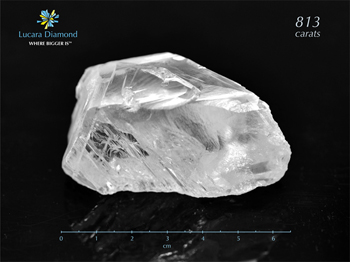
Karowe produced three large diamonds late last year through an industrial process: the Constellation 813 carat stone sold in May for $63 million, a 1,109-carat Lesedi La Rona to be sold end of this month and a 374 carat stone, which is yet to be sold.
Day also spoke about the massive expression of interest on Lesedi by traditional and non-traditional diamond buyers despite earlier fears that a large stone would not attract a good price.
Below are the excerpts.
I understand Lesedi is going under the hammer on the 29th of June (interrupted)...
That’s right.
What are your expectations given that some brokers had told Lucara that it won’t fetch much from a 1000 carat stone?
Some of the diamond brokers said ‘with a 1000 carat stone the best thing you can do is to hit it with a hammer and crush it into smaller stones because they will be easy to sell. A 1000 carat stone will be difficult to sell’, but we really do not believe that. We believe that we have seen a massive interest in the sale of our stones as they become progressively bigger and our first large diamond was a 169 carat which in the scheme of things these days is not even large.
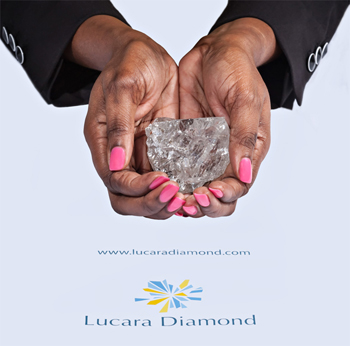 But as we started recovering high quality large diamonds we [are] even surprised ourselves at the level of interest and just last year we sold a highest value stone for $3.7 million, which was a 342 carat stone. This was sold through our normal tender process, so we feel we are getting to understand this market and we see continued interest in these high valued stones and soon as we recovered that large diamond – 1,109-carat Lesedi La Rona – we had expressions of interest from various individuals and bodies, interested in purchasing the stone for a high value, so we see an opportunity for that stone not just for the [diamond dealers] but individual collectors of high net worth artifacts, be they individuals or institutions, and hence that was the reason to take it to an open auction rather than having a closed tender, which typically attracts [diamond buyers]…
Our management team had been touring with the stone starting off in the Far East (Hong Kong and Singapore), the stone then went to Dubai in the Middle East, from there it went over to New York and then to Geneva, Antwerp and now it’s being showcased in London.
Do you have a reserve price for this stone?
We haven’t settled on a reserved price as such, there will be a reserve, but I think the easiest reference for a reserve is the sell value achieved for the 813 carat stone which was $63 million or $77 000 per carat so logically that becomes a floor and although we haven’t settled on an actual reserve ... one should think about that value.
You said there was a marked interest from potential buyers in Lesedi and are there any figures floated around?
I think our CEO William Lamb was quoted as saying we had an offer from an institution in America of $40 million very early on, but currently we believe we will get much more than that on a public platform.
Lucara recovered two other large stones late last year and you have already made reference to the 813 carat stone. Have you sold the other stone?
We sold the stone that is now known as the Constellation 813 carat stone in May for $63 million and that would be cut and polished into a stone. We do also have a 374 carat stone, which we recovered within the same time period as the Constellation and Lesedi La Rona. At the moment we haven’t formulated a sale strategy, but we will sell it, but we haven’t identified a strategy or a timeline.
 Will you benefit from the polishing of Constellation?
Yes, with our client, Nemesis, a company that operates in Dubai, we held a 10 percent interest in the profit that is achieved from the final sale of the polished outcome of that rough stone.
What is your projected revenue for the year?
In terms of market guidance, we have said that we would get a revenue of between $ 200 million and $ 220 million excluding the sale of the Constellation and the Lesedi La Rona (whose value is still unknown out there), so those who want to do the Maths [can do so to see our new market guidance when the stone if finally sold].
How many carats of diamonds are you planning to sell this year?
We will sell between 340 000 and 380 000 carats this year.
How many carats will you produce this year as well?
In terms of production its roughly the same with the sales figures, we don’t hold massive inventories so in any way we sell what we produce on an annual basis.
Your projected capital expenditure for the year is seen between $15 million and $18 million. What are your planned projects for the year?
The project capital expenditure is largely driven towards equipping the plant to deal with two things: to take the top size of diamonds recoverable up from 60 mm to 80 mm and then on to 100mm that will give Karowe an opportunity to recover undamaged stones.
What has helped you recover large stones?
Of course the large stones have to exist in the ore body and their geological phenomenon, the trick where Lucara leveraged its expertise was in the identification of the potential of course diamonds before they were recovered so as we started recovering coarser and coarser diamonds our experts in that regard identified where the top size stones might exists and that early identification enabled Lucara to start equipping the plant and put the engineering capacity to recover those large diamonds in time to be mined and that really is where the success was. Obviously if they are not there you can’t recover them and if they are there you got to be equipped to recover them. The Lesedi La Rona and Constellation are the first truly huge diamonds ever to be recovered through an industrial process, those diamonds were drilled, blustered, loaded into a truck, then to a primary crusher, to a secondary crusher, through a mill and into a recovering circuit. That’s incredibly a destructive manner and I think if you look at the historic diamonds that have been recovered – and there has been some big boys out there – most of those have been recovered from a much gentler process, quite often through alluvial, panning process, etcetera and I think the phenomenal thing about these two diamonds is the fact that they were successfully extracted from an industrial process.
You have a strong cash position, what are your plans with this cash?
We have in mind to invest it and increase the size of the company in future either through a merger or an acquisition activity if not developing a mine at the exploration prospects that we have or through taking the existing operation on the ground in the future, that is the aim.
Mathew Nyaungwa, Editor in Chief of the African Bureau, Rough&Polished
