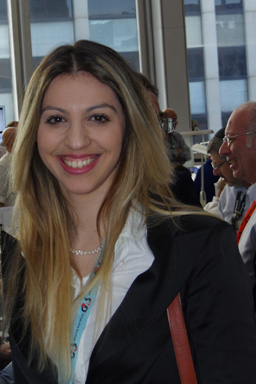
 Ali Pastorini, Senior Vice-President of the World Jewelry Hub in Panama City and owner/partner of DEL LIMA JEWERLY in an interview to Rough & Polished talked about the trends of the jewelry market in Latin America, the preferences of its consumers and the role of women in the regional jewelry business.
How has the current global slowdown affected WJH’s business in terms of demand for its services?
We would be deceiving ourselves if we pretended that what is going on with the world does not affect our business, but at the same time we are fortunate to be a fast growing center, in market that has never been provided the opportunity to demonstrate its full potential. What this means is that our ability to show positive results is easier than it is in other centers.
The infrastructure we have provided is specifically designed to facilitate growth in Latin America, so while there are clearly global issues that need to be faced, regionally we have good reason to be optimistic.
We just finish the Second LATAM Week and our members had chance to meet new and promising customers. These are jewelers who have more than two store in their respective countries.
But even our new clients are report that their customers are buying less, which means that while we are increasing WJH’s client base, the value per sale is lower than we would like. That is the reality of the world around us. People are buying less and it is important that our industry adapt to this reality.
What we are suggesting to our members is that, if they not reduce prices, which are always more difficult raise to their previous levels once the market recovers, they should be more flexible with payment. They should also think of new benefits in order to conquer new clients and hold onto existing ones.
In a short term this strategy may not be profitable, but in a long term it will be, especially when you have a growing client base.
What is your opinion on synthetic or lab grown diamonds (LGD), which sales tripled in the USA from 0.1% in 2015 to 0.3% in 2016, according to Madestones?
Personally, for me a diamond should always be the real thing, which is to say a stone that was produced in nature, making it a unique and ageless object that no factory can reproduce. But that is not to say that there is anything illegal or immoral about synthetic diamond, as long as the consumer clearly understands what he or she is getting, and what is the difference between the two.
I do not buy into the theory that synthetics are cutting into natural diamonds’ market share. As a separate product, they are creating their own market, and we need to defend and grow the natural diamond market.
We know that there are those who are misrepresenting synthetics, and even mixing them with natural stones. This is criminal, and such people need to be weeded out of the industry, expelled, and whenever possible prosecuted.
What kinds of stones are preferred by WJH’s customers?
Colored gemstones are traditionally popular in Latin America, and we are seeing big demand for emeralds, with citrine and aquamarine also popular.
Diamonds, of course, are also very popular stones, with the bulk of demand being in the small and medium sizes.
Why are you so pro-actively contributing to the expansion of the role of women in the jewelry business?
As I noted in my speech to the First Latin American women jewelers meeting in June at the World Jewelry Hub in Panama City, even though I didn't have to fight for my place in my own company, Del Lima, I cannot pretend not to know what's is going on in our industry. I have never understood the reason why, in a business where the majority consumer are women, we have so very few women in key decision-making positions.
As I also said in my address, we don't want any courtesies or favors. All we are seeking is a fair and equal chance to compete for executive status.
Many women around the world never had a real chance. I was empowered because I was able to set up my own company and to expand into new markets, and now to serve as Senior Vice President at the World Jewelry Hub. I learned that, to succeed, we have to take things into our own hands, and not wait for someone to help.
I honestly believe that, because for so long women have played secondary roles in our business, the industry lost the opportunity of truly understanding the most critical segment of our market. Why, over the past 10 years have so, have so many women foregone diamond and jewelry in favor of shoes and iPhones. Buying luxury products often requires an emotional decision, the reality is that we are an industry that does not fully appreciate a woman’s emotions.
Women, like the ones we spoke to at our event in June, understand our target audience better. They have wonderful ideas. They have passion. They are supremely competent and talented. The industry simply cannot ignore them.
As the owner of the jewelry brand what kind of jewelry do you prefer?
I like what I and my partner, Dione Lima, create. This largely is 18K gold jewelry set with colored gemstones, and also only gold jewelry without stones.
I like to play with color because it creates an identity. Emeralds with diamonds are available from many brands. We try to create items that are out of the ordinary, but which our customers appreciate.
What kind of jewelry is in fashion this summer in Latin America?
As I already mentioned, Latin America likes colored gemstones, but there are variations in taste as you move through the region. I have noticed lately, for example, that Colombians like darker dark stones, such as onyx.
My brand has tended toward our blue stones, such as like tanzanite, turquoise, amazonite and blue topaz. But customers requested more pinks and purples, so we added pink opal, morganite, iolite and amethyst.
Have you thought about making an Olympic jewelry line?
Del Lima is a very specific brand, with a closely defined identity, personality and, consequently, specific type of customer. We have carefully nurtured our brand identity, which we believe is not time sensitive nor geographically dependent.
For these reasons we never really thought about creating an Olympic jewelry collection, although like most Brazilians we are proud and excited about the event.
What are your predictions for regional jewelry business looking forward to the rest of 2016?
Latin Americans are spending more than their counterparts in many other places around world, but we do not live in a vacuum. The same factors that have affected in the industry in other countries, including price volatility of precious metals, the relatively high value of the U.S. dollar, the bank credit crunch and the slowdown in China and India, have affected us, although most probably not as dramatically as elsewhere.
Latin America is a not a completely homogenous market. Certain countries, like Brazil, Argentina and most particularly, Venezuela, have been through a particularly tough patch. But other countries, including Mexico, Chile, Colombia, Peru and Panama, have been more buoyant.
Given the general state of the market I do not expect a dramatic recovery this year, but I am not pessimistic. I would predict that things remain stable for the next few months, hopefully picking up before the Christmas season.
Is it too early to say that the global diamond and jewelry market has embarked on the road to recovery?
It is not early. At the recent JCK Show in Las Vegas, my general impression was that the customers were buying more than last year. That, of course, is more indicative of the U.S. market, which is definitely in recovery, but there are signs that things are picking up in China as well.
Everything in life is cyclical, and the same is true for our industry. In my opinion, while we may not be recovering at the pace that some may wish, we still are definitely recovering.
Alex Shishlo, Editor of the Rough&Polished European Bureau in Brussels
