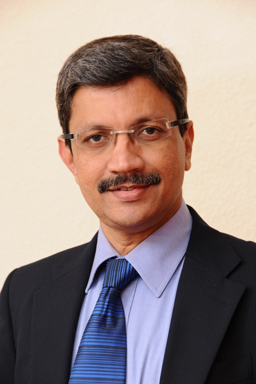
 Somasundaram PR joined the World Gold Council in January 2013, as Managing Director, India. Based in Mumbai, Som is responsible for leading the World Gold Council's activities across the Indian gold market.
A qualified Chartered Accountant, Som has over 27 years' experience across diverse industries including the FMCG and banking sectors. Prior to joining the World Gold Council, Som was the Chief Executive Officer of Lakshmi Vilas Bank, a private sector bank. Prior to that, he was part of Standard Chartered Bank in India for over eight years in various senior roles before taking on the role of Managing Director of Standard Chartered – STCI Capital Markets, the securities arm of Standard Chartered Bank. Earlier, Som had spent over 13 years with Hindustan Unilever (HUL) in a variety of roles, as well as working at Tata Consultancy Services.
Speaking to Rough&Polished, Som not only throws light on numerous aspects of the gold sector in India, but also draws a crystal clear picture of what the future holds for this very crucial market.
Some excerpts…
Where does the Indian gold sector stand right now, given all the market forces at play? Does one look at a scene of volatility in gold prices during the coming months? How cautious should an average investor be while investing in gold at present?
The fundamental drivers of demand and price are robust, there is nothing that suggest that the role of gold in an average household has changed. India’s gold demand, in dollar terms, has grown at a CAGR of 14% over the last 15 years. In H1, though, demand has been lower as the Government’s measures to bring in trade transparency have met with initial trade resistance, more due to fear of complexity of operations. Indian gold trade is at the cusp of major changes and It will benefit both consumers and the trade to transition swiftly to the new reality of better tax compliance – and this is not restricted to gold alone, this is across segments, nationally. The focus has to shift to adopting an industry wide code of conduct covering responsible sourcing, transparent pricing and hallmarking, without exception. At the same time, policy endeavors have to be made towards a reasonable duty framework under and new Goods and Services Tax (GST) considering gold’s role in promoting and protecting savings and in enabling easier access to credit for a wider cross-section of people.
In the remaining six months of 2016, we anticipate gold demand to return to normalcy during the peak season of weddings and festivals closer to Diwali, supported by good monsoons that will positively impact rural demand.
We estimate gold demand for 2016 to be in the range of 750 to 850 tonnes.
The Indian government’s gold monetization scheme current status is not very encouraging. And also, what’s your opinion on sovereign gold bond scheme? Is the government on the right track?
All three schemes - Gold Monetization Scheme, Indian Gold Coin and Sovereign Gold Bond are still very much in their infancy. We believe it is premature to quantify their success. There are operational issues that needs ironing out and the Government is continuously making efforts to address them. For instance, the government allowed the redemptions in gold for Gold Monetization Scheme so that temples can deposit their gold. Having said that, one of the key challenges to make the Gold Monetization Scheme work is to incentivize banks adequately in order for them to participate actively in the scheme. It is always good to expand consumer choices backed by transparency and trust around gold, and to that end, the Sovereign gold bond has a role, though backing it with gold will perhaps open up the market further for pooling gold savings. It is important to remember that the schemes are positive for India as they enable the country’s natural affinity with gold as a savings asset to help boost the economy. Gold is an asset class next only to fixed deposits in a household portfolio and therefore, these schemes that attempt to mainstream gold savings with transparency, will redefine India’s relationship with gold in the coming years. We will have to give them time as it is about a mindset change.
Gold recycling has picked up in India after the gold prices began to rise. You see this trend continuing further? How will this affect the gold sector, in terms of demand? Will this leave jewellers with huge inventories, adversely affecting their profits/liquidity?
Recycling in India through jewelers and refiners is less than 10% of the total demand and this is not expected to change significantly unless the gold monetization scheme through banks picks up. Banks and organized financial players are not allowed to buy back gold and this also limits the recycling market. The current system is opaque and is not conducive to growth, particularly with new compliance measures targeting transparency of sourcing. Total gold recycled in India in Q2 2016 was 23.8 tonnes, as compared to 24.0 tonnes in Q2 2015. Currently gold in India is trading at a discount because of softened demand and therefore, recycling is impacted. Smuggling is also rearing its ugly head and this has impacted the market, many refineries are operating at very low capacity utilization already. In India, however, recycling old jewellery for new is a big business for jewelers (around a third of their sales) and that continues.
According to some retailers, price instability has affected demand for gold jewellery; and jewellery consumers are not too interested to purchase jewellery even during festivals. Your comments.
Gold has been steadily rising since the beginning of the year, in local INR terms, the price rise in H1 has been around 27%. This has been a key factor for the lower demand in H1, though other factors such as trade strike and the insistence on the tax number for purchases above USD 3,000 have been more significant reasons for the drop in demand. Total Jewellery demand in India for H1 2016 was down by 29.6% at 247.4 tonnes as compared to 351.5 tonnes in H1 2015.
The gold demand outlook for the second half looks promising at the back of the good monsoon which will fuel rural incomes. Typically, second half and more particularly last quarter, tends to be the growth season as it coincides with increase in rural incomes after the main harvest along with the festival and wedding season. The risks continue to be the willingness and ability of the unorganized segment of the trade to transition to the new tax transparency measures and the Government’s intent to initiate a fair tax for gold under GST, understanding the value addition of the industry and the economic role of gold in the households. At the heart of the matter is the need to treat gold and jewellery as a currency, an asset class for households, and not a demerit good and address pooling these household savings through the schemes announced.
Do Indian consumers still look at gold jewellery as an investment only or does other factors like fashion or their design, craftsmanship, etc., attract customers to buy them. Has the attitude towards gold jewellery changed over the years? Your views…
Indians are the one of the world’s biggest buyers of gold jewellery with over 600 tonnes bought in 2015. Millions of households in India purchase jewellery not just for adornment but also as part of their household financial portfolio. Several retailers and jewellers offer jewellery purchase schemes which allow consumers to allocate funds to buy jewellery through fixed monthly deposits. Gold jewellery symbolizes prosperity which manifests the most in Indian weddings where the amount of gold jewellery adorned by the bride is considered to be a reflection of the family’s social and economic standing. Today’s urban Indian women have been adopting contemporary designs for everyday use and wear. Younger, more affluent Indian consumers want pieces that are modern, yet reflect their heritage and culture; jewellery that expresses their new identity. Youth are also looking for innovation in gold jewellery and most certainly, want to transact with better transparency and compliance.
Gold vs other luxury products is the scenario we have been seeing of late, especially with the younger generation. How do you think this will pan out in the next, say 5 years?
An average Indian household has always purchased gold with a sense of responsibility, allocating a certain sum and trying to buy gold at the best time within that allocation. Gold in any form is an investment and this unique place is not shared by other luxury spends – which is why Indian households prefer 22K gold.
Rise in disposable incomes in India is inspiring a new generation of consumers to seek out gold jewellery as both a treasured accessory and an investment for the future. Consumers look gold with unique breadth, an expression of who you are and who you want to be, gold combines status with beauty and tradition along with wealth preservation qualities. Working women in age group 20-30 have the greatest influence on the gold jewellery market. Apart from buying or receiving jewellery only on special occasions such as weddings or festivals; they even indulge in self-gifting. An increasingly digital savvy generation connected by social media that is equipped with the purchasing power will continue to build on the rich heritage of gold. We will see the younger lot’s relationship with gold redefined, stronger and more innovative.
Due to high prices, Indians are deferring gold/ jewellery purchases. What is the biggest hurdle for demand for gold at present? Will the coming festival season make any major impact on the domestic demand?
Gold has been a wealth preservation tool for centuries as it is an effective hedge against currency weakness, inflation and tail risks for investors. The re-introduction of a 1% excise duty during the Union Budget which resulted in a 42-day strike, is making jewellery buying more expensive and could lead to irregular business practices. It will also add a significant compliance burden onto an industry already weighed down by a huge burden of customs duty and VAT. Gold is essentially a savings instrument and savings should not be taxed, they should be tapped. The regulation introduced ensuring PAN card details are disclosed for purchases above Rs 2 Lakhs, is also reported to have affected buying. In the first half of 2016, the gold prices saw an upswing of 27 percent which greatly impacted the gold uptake in the country. It will benefit both consumers and the trade to transition swiftly to the new reality of better tax compliance, across segments, nationally. Consumers are also becoming aware that the international drivers of price appear fundamentally strong and sustainable, this will draw them back during Diwali.
Gold jewellery vs total bar and coin demand… what is the picture right now? And how do you expect the demand pattern change during the new few months?
The jewellery and investment demand for the second quarter of 2016 was 97.9 tonnes and 33.1 tonnes respectively. Jewellery constitutes a large portion of the Indian gold demand as compared to bars and coins. Bars and Coins account for 25-30% on an average. Unlike in the west, Indian investment demand also moves through jewellery trade and is driven through households. We expect this trend to continue in next few months. Branded Coins such as the Indian Gold Coin launched by the Government have a big role in recycling of gold and in better compliance, unless this is understood widely and Indian banks distribute Indian gold coin widely, the structure of demand will remain more or less the same as in the last few years.
According to reports, Gold ETFs topped compared to all other investments in H1 2016. What will be the demand for gold for the rest of the fiscal as high prices are negatively affecting demand for gold jewellery?
Globally first half of 2016 witnessed a record high demand for Gold ETFs driven primarily by western investors. Exchange traded funds (ETFs) had a stellar first half of the year at almost 580 tonnes due to the additional inflows in Q2 of 237 tonnes. Usually jewellery comprises of 50-60 percent of the total gold demand but this year, the jewellery demand accounted for 40 percent of the total demand in H1. Indian ETF demand is very small, total of 14 ETFs hold around USD 1 B of AUM.
Where does India stand Vis a Vis China in gold consumption levels; and what does the future hold for both these markets which are major gold consumers? Is China more organized and growing the gold sector?
India is the second largest consumer after China but the largest importer as India hardly mines any gold of its own. China faced a challenging quarter against a relatively soft economic backdrop and the implementation of new mandatory hallmarking legislation that became effective in May. The gold demand in China for H1 2016 was 444 tonnes in comparison to 247.4 tonnes of India. Our full year gold estimates for China is 850-950 tonnes and India is 750-850 tonnes for the current year. We believe that this is a transition phase where markets are adapting to global changes in the gold industry for example mandatory hallmarking, gold policies, etc. India and China are both taking the necessary steps within their capacity to advance their gold industry.
Gold sector in India sees establishing a Gold Exchange and a Bullion board a major necessity. Do you see the Indian government coming up with a National gold policy in the near future? Your views please.
India’s gold industry landscape is strikingly contrasting in nature. On one side, the country is steadily elevating its position in the global gold market with bold new schemes and landmark sovereign products like the Indian Gold Coin. But domestically, the Indian gold market continues to be fragmented and unorganized with elements such as non-trivial price arbitrage prevailing through gold buying and selling. Establishment of a Gold Exchange in India is highly viable and will act as an impetus to develop a regulated channel for buying and selling standardized quality gold in India, while enabling a national pricing structure of gold. It has the potential to conceive a vibrant gold ecosystem through efficient price discovery, assurance in the quality, greater integration with financial markets, and greater gold recycling. Global experience also supports the need for a gold exchange in India as it directly bolsters Gold Monetisation Scheme and gold bonds through hedging mechanism offered to banks and the government. An Indian Gold Exchange could be catalytic to the growth path India has set on. The industry should holistically view its viability and seek policy support to improve the infrastructure for gold, ensuring transparency and quality, both fundamental to making the gold schemes a success.
As highlighted in our report released in 2014 – Why India needs a gold policy, the time has come for India to think holistically on all aspects of gold and have a ‘National Gold Policy’ that makes gold a fungible asset class and enables it to play a bigger role in the economy.
Wrapping up, your take on India’s current gold imports; import controls; and steps that could be taken by the Indian government to suitably stabilize the gold sector.
India has a tacit leadership position and huge stake in the global gold market, it makes sense to acknowledge our role an act appropriately. We are perhaps leaving too much on the table as we focus just on import curbs. It is time to take the debate beyond import curbs and understand how to pool gold savings through the organized financial sector.
Measures on tax transparency are steps in the right direction but this should be followed up with rigorous implementation so compliance is universal. For the gold industry to stabilize, the focus has to shift to adopting an industry wide code of conduct covering responsible sourcing, transparent pricing and hallmarking, without exception. The gold schemes have to be supported with time and better incentives so the organized financial sector play a bigger role in bullion savings over time. At the same time, policy endeavors have to be made towards a reasonable duty framework considering gold’s role, inter-alia, in promoting and protecting savings and in enabling easier access to credit for a wider cross-section of people. Indian households are estimated to have over USD1Trillion of savings and they continue to buy USD 30-40bn each year, this cannot be wished away through supply curbs. India needs a comprehensive gold policy that harnesses this asset class transparently and steers the gold industry into fit-for-the-future role.
Aruna Gaitonde, Editor in Chief of Asian Bureau, Rough&Polished
