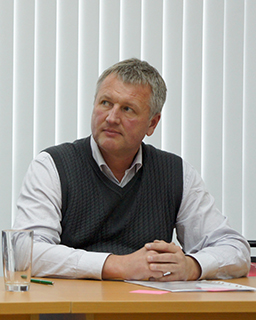
 Eduard Utkin, General Manager of the Russian Jewelers Guild sat with Rough&Polished for a talk about the IV International Economic Forum titled "Jewellery Russia. Tomorrow begins today,” which was held in late September at the All-Russia Exhibition Centre in Moscow. He also spoke about the changes taking place in the domestic jewelry market, about the urgent problems facing the industry and its immediate prospects.
Can you outline some positive changes in the jewelry market in recent years?
If you take, say, the years of 2015 and 2016, it should be noted that before those years our market here was growing annually by 20-30% until the end of 2014. This growth was wanton and brought about allies of the moment. However, now is the time when such allies are leaving the market. In other words, the market is abandoned by those players who came to it by chance, looking for immediate profits, and now they are leaving this market. Hence, the market is purged in a certain way, and I think this is the most important factor among those positive things that are happening there.
In one of your recent interviews, you said that the jewelry market is in a stage of global transformation. What can we expect from the new State Duma regarding the jewelry business? Will it take a harder or more liberal stance?
The share of goods produced by the jewelry industry is utterly small in the country’s GDP to make the State Duma specially address the problems facing the industry. It is unlikely to happen, so we can talk about the general policy pursued by the state in the field of economy. I think that some kind of measures will inevitably be taken to expand non-oil exports from the country. Russia needs earnings in foreign exchange, while its main proceeds are coming from oil and gas, which are currently decreasing. Therefore, I think the government will still be forced to contribute to the development of real production and export of manufactured goods. And here we have a lot of advantages, because the jewelry industry is in a winning position, as compared to many other sectors of the economy, for we have a resource base sufficient for producing our goods, we have qualified personnel, we bought advanced equipment in the fat years and we have the latest technology in jewelry production. And all this arrangement is competitive today with regard to overseas markets in terms of prices, design and value.
What is the burning issue on your agenda today?
Perhaps, there are several of them. The first one and maybe the most important issue is how to sell jewelry goods. The domestic market has sagged, while domestic demand will either remain at the current levels for a long time, or may even go a bit further down, so jewelers cannot rely on the domestic market and are already turning their attention to international markets. In other words, export, export and once again export - this is the major global trend. If we are talking about export, then apart from that we have to learn how to trade in foreign markets, we shall have, so to say, to stake out a claim there – or maybe even to win a claim – to have our own share, our own small piece of the market. To achieve this, we have to be well prepared and assisted by a competent and skilled personnel. But the main obstacle we are facing, oddly enough, lies in the legal framework regulating customs clearance. This procedure is long, complicated and expensive. Therefore, export operations can currently be carried out only by large and medium-sized companies, while small businesses find it very difficult, and the jewelry industry here, for the most part, consists of small businesses. The second issue is the removal of any restrictions on selling jewelry online. The law here has a number of contradictions that allow various authorities to interpret them ambiguously, and sometimes this results in restrictions on e-commerce. Internet providers limit us in placing our materials for promotional purposes, while courts pass judgements blocking our websites. This problem must be solved, and solved urgently - we hope that this will happen soon. The third pressing issue is, of course, the control executed by the Federal Financial Monitoring Service over jewelry circulation. Jewelry here is the only merchandise item which fell under this control. At the same time, other accessories comparable by their price, or for instance clothing, or shoes can be bought without customer identification procedures and without complicated procedures of reporting to the Federal Financial Monitoring Service. However, jewelry items, while having the same value, fall under special control for some reason. Due to some reasoning, jewelry is considered as being specifically designed for laundering criminal proceeds. So our maximum task is to take jewelry from the jurisdiction of Federal Law 115, and our minimum task is to take at least silver jewelry from the jurisdiction of this law, as silver jewelry is now comparable to bijouterie by value.
What are the changes in business tactics and strategies in a contracting market?
I have already described it and the strategy is to repurpose your business, leaving the domestic market for the international market. If any significant share of industry players will find a niche in foreign markets, thereby they will relieve pressure on the domestic market, and the latter will turn more spacious. As for manufactured goods, this is not strategy, it’s tactics. Right now we see that jewelry is made to be cheaper and even extremely cheap. For this purpose, jewelers are switching from natural to synthetic stones, or moving from the category of gold jewelry to the category of silver jewelry; some are trying to make their goods as lightweight as possible, others are saving on their personnel, their training and purchases of equipment - that is, every possible saving method is used to allow companies to survive these days.
Economic forums, conferences, extensive discussions of existing problems – do they contribute to the survival of the jewelry industry?
Formerly, jewelers here used to get together quite often - many took part in jewelry exhibitions, others came to pick goods and while visiting various cities, they talked with each other and socialized. Currently, the jewelry community looks more fragmented, because jewelers turned to be much rarer guests at exhibitions coming at least to one or two jewelry shows a year, while goods are being picked now mainly online, which makes such forums very important for the jewelry community giving it a possibility to convene in one place and work out some kind of a common policy or the tactics and strategy of behavior we mentioned. This is that simple to understand the position at which we are today. Therefore, coming to these forums attended by leading experts from government agencies and jewelry companies gives you a chance, as they say, to listen to clever people to take the right and responsible decision on how to do your business further. And this is something on which our industry depends and on which its survival and flourishing depends as well – on making the right decisions.
Regarding export orientation, how real is the possibility to get access to world markets in the current adverse conditions?
With regard to how real it is, this was just one of the themes discussed at the recent economic jewelry forum held under the slogan, "Jewellery Exports - Fiction or Reality." Even the theme reflects these doubts as to how real it is. There are two problems in this respect. The first one is that all the niches in foreign markets are occupied and there are established relationships between customers and consumers, so it is extremely difficult to edge into such a market. The other factor is that foreign markets are all basically conservative and they are not very eager to welcome new players. Therefore, export operations are being successfully developed by those companies which hold on to the B2C format - that is, they open their own retail networks reaching out to end consumers. In this case they are able to stake out a place and contact buyers directly, getting rid of intermediaries, such as the wholesale sector and local retailers. And, perhaps, this is the most realistic path to foreign markets - by way of opening own jewelry stores, managing such stores and establishing logistics centers. This also goes along with rolling out service centers to repair jewelry pieces, resize rings and so forth. The second format used to enter overseas markets is B2B. But it is difficult, because potential buyers, network owners and wholesale companies already have well-established relationships with their suppliers. So, in order to persuade them to allocate some share in their segment for newly arriving companies from Russia you need to have convincing arguments in store. It is not easy, and many companies have been trying to enter such market for several years, but still stay where they first started. The third option chosen by some jewelry firms is to take jewelry production out of Russia. That is, they establish jewelry manufacturing operations outside the customs territory of the Russian Federation. Accordingly, this simplifies the logistics procedure in the first place and makes it cheaper to produce jewelry to a certain extent. Their production management remains here, in Russia, and often their design departments are also here, but jewelry manufacturing is located abroad. Well, it's the third format, which is also quite promising. But this is, unfortunately, not related to exports - it is the export of capital as it was defined by Marx.
This year, the forum was held at a new venue, which was the All-Russia Exhibition Center in Moscow and not the Chamber of Commerce or the Guild of Jewelers. Why?
We have changed the venue for one simple reason: the forum was always held during the ongoing jewelry exhibition and for many in today's difficult situation it seemed unrealistic to leave the jewelry show to be present at another event. Therefore, if the mountain does not come to Mohammed, then Mohammed goes the mountain... We have changed the venue to make it possible for the vast majority of people taking part in the exhibition – attended by 70% of industry stakeholders - to join the forum. Of course, the new place was a bit far-off for government officials, including highest-ranking leaders, due to difficult traffic. But here it is necessary to understand that the policy of government agencies towards the jewelry industry is basically developed not by the top management, but by the middle staff - those professionals who prepare documents and direct all activities – and for us it is very important to have them at the exhibition. Nowadays, there are so many talented young people working in government agencies, who are ambitious to a certain extent and know well that from time to time they have to be on the shop floor for a successful career. You know, there are high-ranking officers in the army called "parquet generals" - those that never smelled gunpowder and earned their stars and ranks in the comfort of their offices. So, the current generation of our young officials are well aware that they have to know industry problems well, be in touch and monitor the situation for a successful career. And you have to gain experience and knowledge, and it is such events that make it possible to do this. In any case, the format of this forum is focused on dialogue.
In what way are you going to change the format of this forum?
If you remember, earlier our forums were held in the form of plenary sessions - this is when the keynote speaker reads his report, while all the others present in the room listen. At the last forum we tried to animate the procedure with questions from the audience, but the activity was extremely low. To make the event interesting and useful for all, we have decided to change the format, and now the forum will be held in the form of panel discussions. In some part, we tested this approach at a conference on gems and the event attracted more interest from participants.
Did you discuss matters related to the diamond industry?
There was no separate item on the agenda of this forum specially dedicated to rough and polished diamonds. But diamonds were discussed within the session on "Natural gems versus synthetic gems" attended by gemologists. It is a very large and, I would say, a very sensitive issue - the use of synthetic gemstones in jewelry. Diamond synthesis is picking up steam all over the world. And, simultaneously we see how natural gems are being replaced by their synthetic analogues – polished goods cut from synthetic diamonds. And this process is gaining quite a momentum in recent years. This is the topic we discussed at the forum for we have to understand the prospects of natural gems for asserting their place in the minds and wallets of consumers against synthetic goods. Taking into account that the synthesis technique is improving and production costs decreasing, whereas the latter in diamond mining is on the rise, there is a new and very difficult challenge for our industry. All this is causing serious concern – what if synthetic diamonds will eventually slice off some part of the market from natural diamonds. Not supplanting them entirely, but edging them out to quite a great extent due to lower prices. So, what kind of arguments should diamond sellers and diamond suppliers seek to retain their customers? This was the issue, which was discussed.
In your opinion, what are the prospects for the jewelry industry in the near future?
If those companies that produce competitive products will manage to enter overseas markets, they will be guaranteed to have VIP-class tickets to the future. Those businesses, which will not be able to enter overseas markets will have to wage a very bitter struggle for consumers, because, according to forecasts, demand is unlikely to grow, and the operation patterns, which are vital for them today, will turn extinct tomorrow, and they will have to look for some new forms and methods to attract remaining consumers, because the market is shrinking like shagreen leather. Therefore, you can’t say that the prospects for the industry are good. For some, the current situation really opens up prospects, of which they could not even dream earlier, but for someone, unfortunately, these are difficult times that may result in a complete collapse of their businesses.
Speaking of national brands, can you name some specific brands that you consider most promising?
In Russia we have a number of potentially very promising brands, both among large and small jewelry companies. The buzz words here are such jewelry brands as "Sokolov" (Kostroma), "Gevorkyan" (Moscow), "Ringo" (Ekaterinburg), "Pomelnikov" (St. Petersburg), "Sadko" (St. Petersburg), "Tulupov" (Ekaterinburg)... In general, if you mention them all you will probably have a list of five dozen brands that have good prospects for further development of their jewelry business both in overseas and domestic markets.
Galina Semyonova for Rough&Polished
