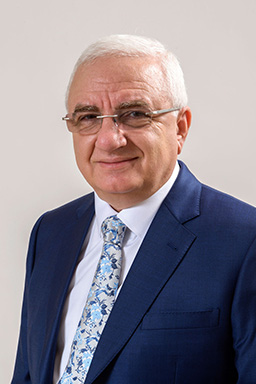
 The activity of World Diamond Mark® (WDM) established by the World Federation of Diamond Bourses (WFDB) to enhance consumers’ desire to buy natural diamonds is currently focused on the downstream segment of the diamond pipeline in the belief that the very first contact customers have with salespersons should be a perfect experience, and to make this happen the WDM is reaching out to retailers offering them a new vision and a profound program for turning their would-be buyers into staunch adherents of fashion for diamonds. Alex Popov, Chairman of World Diamond Mark sat down with Rough&Polished to describe what has been achieved by the WDM on this way and share his views on diamond marketing and diamond education.
What is the progress in the WDM Authorised Diamond Dealer programme? How many authorized diamond dealers are there today?
At the beginning of 2016, we did the assessment of our activities. We invited a world-renowned luxury marketing consultant, Dr. Frank Mueller from Germany, and organised a two-day seminar in Vicenza in January where we discussed the WDM Authorised Diamond Dealer programme. Based on the outcome of those discussions, the value proposition of the programme was re-written and the new plan was put in motion. So almost the whole of 2016 – from January to October - was spent on revamping and refreshing of the programme. If we speak in figures – on January 1st 2016 we had 84 WDM Authorised Dealers and today, there are 225. All the growth was done in December, as we didn’t engage in any recruitment till then.
If it was all done in one month, then it is an explosive growth.
Indeed, I hope that this will continue and in February the number will grow to 400. Serious retail networks are joining and I am confident that during the first two quarters of 2017 we’ll see similar growth.
What was the reason for the pause from March to December?
We took the decision to ask other people for their views and received experts’ opinions to what we had done right and what not. The retailer survey conducted in Dubai, online and through the World Diamond Magazine, helped a lot. Hence the pause to rework the programme and make it more attractive.
According to some publications, diamond jewellery sales of the recent holiday season were positive. Will this help the WDM Authorised Diamond Dealer programme?
No doubt. However, we also need to take into account that the whole year before December was very slow. Our growth in December wasn’t the result of good holiday sales, but the result of work done before and the talks conducted in September, when the market wasn’t optimistic at all. Therefore, I foresee a bright future for the programme. If we managed to achieve major increase of the number of participants in difficult times, in better times it will grow even faster.
We put together a special presentation for retailers at BrilliAnt – the Antwerp Diamond Trade Fair (ADTF) January 29-31st; including two presentations and on site activities. We will continue this drive at the Presidents’ Meeting in Mumbai on February 5-8th, then at the Israel International Diamond Week of February 13-16th, and further in Basel, Dubai, Hong Kong, Turkey. On June 4, we’ll conduct a breakfast meeting for American retailers at JCK in Las Vegas. This is the 70th year from the foundation of the World Federation of Diamond Bourses (WFDB) and all our activities are dedicated to this jubilee. Since the WDM is an inseparable part of the WFDB, the World Diamond Mark is paying a tribute to this important anniversary.
Your organization has started to plan for three years ahead. What long-term goals do you set for yourselves?
We need to understand where we will be in three or five years from now. Being the world organisation, we cannot work ad hoc but need to see the clear perspective ahead, have a serious plan and the vision of where we would like to be. Such a three-year plan was presented by WDM Programme Director Krisztina Kalman-Schueler at the last World Diamond Congress in Dubai where it was adopted for action. Since then we do the reverse engineering from the goal, asking ourselves what needs to be done today to achieve the next milestone. This helps to work in the more organised manner.
Does your programme still aim to reach the widest possible range of jewellery retailers with the goal of raising funds for diamond generic advertising?
Yes, and this takes time. First, this community is disorganised and very wide. Second, this public is not always mentally prepared to invest money in something that will also help their competitors. Two shops on the same street may not necessarily like each other. Sometimes it is difficult for some people to overcome this barrier. We expect to work these difficulties out within two-three years and reach the critical mass. Then, I think, we will be in position to start contributing to Diamond Producers’ Association (DPA) generic advertising efforts if our shareholders will decide to do so.
Speaking of membership – we have introduced three membership levels for WDM Authorised Diamond Dealers – silver, gold and platinum. This comes from the understanding that people need to see tangible benefits before they commit any funds. This approach proved to be successful and many people sign up for silver membership. Some choose outright the gold level and others, starting from silver, moved to gold.
And another important issue: we have understood that if we won’t reach out to consumer, the retailers will be less interested to register as members. So, we started to perfect our digital marketing skills through social media and within next couple of weeks will launch a consumer-dedicated (B2C) website. We have invested significant time, resources and labour in this.
Generic diamond marketing has been re-started in the framework of the DPA programme. Do your efforts supplement theirs, or you have taken a separate path?
We all share a single goal – to increase the consumption of diamonds. The World Federation of Diamond Bourses gave us the assignment to study the options to do exactly that. We spent a year and realised that the answer lies with the retailers, for two reasons. First, they have the margins; second – if we want customers to buy diamonds, their very first contact with the seller over the counter should be the perfect experience and our task is to help retailers to make this first experience as pleasant as possible and make the customer return.
This is generic marketing that focuses particularly on the segment that, in our opinion, is the most important in the diamond supply pipeline. Retailers understand us, as we have learned to speak their language. They prefer to see tangible benefits, like, for example, increase in customer traffic.
The DPA’s formation has been the blessing for the industry. I think that if there will be no DPA’s generic campaign, our efforts won’t bring the desired results. Our efforts supplement and, in a way, serve as a catalyst for their efforts, taking care of the small and medium retailer – the backbone of the industry.
The initial DPA’s budget for generic advertising was $6 million. It was estimated that De Beers used to spent $ 200 million annually on their campaign. What is target set by World Diamond Mark?
To expect that the DPA will also raise those large sums is wishful thinking. This won’t happen, and there’s no need for that. Even though my parents always taught me not to count other people’s money, I’ll give my opinion. When De Beers spent $200 million on promotion times were very different. Then, ladies used to read glossy magazines where an ad page could cost as much as $20,000. Today all is different. We want to catch the attention of young people who don’t read these magazines. Young people are very selective in what television they watch and therefore, it makes no sense to invest heavily in TV advertising. There are huge differences between the various target markets and target audiences, and each one needs a different approach - and a different budget. We estimate the funds necessary to conduct quality, modern, generic promotion is $60 million at the most. I give you one example – we conducted a small scale digital advertising project in the Middle East, reaching 750,000 unique visitors, and paid less than $ 0.01 per click that is an incredible result, beating estimates more than 200 times.
We live in the age of information and the work is easier than before. I regularly meet with leading advertising agencies executives who work in UK, India, Israel and Europe. They all complain about sharp reduction of their media budgets whereas their digital departments grow steadily. Those who will not adapt will lose their jobs. Our world has changed and in five years will change again. Therefore, in my opinion, advertising will become cheaper and cheaper.
Do we need programmes for long term consumer education about diamonds? And if yes, when do we need to start? From the early age or later?
One of the first ideas of the WDM was to produce cartoon series for the 4 to 11-year old girls, focusing on diamond super heroines. This project is waiting for its time to come, like several others. We just wait for the right opportunity and right partner. We need to teach gems as part of the world heritage and contemporary culture, technology, fashion, art and lifestyle. Diamonds surround us everywhere we go and this should be well known to all generations. There are a lot of gaps in this knowledge and our job as the industry is to fill those and bring the facts to replace the rumours and half-truths that fill contemporary media. Education is perhaps the most important part of the generic promotion effort.
People living several centuries ago didn’t have much variety of impressions in their relatively meagre existence, and the reflection of light in a diamond was a very strong experience then. That is not the case today. What do you think should be done to make diamonds stand out in the myriad of visual impressions today?
Indeed, the diamond doesn’t stand out as it used to be in the endless kaleidoscope of impressions that we experience daily. But I strongly believe in the exclusivity and importance of this magic stone. We are working on the consumer website built around the phrase “Part of You” – notion that diamond is a part of every one of us. In diamond, each one finds a part of him or herself, and not necessarily it reflects light or shines in the dark, but because it triggers emotions, glimpses of a wedding or other emotional event in person’s life.
I am sure that every now and then, each owner of a diamond, coming home, opens the coveted box and enjoys some intimate time with the stone. People continue to be enchanted with this stone and this feeling continues to exist and no logic can take it away. If it would not be the case, our industry would die long time ago. But we continue to exist and apparently, lots of people find interest in us. Up to the point when something goes wrong, or the economy is down, the diamond is always a culprit. No one curses iron, as it is not interesting, but diamonds mesmerize, for good or for bad.
This mesmerizing saves us from extinction and is a testimony that diamonds haven’t lost their place in the variety of visual impression of the modern man.
How is the World Diamond Museum doing? How is the project going on and what does it bring about?
Well, it hasn’t been built yet. We are working hard. The WDMuseum project is coordinated by Ms Noga Raved, former curator of Harry Oppenheimer Diamond Museum in Ramat Gan, who has fifteen years of experience in the museum business behind her. She is very busy meeting her colleagues in different countries and putting together the master plan.
The strategic objective of the World Diamond Museum is to be recognised as the world's leading cultural institution in the field of diamonds. The master plan includes four goals.
First, to combine all existing knowledge of diamonds and jewellery either by collection existing or by engaging in proprietary research and provide the platform for scholars worldwide. We are building collection in accordance with the plan. You must understand, that this is not just a diamond museum (like the diamond museum, and a very good one is, for example, in Yakutsk), but a tool to research the connection between the diamond and the human experience, to understand the reason why this stone created so much interest through the centuries. Noga has gathered, with a help of other curators and researchers, a lot of interesting ideas and information.
Second, like any other museum, the World Diamond Museum will preserve the precious artefacts for future generations, by making every effort to access the objects, producing new images by using state-of-the-art technologies, and cataloguing them with the corresponding documentation. We are projecting where we want to be in ten years and creating the catalogue of objects. This includes both known pieces as well the ones are interesting but less known and haven’t yet reached the “museum quality”. Obviously, we speak about the stones that have extraordinary qualities that will wait for their turn to have their own history.
Third – education, to make the knowledge available to public, with the emphasis on younger generations. Present it in a way that will be easily absorbed and will excite all generations, broaden the horizons and change the perceptions. We work on the first stage – the website. This is very intensive but very complicated work that will last several years as it includes a comprehensive data base that will be available both to scholars and to the public.
Fourth – to promote the values of the World Diamond Museum - The Facets of Mankind to the public by bringing virtual reality and the real objects to the best museums around the world, in the form of public exhibitions.
This obviously includes fundraising. For the time being it goes by the plan. Everyone is willing to give a hand. Simultaneously, the legal structure of the foundation is being built to be accepted as recognised charity in the UK, where the museum is incorporated as a non-profit entity. This will bring our sponsors and contributors some tax privileges and put us on better funding. We also work on the recognition of the World Diamond museum as a member of ICOM (International Council of Museums) under the intangible asset category.
We are trying to study and understand why the first human being who found this stone, got interested in it, starting the five-thousand-year journey of interaction between humans and the diamonds. Not by chance the name of the museum is The Facets of Mankind. Our goal is to find this magic mesmerising point that connects us with the stone. If we will succeed, everyone will win. This is a serious challenge for the museum. In this respect, we are planning to research the evolution of the aesthetical восприятие of the outer world and, in particular, what role the women emancipation played in it.
I can speak on the subject endlessly and will just add that we are now working on state-of-the-art multimedia “teaser” that we plan to show first in India, and then take around the world. Will just say that it will be a “black box” with entrance and exit where visitors will live through the six-minute experience about the places in the world, where diamonds can be seen today in the museum environment. This installation will be used at mass gatherings as well as at fundraising events around the globe.
Some museums approached us to help with organisation of diamond expositions and we are happy do it. Some of those exhibitions are planned for the end of this year.
Last summer, the WDM conducted a retailer survey to define the scope of services that retailers are looking for to improve their diamond jewellery sales. What are the results and takeaways of this survey and what are you going to do with them?
Irina Litvinova, Project Head, World Diamond Mark: In brief, the results are as follows. Speaking about the market: 80% of respondents believe that the reason for the decline in sales of diamonds and diamond jewellery is not the lack of money held by customers, but the change of priorities pursued by the current generation of buyers in the market for luxury goods. That is, having enough money, consumers prefer to spend it on travel, recreation, aesthetic medicine, real estate and the like, instead of jewelry. 83% of respondents agreed that because of the abundance of various publications in the media, buyers have less confidence towards merchants selling diamonds due to doubts concerning the latter’s supply sources, natural origin, accuracy of characteristics and price validity. 75% agreed that the market needs a large-scale campaign aimed at the end consumer to promote and advertise diamonds as a category of goods. Speaking about the services: Having agreed with the need for generic advertising of diamonds, more than 60% of respondents expressed interest in receiving ready-for-use promotional materials from the World Diamond Mark to which they will be able to add their data and publish them in any media of their choice. Thus, they can simultaneously participate in large-scale campaigns to promote diamonds and advertise their stores. 60% are interested in direct promotion of their stores as reliable sellers of diamonds in social networks and through other digital media, as well as within events organized by the World Diamond Mark. 75% were in favour of training courses for their staff - from training on sales psychology and diamond courses to workshops on legislation.
It is known that diamond polishing triggers the development of new technologies and machinery to stimulate minds to develop new geometric shapes in cutting, that has influence on rough valuation, where people with better thinking, get better results. What is your opinion of the role played by technology in diamond polishing?
I’m fascinated with such machines as Galaxy and other sophisticated devices that provide all geometrical and graphic solutions. It seems that all has been solved and sorted out, but it is a human being that always must take a final decision. All the machines are just “pencils” in the hands of a master. The technology is essential, we cannot live without them today. But there are few real artists who can challenge the machines and use the most of their computing power.
The understanding of this artistic perception is essential for the museum as this is boundary that divides the mass market from the work of art. Even if you take diamond jewellery of famous houses like Cartier, Van Cleef & Arpels, Bulgari, Harry Winston or others, the distinction between the mass market and the museum pieces is obvious. These companies produced millions of jewellery pieces, but only some of them found their place in museums.
Here I would like to stress again that our industry is an industry of emotions, even in the investment grade diamonds. It is my opinion that the DPA is doing right accenting on the human emotions in its activities. Our common job is to reflect these emotions in diamonds and do it in the simple and easy for all way.
Vladimir Malakhov, Rough&Polished
