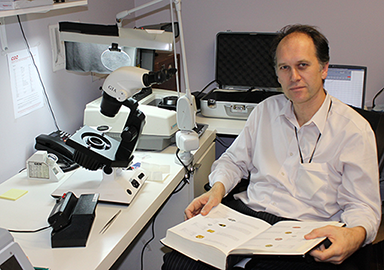
 Founder and Chairman of the Mediterranean Gemmological and Jewellery Conference, MGJC, Branko Deljanin kindly agreed to answer questions from Rough&Polished related to synthetic diamonds and the upcoming 4th session MGJC in May in Budva, Montenegro.
Can we talk about the threat of synthetic diamonds?
In the last few years, more and more parcels of natural near-colourless diamonds are salted with synthetic diamonds and have put the industry on high alert.
Major threat coming from smaller and melee diamonds that are not sent to labs for proper testing and grading, where they could be identified with combination of standard and advanced instruments.
It’s even bigger problem when they are mounted in jewellery so some fast “melee screening:” instruments cannot be used. Though amount of lab-grown diamonds is only few percent of natural diamond market every year production is doubling.
Do they deserve a share of low quality small stones in the total volume of the market?
Price of melee synthetic HPHT-grown diamonds is not much lower than natural melee diamonds, and when they are lower quality not so great alternative to natural diamonds. Melee and small CVD diamonds are especially difficult to source and price is very close or similar to natural diamonds.
What is the market share of synthetic diamonds, according to your assessment?
Difficult to say, production is still larger than consumption, maybe around 4-6% the most. World synthetic diamond production volume between 2014 and 2017 increased from 350,000ct to 4.5 million carats per year what is quite impressive (Zohar, IDEX 2017).
Millennials help to increase the demand for synthetic diamonds, succumbing to the image created by its producers, assuring that their diamonds are not associated with the exploitation of labor and do not harm the environment. Do you see here a problem?
Problem is really that in this decade production of natural diamonds decreased, and it requires lot of time to find and then finance and open new diamond mines. Millennials are more open to buy synthetic diamonds and could switch more to this product for same ethical reasons as they switched from fur to synthetic leather.
How do you feel about the emergence of a large number of small and medium-sized diamond producers?
I study synthetic diamonds since 2000 when I certified first synthetic diamond in the world in New York and worked with 10 major producers from 4 countries who openly certify and proudly sell their product as “lab-grown”.
In last 5 years there are so many small and medium producers from India, China, former Soviet Union countries and Asia and I cannot track their names anymore. I think its problem because majority do not necessary want to certify and laser their production, making job of screening and identification with standard instrument more important.
What are the MGCJ priorities for the 2018 session?
We always make sure we have lectures from leading experts with original research on topics that are of most concern to the jewellery industry and this year focus is on Synthetic Diamonds and Gems.
Our conference positioned itself as bridge between many business and appraising conferences and a few highly scientific conferences as ‘trade-technical conference’ that brings up current trade problems and offers solutions with standard and affordable instruments.
Over the last 3 annual Mediterranean Gem and Jewellery conferences and over 30 workshops given in 17 countries, CGL-GRS Swiss Canadian gemlab Chief Gemmologist Branko Deljanin, IGL Greece Director George Spyromilios and Australian Gemetrix instrument maker John Chapman assembled a NEW Portable ‘Synthetic Diamond Identification Kit’ with AGIL Hong Kong Director Dominic Mok that will be launched at MGJ conference e 2018 in Montenegro.
Education is what it takes for the Diamond and Jewellery industry to grow and to endure the difficult times, so we prepared 6 practical workshops with latest research samples on natural, treated and synthetic diamonds, rubies, sapphires and emeralds.
A ‘Round Table’ on "Marketing of Synthetic Diamonds and Synthetic Gems in 21st century" with 6 international experts will discuss issues and answering questions from other delegates. Beside gemologists and appraisers, we are having more retail jewelers and dealers attending, meaning they are concerned about synthetic gems.
Due to the central position of Montenegro in Europe and Mediterranean, many participants are expected from Western Europe and USA, but also from Russia, Turkey and other Mediterranean countries.
Alex Shishlo, Editor of the Rough&Polished European Bureau in Brussels
