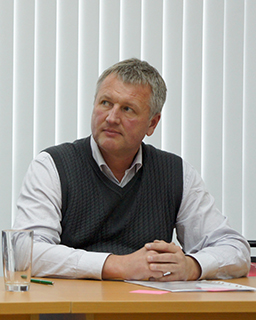
 Eduard Utkin, Director General of the “Jewellers’ Guild of Russia” Association, expert of the RF Chamber of Commerce and Industry’s Committee on Precious Metals and Precious Stones, told R&P about implementing the SIIS PMPS (State Integrated Information System in the Sphere of Control over the Circulation of Precious Metals and Precious Stones) and the latest developments and sentiments in the jewellery industry.
Is a new era in the history of state control in the jewellery sector beginning early in September?
This is just the first stage when all the market participants must register in the System, open a personal account and apply for special registration. Actually, there are no more mandatory requirements. But epoch-making changes in the System will begin on March 1 next year, it will be necessary to release products with assigned UINs that will be applied on jewellery tags.
Meetings of the leaders of the Jewellers’ Guild of Russia with the Ministry of Finance on the state regulation of the PMPS industry - now held on a regular basis - help improve the jewellers’ position. As far as we know, in some issues their (and your) wishes were taken into account, weren’t they?
The Guild has very many wishes, and most of them are so ambitious that we can hope that the Ministry of Finance will support them. Nevertheless, the negotiations are underway and we are trying to talk with the Ministry of Finance so that our desires are satisfied at least to some extent. And the jewellers’ desires are about reducing their administrative costs, especially those connected with Federal Law No.115 (anti-money laundering). Reducing costs and increasing sales are the main jewellers’ wishes. Cost reduction is only possible through simplifying the administration of mandatory requirements established by the statutory enactments that regulate entrepreneurial activities in the field of PMPS circulation. These negotiations have been going on for as long as this industry has existed, and it is impossible to say that any breakthrough would happen at any of the meetings. This is a usual working process, and I think that it should go on as we bring our concerns to the regulator, and it tells us about its problems and claims. We believe that these meetings are useful, because some questions arise regularly, as well as some obstacles in the business development, and we would like the regulator to be aware of these problems and have the opportunity to provide us with all possible assistance. But to provide this help, the regulator really needs to understand these problems and be in the know.
And I would like to add that when market players have no meetings with the regulator, they do not know what regulatory problems the ministry has, and knowing them is also important. Everyone is focused on the own problems. And to understand how some decisions can be made, it is necessary to sit down to talk, and both sides should, as they say, put everything on the table.
What are the key, top priority tasks facing the Jewellers’ Guild now?
Our top priority and key task is to ensure that our industry could enter the SIIS PMPS easily, smoothly and without losses. Today, this is a problem that worries absolutely all the jewellers, both small and major ones, as well as the manufacturers, sellers, and repairmen - absolutely all of them. The system is new, it has never been used before, and everything new is, naturally, frightening.
I will certainly be heavily criticized again, but I should say that today, the need to be included in this System annoys most jewellers. However, the decision has been made – and it applies not on jewellery only. You know, other types of goods are also subject to hallmarking. The system of control and supervision is changing, the system of assaying and hallmarking is changing, too. Seriously speaking, really, assaying and hallmarking were introduced in Russia more than three centuries ago, and during this time, nothing has changed. But during this time, the technologies in other industries have made a great step forward, and in our industry, still a hammer is used to make the product. Unfortunately, the absolute majority of people always oppose any changes vigorously. But the Association’s task, among other things, is to convince the market participants of the need for this move.
It is clear that the task of the state control is simpler with the introduction of this System. But as far as jewellers are concerned, this is an additional burden on them, isn’t it?
Certainly, for jewellers, this means additional costs and administration efforts, this is clear. But even now, it is impossible to do without this because the system of assaying and hallmarking in the form it has been used for a long time, today does not protect the market against smuggling, counterfeiting, or against the illegal jewellery manufacturing. And the most advanced market participants who want to build their business not for the next five to ten years only, but for the coming decades, are interested in this. That is why the majority of them are displeased but, as a rule, a forward-looking minority of people are the driver of any progress. The forward-thinking minority of jewellers are doing everything possible to convince everyone else of the need for these changes. The System itself is well designed but its implementation does not go smoothly, and the functions have not yet been finalized. I am sure that the developers and users will be able to overcome these difficulties.
In addition to implementing this new system, SIIS PMPS, what other tasks are being solved in the Jewellers’ Guild?
Another most important task is, of course, the promotion of our goods among consumers. We believe that first, jewellery has been pushed aside by other goods on the market for a long time. Second, by the way, there is a problem that should solved thanks to the SIIS PMPS, and this problem is that many consumers are sure that some fakes are being sold at our stores; as they say, the stones are not real, the gold is not real, and this restrains the market growth and impacts the sales. We need to restore the consumer confidence in our products, and we should do this through the SIIS PMPS as well. That is, we need to increase the sales, as well as the domestic market. Well, the third task is, of course, to make an increase - a multiple increase - in the goods exports.
Have the diamond jewellery and rare gemstone sales really increased compared to last year?
Compared to last year, the sales have increased - the increase was not so significant in the diamond jewellery sales, but rather, in the premium jewellery sales, and they really have almost doubled. This is due to the fact that wealthy people who can afford buying something do not have the opportunity to go abroad now and spend their money there. So, they have to spend their money locally, including for buying jewellery.
Has this anything to do with their investment attractiveness?
I come across potential consumers and hear their points of view, and every year, there are fewer people purchasing jewellery as an investment asset because people who can afford buying jewellery worth hundreds of thousands of roubles are usually well-educated and experienced professionals. They know how to use other financial instruments to invest their money. So, they buy jewellery as beautiful jewellery pieces to be added to their family jewels that can be inherited or given to a granddaughter like a gift. A jewellery piece is purchased today not with the purpose to sell it in a few years. Not so many people consider jewellery for this purpose.
Now, when many players have exited the market, and the most persistent and strong ones remained, what are the Guild members’ sentiments?
I would say, the sentiments are positive. If we take the latest data on the volume of jewellery assaying and hallmarking, we can see a steady growth - about 15-percent increase in gold jewellery, and I think, it should continue till the end of the year. Regarding the introduction of the SIIS PMPS, as they say, “All things are difficult before they are easy”, that is, gradually, the market players will get used to this System and accept it. Well, and as for those who decided to leave the market - in periods of change they always have a choice: you either stay in the market, or you exit. Those who leave it, give the niche they previously occupied to those who remain. That is, the share of those who remain on the market increases. You have to pay for increasing your market share. Working in our market will become more complicated, and the costs of doing business will rise.
As for the jewellery export, is there anything promising?
The main and big problem, which is currently holding back our exports, is the import duties on stones used as studs in jewellery. Unfortunately, in our country, no gems are mined on a commercial scale, except for diamonds and amber, and the list of stones currently used in jewellery manufacture is quite extensive. That is, we have to import all other stones, and the import duty is 10 percent. So, our product becomes more expensive by this amount compared to the price of goods made by our competitors in Thailand, Turkey, China. Therefore, in order to develop exports, it is necessary to cancel this import duty. It is not even clear whom it really supports and protects - after all, we have practically no cutting and polishing sector for any stones except diamonds.
For a long time, we have developed our domestic market, and were not present on foreign markets, which, of course, are much bigger than the domestic one. And by occupying some niches there, the company can significantly increase its production within the country. Therefore, we need to do something to simplify the jewellery export procedure, since the jewellery has a number of advantages and benefits over the goods made by our competitors. Our goods go well in Kazakhstan and Belarus, but we would like to actively enter the markets in the non-CIS countries. This can be really done, because there are companies that export a significant share of their products and are quite successful. They are pioneers, and their experience, their achievements show that to accomplish this task, you have to work hard and you will find success.
Galina Semyonova for Rough&Polished
