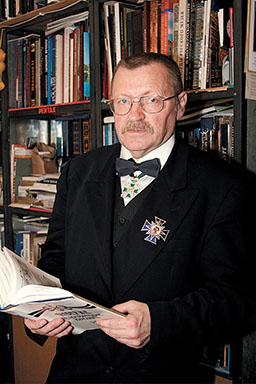
 Valentin Skurlov is an art expert, jewelry historian, honorary academician of the Russian Academy of Arts, expert of the Ministry of Culture of the Russian Federation, scientific secretary of the Fabergé Memorial Foundation, consultant-researcher on Fabergé works of the Russian Department of the Christie’s Antique Auction House.
He is the author of the book “In Search of the Fabergé Archive” which is the result of about 40 years of work with Fabergé’s heritage.
He was honored with many titles and awards and is a full Cavalier of the Orders of Carl Fabergé (2002), of A. K. Denisov-Uralsky (2008), of Mikhail Perkhin (2010), and of Franz Birbaum (2012).
Valentin Skurlov told Rough&Polished about the scientific research, discoveries, and recent achievements related to the Fabergé dynasty’s legacy.
What events dedicated to Carl Fabergé’s artworks took place in the past year, and what will continue to delight the admirers of the famous jeweler this year?
Interesting dates are coming up in 2022, including as follows:
180 years since the founding of the Fabergé firm by Gustav Fabergé (1814-1894);
150 years since Carl Gustavovich Fabergé headed his father’s firm (1872);
150 years since the birth of Franz Bierbaum (1872 - 1947), chief master of the Fabergé firm;
110 years since the founding of the Russkiye Samotsvety (Russian Gems) Association. This suggests interesting activities and research.
The last year was very interesting. At the beginning of the year, the “Fabergé” exhibition was held at the State Hermitage that had a great resonance. There was also a conference held at the Hermitage where I also made two presentations. That is, scientific life on the Fabergé theme continues.
In early June, I traveled to the Crimea to take part in the annual conference “The Romanovs and the Crimea.” After the conference, I visited Irkutsk where I lectured on the celebration of the 175th anniversary of the birth of Carl Fabergé. At the end of June, I visited Kaliningrad where the Biennale was held, a competition of painters and craftsmen, and I took part in it as a member of the jury.
In July, the Russian Historical Archives published a book, a collection of archival documents, dedicated to Carl Fabergé’s 175th anniversary. In autumn in Moscow, at the “Sobraniye” (Collection) Museum in Solyanka Street, there was an exhibition dedicated to one of Carl Fabergé’s contemporaries, Fyodor (Theodor) Antonovich Lorié (1858-1920), the jeweler. His store was located next to the Moscow Fabergé store on Kuznetsky Most (Bridge). I was one of the co-authors of the monograph on the F. A. Lorié’s creations. Finally, in October last year, I took part in the conference held in Yekaterinburg on the history of jewelry and stone-cutting art. I made my presentation on stone-cutting jewelry pieces, the diplomatic gifts received in 1881-1917 that were earlier displayed at the Cabinet of His Majesty.
A year earlier, in October 2020, the Tatiana Fabergé’s archive was transferred by the Tatiana Fyodorovna‘s administratrix to the Moscow Kremlin Armory. In April last year, a conference was held there at the Moscow Kremlin Armory on the studying of this archive. I took an active part in the conference and spoke about the significance of this archive for the global “Fabergiana” literature. At the end of last year, a significant exhibition was held in London at the Victoria and Albert Museum. The exhibition was dedicated to the work of the London branch of the Fabergé firm, but its subject matter was much broader. It is very interesting and surprising that in our difficult time of the global pandemic, such great and amazing exhibitions are held. In addition, at the end of the year, the traditional Christie’s and Sotheby’s auctions were held in London. I was especially pleased with the Christie’s auction where the Woolfs’ (spouses) collection - which has become famous for more than 40 years - was sold.
What made you especially happy?
Very good prices for the Fabergé artworks. A separate catalog of the collection of 86 art pieces created by the Carl Fabergé firm and collected by the Woolfs was made, and there was a serious struggle for them; as a result, the price rose by two or three times, and sometimes by five times. Among the most high-end lots was a sprig of wild strawberries in a glass of rock crystal with jade leaves and enamel berries that was sold for £325,000. A gold and platinum brooch designed by Alma Pihl and decorated with a micromosaic of precious stones was sold for €350,000 (instead of the estimated £70,000-90,000)
An Easter egg made of red jasper by Mikhail Perkhin was sold for £200,000. The media rightly called these auctions “triumphant” and they have yet to be considered.
In April, I also attended the Spring Antique Salon located at the shopping mall Gostiny Dvor (in Moscow) where there were a large number of visitors. The participants obviously were looking forward to communication and the opportunity to show their acquisitions.
You take part in the activities of the Ulyanovsk regional branch of the Imperial Orthodox Palestinian Society (IOPS). How does this relate to the Fabergé Foundation?
Recently, I have become a full member of the Simbirsk (Ulyanovsk) regional branch of the IOPS.
Six years ago, in December 2015, the Museum dedicated to Vasily Ivanovich Zuev (1870 - 1941), a Fabergé miniaturist, was created at the Centre for the Children’s Additional Education in the settlement of Cherdakly located 30 km from Ulyanovsk. Born in the Cherdakly District, Vasily Zuev participated in the creation of 12 imperial Easter eggs and created over 200 miniature portraits for the Cabinet of His Majesty. The original sketches by Eugene Fabergé made in the 1930s were among the Museum’s exhibits (they were donated by Tatiana Fabergé) as well as the portraits dedicated to the Fabergé theme. Over the past six years, the Vasily Zuev Museum has been replenished with works by contemporary miniaturists. In 2016, the Fabergé Foundation established the Order of Vasily Zuev. In 2017, there were 20 Cavaliers of this Order, now their number is 80. The painters, the Cavalier of this Order, donate their works to the Zuev Museum. Over the years, the Museum has organized more than 20 competitions, in which several thousand children and schoolchildren took part. Unfortunately, on March 30, 2020, the meeting of guests at the celebration of Vasily Zuev’s 150th anniversary was not held because of the worldwide epidemic. But in January 2020, many artists and masters were awarded the Vasily Zuev orders, including the enamellers (30 people), the successors of the Vasily Zuev’s traditions, in the city of Rostov Veliky (Rostov the Great). The activities of the Fabergé Foundation continue, the number of members of the Foundation is increasing, although over the past 25 years, for natural reasons, about 70 Cavaliers of the Foundation’s awards have gone to a better world.
By the anniversary, in 2020, the second book dedicated to Vasily Zuev was published (the first 220-page one was published in 2017). The second 520-page book was called “Vasily Zuev and His Successors”. The book includes new archival materials on the history of the Fabergé firm and the biographies of 60 Cavaliers of the Order of Vasily Zuev.
It was recently mentioned that you were awarded the Honorary commemorative “Order of Emperor Alexander III”, what kind of award is this?
The “Order of Alexander III” is the Imperial Orthodox Palestinian Society’s award.
By the way, which of your many awards is the most precious one to you?
The title of Honorary Academician of the Russian Academy of Arts is the most precious award to me.
What are you working on now?
In December 2020, under the auspices of the Fabergé Foundation, my monograph was published, a reference book “Award, Plaques of Honour and Gifts from the Cabinet of His Majesty. 1881-1917” (576 pages) and “Index of Names” including 2,500 surnames (48 pages). I am currently working on a second similar book. Unfortunately, we had sad events in the last four years. In February 2020, the Honourary Chairman of the Fabergé Memorial Foundation, Mrs. Tatyana Fyodorovna Fabergé, passed away, just three weeks before her 90th birthday. Sergey Ivanovich Kvashnin, a full member of the Russian Academy of Arts and the founder of the Volga-Vyatka Mint, became the Chairman of the Foundation. Unfortunately, he held this position for a year and a half only and died suddenly from Covid-19 on October 28 last year. It is necessary to pay tribute to Sergey Ivanovich Kvashnin, an outstanding figure in Russian jewelry art, the only academician of the Russian Academy of Arts.
Five years ago, you started the editorial project “Ukraine and Fabergé”. How is it progressing? Have recent events in our countries affected the project?
The Fabergé dynasty was really very closely connected with Ukraine. Last April, the Fabergé Memorial Foundation marked its 25th anniversary. Over the years, more than 700 people from 20 countries of the world have become members of the Memorial Foundation, including 350 people from Russia and 140 from Ukraine. 30 persons from this list are from the Republic of Crimea that returned to Russia in March 2014, and from the Lugansk and Donetsk Regions. At the beginning of June 2014, I was in Ukraine for the last time and since then I did not go there, so my project “Ukraine and Fabergé” slowed down and only some parts of the project were completed.
In December 2015, our joint book “Carl Fabergé and Joseph Marshak” written together with Tatiana Fabergé and Natalia Sapfirova (Kiev) was published. In May last year, Natalia Sapfirova, Head of the “Ukraine and Fabergé” program, a research officer of our Foundation, defended her Ph. D. thesis on the artworks by the outstanding Ukrainian jeweler Joseph Marshak.
Galina Semyonova, Rough&Polished
